It was October 2021, and I was trying to figure out if I had accidentally written a romance when I was trying to write a fantasy adventure. I had experienced a less than successful response from beta readers. Most didn’t finish, and different versions of the same reason stuck out: “I didn’t know this was going to be a romance.”
It’s not. I mean, there’s a romantic subplot that is heavily intertwined with the main plot (and the romantic subplot does become the main plot of the sequel). But if the romance isn’t the main plot, then it’s not a romance, right? With this confusion, I had to stop preparing a query letter and research romance, because I needed to query the right publishers.
I came across a week-long webinar all about writing romance put on by ProWriting Aid called “Romance Writers Week.” Almost every presenter stressed the same thing: in order for a story to qualify as a romance, the relationship between the love interests is the focus of the story and it must end in Happy-Ever-After (HEA) or Happy-For-Now (HFN).
Right away, I was like, “Um, excuse me? What about Nicholas Sparks?” Someone else asked that question, but more respectfully. The presenter said, “Nicholas Sparks doesn’t write romance, he writes love stories.” It turns out, a love story does not require a HEA, but a romance does.
As I talked to other writers and studied what makes a romance a romance, I was correct in originally thinking that I did not write a romance. But the romantic subplot was important enough that I needed to market to romance readers, and make sure the subplot matched romance expectations. But I struggled with the HEA/HFN aspect. I felt like if the ending required a guarantee that the romantic interests end up together, then if a story is a romance, the ending is already spoiled the moment I open the book.
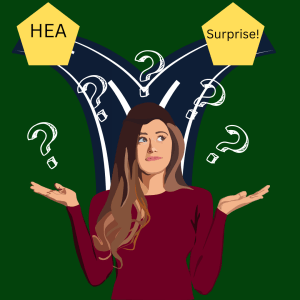
I went through a little identity crisis as a romance reader. The love stories I have read where the couple goes their separate ways or one of them dies, gave me enough pause to believe that any romance could end that way. So the tension and roller coasters the characters go through, I went through with them. But knowing ahead of time they are going to overcome it, temporarily took that magic away from me. I felt like “the man behind the curtain” had been exposed, and I was struggling with what I saw.
In the next romance I read after learning about HEA, the female MC was in a carriage accident. The final sentence of that chapter is, “And he watched his wife die.” I snorted and rolled my eyes. No he didn’t. She can’t die if this is a romance. The next romance I read had a gunshot at the end of a chapter, but who did the bullet hit? Well, before turning the page, I knew it wasn’t the female MC. How was I ever going to enjoy a romance again?
As I reached out to other romance readers about this identity crisis, most of them said something along the lines of, “I like knowing I’m guaranteed a happy ending. I read romance to feel happy. So it’s not about a surprise ending. It’s about the journey. How is the author going to bring them tension, danger, and drama to test their relationship? How are they going to overcome it? Is the journey believable, relatable, and entertaining?”
It took me a while to accept that mindset. And I had to read through several romances where I practiced viewing the story from that angle. But I eventually got it, and I’m back to enjoying romances.
This has also helped me in my own writing. Since as the author, I know the ending, I need to make sure that the journey to that ending is believable, relatable, and entertaining for my readers.
Are you a romance reader? What’s your favorite romance? What’s your favorite type of romance or trope?
 Chelsey M. Ortega
One comment