Should you repeat a writers conference?

In June 2023, I took the opportunity to attend my first educator’s conference with my administrators and several other teachers. The conference was in Austin, Texas. I’d never been to Texas before, so that in and of itself was motivation enough to accept an everything-but-meals-and-activities paid trip. About halfway through the conference, one of my colleagues said that he’d attended this exact conference with his previous school a few years prior, and the sessions and keynotes were the exact same. So he spent the week picking sessions he didn’t pick last time, or just enjoying himself in a city he’d never been to. Six months later, that same conference came to Salt Lake City, Utah – an hour north of us. Those of us who went to Austin saw no reason to attend again. So, the teachers who didn’t go to Austin, went to the Salt Lake sessions.

An editing software that I use hosts several online conferences each year for different genres. I religiously attended for a couple of years, and I noticed that they had the same presenters teach the same session for the topics of marketing, plotting, and different world building and editing programs. After the third repeat, I stopped attending those sessions.   

With that being my introduction to conferences, I struggled in deciding if attending the Quills Conference two years in a row would be worth it. 

It was.

First of all, the sessions were completely different. There were new presenters that were not there last year, and returning presenters taught completely different classes – or different enough, that it didn’t feel like a repeat. 

The networking opportunities were different as well. In fact, if my memory serves me correctly, there were more networking opportunities this year. 

Some things remained the same: pitches with agents and editors, headshots with a professional photographer, and banquets featuring three keynotes speakers (though the keynote speakers were different).

Overall, I learned plenty of new information, connected with new writers, reconnected with writers I only get to see at the Quills and Pre-Quills, and had an enjoyable break from my normal life. 

So, yes, attending the Quills Conference year after year is totally worth it. I look forward to having it be part of my summer travels each year. 

What writers conferences have you attended that you would recommend to others? Tell us in the comments!

4 Writing Tips from the Pre-Quills Conference

The last weekend of March, I attended the Pre-Quills Conference put on by the League of Utah Writers. It’s a one day conference whose sessions are geared toward beginner writers. And I honestly still consider myself a novice writer. I still have a lot to learn. There were four sessions, with three options per session. I attended a session on writing short stories, writing BIPOC characters with respect, Marketing for Beginners, and how to write a first Chapter. I want to share the highlights from each session with you.

Short Stories

The presenter for this session was Cassidy Ward. He writes science articles and short stories. He started the session by reading one of his short stories out loud, and then using the parts of that story as an example for what he taught us. (The short story in question is on his website here. Go read it. It’s amazing.)

I chose this class for session 1 because I have written a short story that I’m submitting to a contest, an anthology, and a magazine. Some of the feedback I’ve received in my critique group has really frustrated me, and I needed to better understand what I was doing wrong from an actual published short story author. 

Cassidy’s presentation was so wonderful. What he taught helped me see where I can improve, but I also got some validation in certain areas that I was convinced were okay despite my critique group’s comments. (I do think that a lot of their comments would have worked for critiquing a full-length novel. And to be fair that’s what I generally bring to the group.)

So, after spending way too much time on this introduction, here are the highlights from his class:

  • “Get words on the page and get rid of the ones that don’t work.”
  • Treat exposition like salt: enough to set the stage → as little as possible, as much as you need
  • Give the reader at least one character to root for
  • Every character should want something. The stakes don’t have to be huge, but they should feel huge → the reader should feel what the character feels.
  • Focus on feelings rather than events → zoom in one thing (i.e. 20 minutes of someone’s life)

BIPOC Characters

This session was taught by J.T. Moore. I didn’t take many notes because I was just enjoying listening to her. Ms. Moore’s presentation was about how representation is important, and should be done respectfully. And like with the short stories session, I had a personal reason to choose this session.

I have Black, Asian, Latino, and Gay characters in my stories (none of which were chosen for the sake of representation – I strongly believe that my characters are “alive” in a way, and they tell me who they are). And my beta readers have never picked up on my attempt at respectfully describing these characters, assuming everyone was white and straight. *sigh* So, I needed help from someone more knowledgeable than me.

This is what I learned from J.T. Moore:

  • Give your characters hobbies, personalities, and descriptions other than skin color
  • Give your characters unique and complicated back stories to inform who they are
  • In speculative fiction, your characters don’t have to reflect the current world
  • Still identify their race, just don’t use their race to be their only description and personality

Marketing 

Like most authors, marketing is my weak spot. So, any time there’s an opportunity for me to learn from someone successful to see if what they do works for me, I’m going to take it. 

Candace Thomas has successfully tapped into an engaging website, using influencers, and creating merchandise. I took a lot of notes, but I’m only going to share a few highlights – specifically the ones I’m in the process of applying to my marketing.

  • Have your most recent book be the landing page for your website
  • Make your newsletters short and sweet
  • Know which generation prefers your genre and what social media platforms they use (i.e. Gen Z loves Romantatsy and are mostly on Instagram and TikTok)
  • Make content that matches your books that isn’t “Buy my book!”
  • Utilize influencers (they do cost $$)
  • Create merchandise that brings people to your website (and hopefully buy your book as well)

First Chapters

Lindsay Hiller has won several first chapter contests, and now heads and judges first chapter contests. I picked her session because I’ve never placed in a first chapter contest, let alone won. And most readers who attempted The Wolf Whisperer and the Warrior when it was on Kindle Vella stopped after chapter 1. So, I clearly need some help. 

Lindsay broke it down into 3 main writing tips:

  1. Follow the 4 emotion beats: What is the character’s goal (both for the chapter and the whole story)? What are their motivations for those goals? What obstacle(s) will prevent them from meeting that goal (at least the smaller one)? And what are the stakes if they don’t reach their goal (at least the smaller one)?
  2. Organize the following aspects: Provide a setting, give the basics for character description, voice, and flaws, and create a hook to convince the reader to keep reading after chapter 1.
  3. Put it all together: Begin by introducing the character, describe the setting, and provide a status quo. Go into their goal and motivation. End with the inciting incident that launches the character and reader into the rest of the story. 

I am so grateful I got to attend this conference. (Last year I got sick and had to stay home and watch the virtual sessions, which really wasn’t the same as being there in person.) I’ve already started applying some of the lessons I learned, and I’m hopeful for positive results. 

Learning How to Read Novellas

Before I knew that there were more differences between a novel and a novella than just word count, a lot of my reviews of novellas read like this:

“The story ended too quickly for me.”

“I would have loved the resolution to have more details.”

“I wish the ___ plot was more drawn out.”

I read dozens like that. And then, one day, it hit me: these are meant to be short, which means the plotting is going to be structured differently than a full length novel. So, I googled “What is the difference between a novel and a novella.” Endless articles have already been written, so I’m just going to summarize three* of them:

  • Word count: A novel is 40,000+ words, a novella is 17,500-40,000 words (I don’t know where the 17,500 comes from or why it’s that specific. If you know, feel free to share in the comments!)
  • Characters, events, themes, and subplots: There are more of all of those in a novel than a novella. If there are any subplots, very little time is spent on them. In fact, it’s easier to not have a subplot. Character development happens for the protagonist only.
  • Plot and Pacing: A novella has a singular event that is the central crisis and focus of the plot, allowing it to be faster paced. A novel has several points of rising and falling action and interconnects subplots with the main plot.

*Sources: https://www.uobabylon.edu.iq/eprints/publication_10_21876_1383.pdf , https://kindlepreneur.com/novel-vs-novella/ , https://www.firstediting.com/blogs/difference-between-a-novel-and-a-novella/  

Now that I better understand the organization of a novella, I’ve had a much better experience reading them. And those authors are also getting better reviews from me! 😉 I also really enjoy reading a couple light hearted and spicy novellas in between the longer and darker fantasies I’ve been reading (ACOWAR I’m talking about you). And I’d like to share with you my favorite Novella series and authors:

  • Warriors of Sangrin (a.k.a. Madfhel Brides) by Nancey Cummings – First book: Paax
  • Tail and Claw by Nancey Cummings – First book: Have Tail Will Travel
  • Any of Carly Phillips’ series. So far I’ve read: Billionaire Bad Boys, Dare to Love, and The Knight Brothers series.
  • Any of Aurelia Skye’s series. 

I’ve read plenty of others, but those are my top three novella authors.

And in learning more about Novellas, I decided I want to be able to write some as well. So, I tried to write one, and *sigh* it turned into a 99,000 word novel. (It was The Wolf Whisperer) But I haven’t given up. I’m going to keep working on concise writing and shorter plots. And hopefully, one day, I’ll have some Novellas under my belt. 

Are you a fan of Novellas? What authors/series would you recommend? Let me know in the comments!

How Music Inspires My Writing

The greatest pop hits of 2006 bring me back to working in a Snowie Shack on the corner of Center Street and Geneva Road. For some reason, anything by Alanis Morisett, The Cranberries, and the Pina Colada Song remind me of working at Mervyn’s. And a catchy cha cha or samba is going to bring me back to the competition floor.

Music has always been a part of my life, and specific songs are nostalgic for different eras in my life. 

Writing Bondwitch was no different, and as part of celebrating my book’s birthday, I thought it’d be fun to share what songs inspired or helped me write specific scenes.

During the second act, Annamaria meets a pair of professional ballroom dancers who are also vampires. Kylie and Tyler have a YouTube channel, and invite Annamaria to join their dance routines. The routines I spent significant word count on went with a real song to help me describe the choreography. So, here are the songs that helped with the key dances:

  • “A Thousand Years” by Christina Perri – The Viennese Waltz that Annamaria and Tyler perform. It’s Annamaria’s first ballroom performance, and the choreography tells the story of Annamaria’s parents’ courtship.
  • “The Shallow” by Lady Gaga and Bradley Cooper – The contemporary routine Annamaria and Kylie perform. This routine tells the story of Annamaria and Marianna growing up apart from each other throughout the years. 
  • “Human” by Christina Perri – this is a contemporary duet that Kylie and Tyler perform. It showcases Marianna’s upbringing by her “adopted” vampire father. 
  • Jasmine Thompson’s cover of “Like I’m Gonna Lose You” (originally by Meghan Trainer and John Legend) mixed with “Perfect” by Ed Sheeran – This is a foxtrot-tango medley that tells the story of Annamaira’s relationship with her first boyfriend, Cody.
  • “How Can I Not Love You” by Joy Enriquez – This is Annamaria’s contemporary solo. She choreographs it all herself and designs her costume. The purpose of this routine is to say goodbye to her human life. 

The last song that goes with a specific scene is “Almost Lover” by A Fine Frenzy. This song goes with Annamaria’s dark night of the soul moment. In this scene, Annamaria is heartbroken because she has been betrayed by people she cares deeply about, and she thought they cared deeply for her. She’s literally chained up and has a decision to make that could lead to fatal consequences. 

Other songs I listened to while working on Bondwitch:

  • Arms by Christina Perri
  • Jar of Hearts by Christina Perri
  • Fight Song by Rachel Platten
  • Down by Jason Walker
  • I Won’t Give Up by Jason Mraz
  • My Heart Will Go On by Celine Dion
  • My Immortal by Evanescence

Music plays a huge part in most people’s lives. Certain songs have inspired decisions and creations. And sometimes, we just need the background noise while we work. 

What song has been important or inspirational for you?

Let me know in the comments! 

How I Found My Perfect Critique Partner

Back when I finished the first draft of Bondwitch, and googled “how to publish a book,” one of the deep dives I went into was beta readers and critique partners. So many authors I talked to online were adamant that I should not publish my book without other people looking at it first. But taking that step of trusting someone else with your writing is really scary when you are new to this world. And after four years of sharing my writing with others, I have a critique partner who is my ride or die. So, I wanted to share how we found each other. And hopefully my journey will help someone else who is in the early critique group trenches. 

Get comfortable with someone else reading and commenting on your writing and vice versa.

Before I knew anything about alpha readers, beta readers, and critique partners, an acquaintance from high school was asking for beta readers on facebook. My husband is a gamer, and I knew that beta players got to play a game before its release or play an updated version before it was available to the general public; I figured that was something similar. I volunteered and read her story. Now that I know more than I did, I’m sad to say, I was not a good beta reader. After finishing her story I sent her an email that said something to the effect of, “I really enjoyed your story. The ending makes me want to know more. I noticed a few spelling and grammar issues.”

I’ve since learned how to be a better beta reader.

When my own story was ready, I sent it to this acquaintance and my brother. The acquaintance never told me if she finished or not, and my brother couldn’t get past chapter 10 – I would later learn the lingo that he is not my target audience. But based on what my brother did say about the beginning, I was able to figure out some slight changes to the plot and improvement in character development. 

I did a year of researching, editing, and revising, and my next batch of beta readers were going to (hopefully) be strangers. A big worry that many new writers have is “What if one of my beta readers steals my work?” I had that same concern. U.S. copyright law is on your side. Even if you don’t get an official copyright ISBN, by simply writing your words down, you own them. (I know, actually taking such an issue to court is a whole other beast. But in my experience, you’re more likely to simply encounter people who will agree to read it and won’t, than steal your work.)

I decided that the only way to know if beta readers were worth it was to experience it. I  got 15 people to express interest in reading my story. Of those 15, 3 finished: 2 cousins, and a stranger. 

Many people will say to NOT use friends and family members as beta readers because they may not be honest with you. Well, these two cousins were absolutely honest, and their comments were very helpful. And that’s something you can try with friends/family beta readers. If their comments aren’t helpful, then don’t ask them for your next project. If they were, then you can. 

During this time, I was also actively beta reading other writers’ work. Commenting on their stories was hard at first because I didn’t want to hurt their feelings. But I put myself in their shoes: Would I want only comments that said how awesome it was, or would I also want comments that could help me be a better writer? So I made sure to express my critiques in what I hoped was a helpful way, not a “this is terrible” type of tone. 

Start by joining a larger group.

When I finished an early draft of Bondwitch: Hybrid, I learned that it’s even harder to find beta readers for a sequel when they haven’t read the first book. No one accepted the invitation to beta read except for the 3 who already read the first book. So, I needed to find a way to get more people looking at it before I sent it in to my publisher. 

There are some online groups like Critique Circle and Writer’s Cooler (I think that’s what they’re called, it’s been a while). But just jumping in online was still really nerve wracking for me. Then the founder of TWRP sent an email out to all of the authors signed with them to let us know what her three favorite conferences to go to. One of those conferences is the Quills conference in Salt Lake City, Utah. Well, look at that, I’m 45 minutes south of there!

So I looked up the conference and discovered the organizers are the League of Utah Writers. And there are chapters all over the state. I looked through their list of chapters and found three that looked promising for what I was looking for. One of them meets at the library down the street from my house. I emailed the chapter president. She invited me to come to a meeting, and if I was comfortable, to bring an excerpt of 1500 words or less and bring at least 6 copies. We go around the table and read our stuff, and take notes on others, give them comments, etc. I felt right at home after the first meeting, and joined the League and that specific chapter right away.  

Eight months later, a member of the group created an off-shoot group where we read the same person’s entire manuscript on our own time in a month, and then meet and deliver comments to help the person improve their story. I joined that as well and created some deeper friendships. 

The connection needs to be organic.

My earliest memory of Megan was a couple months into joining Nebo Novelists. I don’t know if it was her first time attending, but it was her first time bringing something to read. She read the prologue to her debut novel, Swayed (which I’m so excited to review and interview her here on my blog once it’s officially published!). It was one of the best prologues I’ve ever read, and I told her so that night. 

A few weeks later, so many people had come to the group meeting that we had to split into 2 groups, or not everyone would be able to get through their stuff. Megan immediately requested to be in the same group as me, and I had already been thinking the same thing! We both wanted to continue to read one another’s stories. From then on, we’ve always sat next to each other, and on the occasional night the group needs to split up, we stay together.  

One thing that makes us such good writer friends and critique partners is that we both read and write romance. Since we understand the rules and expectations of the genre, we are the best at helping each other. In addition, we truly care about one another’s stories and success. I love Megan’s writing, characters, and plots. And she loves mine. But that love doesn’t prevent us from pointing out ways we can improve. 

Create a system and schedule that works for both of you.

Our official partnership outside of group meetings started when Megan texted me follow up questions about some of my comments. That led to texts about plotting, foreshadowing, etc. Then she asked a question that I couldn’t answer in a text message because it was too long and I wasn’t the expert. But I had an hour long video clip that could help. I tried to email it to her, but my email couldn’t send that large of a file. So, I created a Google Folder and named it “Chelsey and Megan: Writing Buddies”. 

Megan ran with it, and started uploading her manuscripts and notes from courses and seminars she’d taken. So then I uploaded my manuscripts. And now we read each other’s stuff well ahead of our bi-monthly group. She has been paramount in helping me edit episodes of The Wolf Whisperer for Kindle Vella. I have found a true friend in her.  And I seriously cannot wait for her stuff to get published so I can tell you all about it!

What Catches a Reader’s Eye? A Reflection on how people find and choose books.

One day, during my sophomore year in high school, a classmate grabbed my arm and said, “I just finished the most amazing book, you have to read it!” That book was Twilight  by Stephenie Meyer. I trusted this classmate’s opinion, asked my mom for the book, and it ended up being my Easter present that year. I read it in one day, bought the second one and read that in one day. Then I had to wait a couple months for the third, but I was hooked. 

Two years prior to that, in eighth grade, a friend of mine found her mom’s copy of The Notebook by Nicholas Sparks, read it, and passed it around to the rest of our group. She had us write our names inside the front cover when we finished it to make it our own “sisterhood of the traveling pants”, but with a book. From there, I sought out other Nicholas Sparks’ books (Safe Haven is my favorite). 

That same year, I checked out a copy of A Dance for Three by Louise Plummer from the school library, and recommended it to my friend. She checked it out next and loved it so much, she made her mom hunt it down so she could own a copy. (And let me tell you, that book is hard to find in a traditional bookstore. This was 2004.)

What is the common denominator in those three tales? Word of mouth. Most of the books I have read, I came across via recommendation: a friend, a family member, maybe facebook ads, etc. And according to many blogs, podcasts, and seminars; word of mouth is still the best way to sell books. 

Even so, authors are also told that online reviews are important because the algorithms on those websites recommend books that have a lot of reviews. But even though that’s what the algorithm does, is that really how potential readers find books? And do readers read reviews before deciding whether to read a book or not? 

I created a Google Forms survey, and 76 people responded. Here are the results:

What helps you learn about and choose to buy a book? 

*Note: This was a “Check all that apply” question, so all numbers together will go beyond 76

Recommendations from family and friends58
Window shopping in brick and mortar bookstores 36
Online ads (i.e.facebook, instagram, etc.)18
“Also bought” on Amazon19
“Readers also liked” on Goodreads12
Searching a preferred genre/trope on Amazon27
Other25

Surveyors got to type something if they clicked other, and here are the common “others” summarized into general categories:

  • Book influencers/reviewers on Instagram, TikTok, and blogs
  • Websites like Bookbub
  • Libraries
  • Events like festivals
  • Book clubs
  • Gifts

So, like my own experiences, most people still rely on recommendations from trusted people. But a decent number of people are also using the internet in some capacity (Amazon, social media, etc.)

Forms response chart. Question title: Do you read the reviews on sites like Goodreads or Amazon BEFORE buying a book?. Number of responses: 76 responses.
Forms response chart. Question title: If you read the reviews, do they affect whether you buy the book or not?. Number of responses: 75 responses.

These next two responses totally threw me. Because I don’t read reviews before buying a book, I erroneously assumed most people were like me. And this has completely turned my marketing world upside down. 

Forms response chart. Question title: What number of stars do you personally think is a positive review? (check all that apply). Number of responses: 76 responses.

I was not surprised by these results. For me, 3 stars means that I enjoyed the book enough to finish, and I don’t regret spending my money on it. So I consider 3 stars a positive review. But at the same time, I know on the marketing side, you don’t choose a 3 star review to highlight. You choose 5 star reviews to highlight. 

At the end of the survey, I provided space to type anything they wished to add, since I often struggle with multiple choice, because I want to explain my answer. With respect to transparency, I did use AI to help me find commonalities in the 49 responses, and come up with categories based on those commonalities. AI discovered 5 categories, and as I went through them, I deleted two of AI’s category and created a two of my own, moving some of the responses around to the following:

Category 1: Preference for Cover, Blurb, and Initial Impressions – 14 people expressed this was important to them in selecting a book.
An attractive cover and a strong blurb on the back will get my attention. I’ll read a page or two (unless it’s by an author I’m already familiar with) to see if they can get my interest. It’s rare that I will read a review first.
By far the first thing that gets me to look at a book is the blurb and a cover, and from there, I will look at reviews or recommendations before I decide to buy.
Sometimes I get recommendations from word of mouth, but not often. 95% of the time, I’ll see an ad on FB or IG. If the blurb is interesting, I’ll click on it and go to the Amazon page and read through that. If it still seems worth getting, I’ll read the sample. If it still seems good, I’ll get it on Kindle Unlimited. If I absolutely love it, I’ll buy the ebook. Even rarer, I’ll buy the physical copy. Occasionally I’ll buy books not on KU, but that’s even more rare. That only happens when an author I already trust has a new release. And right now, that’s…. one, but used to be two. But I stopped liking that author’s books, so it seemed silly to spend money on a book when it was a “maybe I’ll like it.”
I usually choose a book based on the blurb, the cover, and the genre.
Cover and genre recognition are big factors for me – the “catch your eye” thing.
I read the synopsis or hook that is on the back or inside of the cover of the book to see what it’s about most of the time and if it captures my attention then I read it. A quick little summary of the story over reviews is usually what helps my decision more than book reviews. How I find out about the book is in all sorts of ways, wandering through bookstores, Amazon, Facebook, and every other way to find new books.
Most times it’s the blurb. If it reads like it’ll be an intriguing story, I’m in.
Cover and blurb is what usually leap out at me. Also read the first pages.
Excerpts on Facebook ads and catchy stock pics or video grab my attention.
Cover art then blurb.
I read a few reviews, but they don’t carry much weight. I mostly rely on the sample pages. If they grab me, I buy, if not I pass for now.
I usually read the jacket cover before buying.
I rarely read reviews because I like to make up my own mind. I look at the cover, read the blurb, read the author’s info, and read the first couple of pages.
If a book catches my eye, I read a page or two of the preview. If it intrigues me and is not full of typos, grammatical infelicities or clunky writing, I’ll buy it.
Category 2: Number of Stars Matters – 5 people explained how they use stars and averages to help them decide whether to read a book or not.
I would select a book with four stars and above. If there are a lot of reviews, I don’t pay attention to negative ones since it may just be a personal opinion.
If there’s a few 1 or 2 star reviews but the rest are 4 and up, I usually disregard the lower reviews. It’s simply the taste of the reader. I sometimes seek out books because of something I’ve heard or read in the media about a book or author. For instance, I recently read my first Emily Henry book because of an article I read online.
Sometimes reviews affect whether I will purchase a book, but if a book has been recommended by someone I know personally, that would have more weight, even if the reviews aren’t outstanding. I’m also more likely to look at the number of reviews and the average rating than to read individual reviews.
I use book reviews, but I don’t read them. Spoilers being what they are, I don’t want anything to color my expectations. If a book has a 3.5/4+ out of 5 stars, and a number of reviews north of 10, I’ll likely pick it up.
I think any number of stars is a positive review. It really depends on what the actual review says. After all, you can give a 5 star review, but then in the post, the reviewer can list more negative things they thought about the book than positive.
Category 3: Mixed Feelings or Limited Reliance on Reviews – 7 people shared their reluctance to trust reviews 100%.
I take all reviews with a grain of salt. I usually never agree with movie reviews. I do look at the reviewer’s bio information, if any, such as age and gender. I really try to take information from multiple sources.
I read the reviews, but if the blurb and book cover attract my attention, I will make up my mind based on what I think, not what a stranger says.
I rarely read reviews because everyone has different tastes and the people who write reviews tend to be the angry rude people. I don’t like to support that kind of negativity toward someone’s art. More often than not, I have a different opinion from the reviewers, so it does me no good to read them first.
I don’t always read reviews, especially if I’m familiar with the author’s work. Reviews are just opinions, and whether or not I buy a book depends on if it sounds interesting to me, and is the type of story I like to read.
I dislike and ignore the value of 1- or 2-star reviews without text. I think Amazon does a disfavor to authors when they allows this type of review since it pulls down your score with no reason why the book was rated so low. For example : “2 star – Clear filter – 1 total rating, 0 with reviews” – Are these trolls?
Reviews are all over the map. Often the text doesn’t match the number of stars I would think it merits. Some get low stars because the Reviewer has an axe to grind like doesn’t one of the characters because they are multiracial or something that has little to do with the quality of the story. I rely a lot more on friends and family recommendations.
I’ve worked in the publishing industry as a marketer and am wary of the techniques used to sell books, many of which are hollow and baseless, including book reviews. A positive book review is practically a given to most reviewers who receive a free copy.
Category 4: Looking for specific info. in reviews – 9 people said that the purpose of reading reviews is to look for specific good or negative hints on whether the book will be worth it.
I tend to read the actual review rather than just go by the star rating. I will disregard one or two negative reviews (there is always someone who likes to destroy an author’s confidence) but if there are a lot of negative reviews saying a similar thing, I will probably pass on it.
There are certain things that really bug me when I read books, and if reviews mention any of those things, I tend to avoid the book. Sloppy prose is one of those things. Most books I read nowadays are on Libby, but I will occasionally buy a book if I want to read it sooner than it will be available to check out.
I depend heavily on reviews to decide whether to try a book by an author unfamiliar to me. A well-written review will give me a general idea of the plot and tell me whether I would probably like the book. Even if the reviewer disliked it, a good review will explain lucidly exactly what the reviewer disliked — and it may be a feature that would appeal to me. For example, if a review complains about a story being too “slow,” with too much dialogue and not enough action, I know I’ll probably enjoy it.
I like when recommendations or reviews compare the books to other popular books or series that I may have read
I’ll look at reviews depending on how I found a book. If it’s an online recommendation I don’t know anything about, I’ll always read a review. If it’s the author or a friends recommendation, I’ll never read a review.
I read the reviews to see if they tick any of the boxes of my likes and dislikes. For instance, I won’t read/buy a book with a cliffhanger ending, and I’m leery of books with poor editing.
Book reviews give me a better idea of what the book is about. Blurbs aren’t always great.
Re reading reviews, I read them sometimes, but if I’m in a physical bookstore I wouldn’t. When reading a review, I don’t take it for being 100% accurate but allow for any bias I see creeping in. I like a reviewer who spells out what sort of reader would like a particular book and what sort might not.
I often read reviews after I’ve started reading a book, particularly one I either love or hate just to see if other people thought the same.
Category 5: Reliance on Recommendations or Familiarity -11 people explained they have specific trusted sources to help pick their next book.
I often take recommendations from the Today Show.
If I have read and enjoyed something else in that author’s backlist, I will often be on the lookout for a new release. I will sign up for their Bookbub or to follow them on Amazon.
There are certain authors I follow and their books are usually the first I gravitate toward. Also, many of the books I read are the next month’s selection for my book club. Before choosing a book, I read a few of the reviews, both the good and the bad, just to get other peoples’ opinions. What the reviewers liked/disliked may not be what I look for in a book, so I won’t not read a novel based solely on someone else’s rating. I then read the blurb and the first couple of pages and give a thumbs up or down based on how I like the book’s opening.
I sometimes read reviews from instagrammers with similar taste in books.
I am more likely to read a book based off recommendations of people I know than reviews, but I do read reviews periodically, and factor them into my considerations.
Authors I follow
I choose books when I see an across the board popularity
I don’t always read reviews, especially if I’m familiar with the author’s work. Reviews are just opinions, and whether or not I buy a book depends on if it sounds interesting to me, and is the type of story I like to read.
As a former librarian, many of the patrons I talked with chose books to read based upon book cover, familiarity with the author, recommendations by library staff and viewing displays in the library. As for reviews, I am somewhat cynical about Amazon and other larger online entities because many of the reviews appear to be a trade (I will give you a good review if you give my book a good review) or manipulated by larger publishers to get their books out there–to make money, of course.
I am generally searching books by favorite authors. I also tend toward books carried by my library. Ebooks there are acquired through Amazon.

Final Reflections

To be honest, I did not get the results I wanted and thought I would get. Reviews really are just as important as all the marketing articles and webinars have been telling me. But I think I needed this wakeup call. One of my weaknesses is I can get prideful and not accept information if it doesn’t match my personal life. I’m going to have to do some soul searching for my next marketing endeavor. 😂

What responses stuck out to you or surprised you?

Anything you connected with or feel like it didn’t match you?

How do you choose books?

Let me know in the comments! 

Historical Fiction: How Much Fiction is Okay?

I recently enjoyed following a discussion among historical fiction authors about accuracy and research. Probably my favorite thing I learned is that the food the ton eats in regency novels is often inaccurate to real life. I learned that bacon and eggs was a lower-class breakfast, and chocolate wasn’t a commonly accepted dessert yet. And when authors make such errors, readers who are educated in the time period they love are going to get upset. 

To be honest, learning that didn’t turn me off to any of the regency novels or authors I’ve read that have been inaccurate. As a high school history teacher, I don’t teach what type of food a specific socioeconomic class ate in a specific time period. I teach the impact people, events, and movements had on society and progress. And so it is those details that I’m hyper aware of when I read historical fiction. And yet, other people clearly do care about the minute details, which is completely valid. So, how does an author decide how much fiction to put into historical fiction?

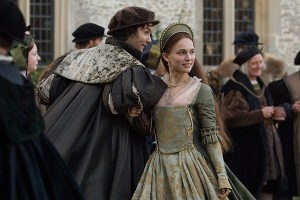
Let’s use my favorite historical fiction author, Philippa Gregory, as an example. Readers either love her or hate her. I am in the camp that loves her. She makes a lot of risky moves with her historical accuracy, but I don’t always agree with all of them even though I love reading her books. Let’s take a look at The Other Boleyn Girl as our main example. (Mainly because I know both the book and historical facts very well.)

In several interviews, Ms. Gregory has stated that when she writes a royal court story, she has a timeline up on her wall that shows the movement of the court, so that she can put the characters in the right geographical location in the right month/season. From there, depending on who you talk to, things can get murky. 

In The Other Boleyn Girl the 4 main deviants from other accepted sources are:

  1. The birth order of the Boleyn children
  2. The publicly known father(s) of Mary Carey’s children
  3. Mary’s role in the court after her second marriage 
  4. George Boleyn’s sexuality 

The birth order of the Boleyn children

Every historical source I have ever read puts Mary Boleyn as the oldest, Anne Boleyn as the middle child, and George Boleyn as the youngest. Philippa Gregory switches the characters around completely: George, Anne, Mary. I do understand why (I think) she did it. The relationship she created for the two sisters – Anne as a bossy bully and Mary as passively compliant (which she grows out of over twenty years) – works better for Anne being “the mean older sister”. Despite me understanding what is most likely her reasoning for doing this, it still bothers me.

Who fathered Mary’s children?

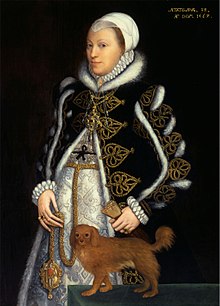
When Mary Boleyn became Henry VIII’s mistress, she was married to William Carey. She became pregnant during that time, and the court believed – as well as historians – that the king was the father of Mary’s oldest child, Catherine Carey. Surviving portraits of the oldest Carey child do hold similarities to other known Tudor children (according to those with the eye to see such details). According to historical sources, Henry had set Mary aside well before she became pregnant with her second child, Henry Carey. Historically, there was no doubt in anyone’s mind that William Carey was the only possible father to baby Henry. Philippa Gregory, however, made the decision to keep Mary as the king’s mistress longer than is accurate, and to make the father of her second child Henry VIII. Once again, there is a method to her madness. Later on, Anne adopts Henry so that she would be the “mother” of a biological son of the king, so he would be more inclined to marry her. But once again, the inaccuracy doesn’t sit well with me. The rest of the plot can continue as normal without this change.

Mary’s role in court

After Henry VIII set Mary aside, she’s a background character in the main historical record. We know she gave birth to a boy named Henry, and her first husband, William Carey died during one of the sweat summers (a type of plague disease that killed thousands of people every year). At some point after Princess Elizabeth was born, and during Anne’s unsuccessful pregnancies, Mary married a man well below her station, William Stafford. She kept her marriage a secret until her third pregnancy became too noticeable to hide (or perhaps, they married because she became pregnant). Queen Anne banished her own sister from court, and Mary’s remaining family followed their queen and shunned her. Mary moved to Calais, and that’s where they were living when Anne was beheaded for false accusations of adultery. 

In The Other Boleyn Girl, Philippa Gregory condenses Mary’s banishment to less than twelve months, and she’s back at court as the queen’s sister. How does Ms. Gregory justify this very obvious discrepancy? An actual primary source states that during Anne’s last miscarriage, she let no one in her chambers besides her mother and her sister. Now, this sister could have been Jane Parker, George’s wife. But it was also well known that Jane and Anne didn’t like each other. In fact, Jane and George didn’t like each other. But still, how can Mary be at court if the historical record puts her in Calais? Or was it a misunderstanding on who was actually in the room? (Especially since this is a time where false accusations of adultery were being prepared.) Either way, Philippa Gregory has one source to validate her decision to keep Mary at court for the story. 

And this is actually how she does it in all of her books. As long as one source records a guess, rumor, etc.; she can put it in her book and says that she is exploring what the story would look like if that source were true. Which, I think, is fine. Provided she justify it in her Q&A section she puts at the end of each book. And she does, most of the time.

George’s Sexuality

A major side plot in The Other Boleyn Girl is George Boleyn falling in love with Francis Weston, and embarking on a love affair with him. Once again, Philippa Gregory uses an obscure source that claims George’s pre-execution speech included an apology for sodomy. This claim can’t be combatted the way that the others were. Historians can’t discover the thoughts and feelings of long dead people. So, if a historical fiction author wants to make someone gay, they can do so. 

Any other Philippa Gregory book is going to have similar changes. She uses the lack of perfect records to fill in the blanks with her own imaginings. She uses the very real beliefs of the time in witches to include spells, curses, and fortune telling. And she finds obscure (but real) claims to further dramatize an already dramatic era. 

But even though she does her homework to justify the changes she makes, the real question is: Do you readers support these changes? Enough that she is still writing and selling books, and Starz is slowly turning her more popular books into mini-series. But the naysayers are still quite loud. 

So, at the end of the day, if you’re going to write historical fiction, just know that any changes you make will be noticed by some while unnoticed or ignored by others. It’s still your choice to make, but it will affect your readership. As for me, I’m going to continue to read regency romances regardless of what the upper class eats; and I’m going to continue to enjoy Tudor era stories – though I will grumble internally when things are too wrong for my taste. 

What’s your favorite time period for historical fiction? Let me know in the comments!

Short Story Prompt

At my launch party, I shared a modified lesson plan that I do in my ELD class each school year. We read a fractured fairy tale and watch an episode of “What if…?”. Then my students write their own short story. I provided the outline for the short story that my students use. To help them, their short story is them rewriting a story that already exists. I have found this helps with stress and the time constraints of the school day, because they don’t have to come up with an original idea.

But in reality, no story today is purely original. We all take inspiration from elsewhere. In How to Read Literature Like a Professor, Thomas C. Foster wrote, “there’s only one story… everyone who writes anything knows that pure originality is impossible… Writers notice all the time that their characters resemble somebody… works are actually more comforting because we recognize elements in them from our prior reading.”

So with this idea of taking inspiration from elsewhere, my short story prompt is: Choose an existing story and rewrite it to make it your own. (For copyright protections, use a story that is in the public domain like a fairy tale or a Shakespeare play.)

You can use this outline template: https://docs.google.com/document/d/1mVoLrANT82eaAe8epxNdNWVpI3wnUqZEJnSxvdFZWIY/edit?usp=sharing

Those who share their short stories* with me will get their name entered into a drawing for a $25 gift card to Amazon. Email me your final draft at chelseymortegauthor@gmail.com by October 23rd.

*Note: I will NOT be publishing or sharing your stories with anyone. These are your stories, and I am honored to read and enjoy them for myself. This is NOT a contest for the best story. It’s a random drawing of names. I hope you enjoy creating a story and it sparks something in you.

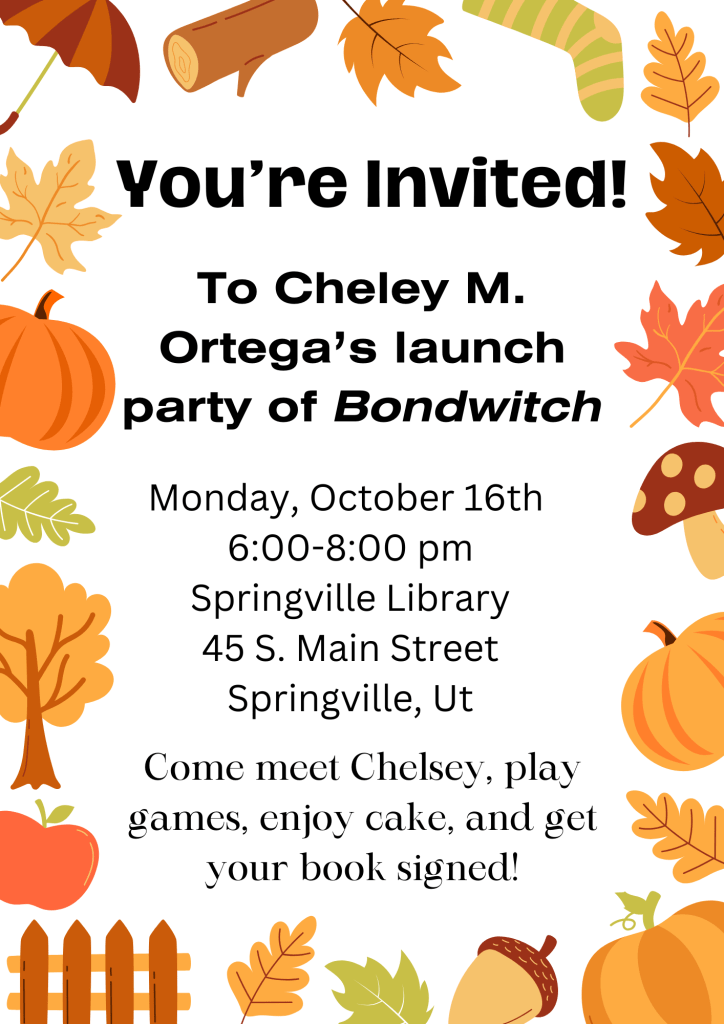
It’s a Launch Party, and You’re Invited!

We are 8 days away from my launch party for Bondwitch, and I am so excited! I got the schedule planned out at the start of the weekend, and I’d like to share it with you and invite you to come in person or online:

Don’t live in Utah County, or can’t make it for other reasons? Not a problem! I will record reading chapter 1 and the following Q&A session and post the video to YouTube, Facebook, Instagram, and TikTok (I want to go live on one of those platforms, it will most likely be Facebook). 

If you would like to ask a question ahead of time, email it to chelseymortegauthor@gmail.com. I will answer it during the Q&A and give a shoutout to you. 

I will also post the short story prompt on my blog that night, and if you would like to participate in that drawing, submit your story to my email by October 23rd.

Thank you so much for being here with me in this little corner of the internet. I hope you enjoy reading Bondwitch as much as I enjoyed writing it. And I can’t wait to share more stories with you. 

Giving in to the HEA

It was October 2021, and I was trying to figure out if I had accidentally written a romance when I was trying to write a fantasy adventure. I had experienced a less than successful response from beta readers. Most didn’t finish, and different versions of the same reason stuck out: “I didn’t know this was going to be a romance.”

It’s not. I mean, there’s a romantic subplot that is heavily intertwined with the main plot (and the romantic subplot does become the main plot of the sequel). But if the romance isn’t the main plot, then it’s not a romance, right? With this confusion, I had to stop preparing a query letter and research romance, because I needed to query the right publishers.

I came across a week-long webinar all about writing romance put on by ProWriting Aid called “Romance Writers Week.” Almost every presenter stressed the same thing: in order for a story to qualify as a romance, the relationship between the love interests is the focus of the story and it must end in Happy-Ever-After (HEA) or Happy-For-Now (HFN). 

Right away, I was like, “Um, excuse me? What about Nicholas Sparks?” Someone else asked that question, but more respectfully. The presenter said, “Nicholas Sparks doesn’t write romance, he writes love stories.” It turns out, a love story does not require a HEA, but a romance does.  

As I talked to other writers and studied what makes a romance a romance, I was correct in originally thinking that I did not write a romance. But the romantic subplot was important enough that I needed to market to romance readers, and make sure the subplot matched romance expectations. But I struggled with the HEA/HFN aspect. I felt like if the ending required a guarantee that the romantic interests end up together, then if a story is a romance, the ending is already spoiled the moment I open the book.

I went through a little identity crisis as a romance reader. The love stories I have read where the couple goes their separate ways or one of them dies, gave me enough pause to believe that any romance could end that way. So the tension and roller coasters the characters go through, I went through with them. But knowing ahead of time they are going to overcome it, temporarily took that magic away from me. I felt like “the man behind the curtain” had been exposed, and I was struggling with what I saw.

In the next romance I read after learning about HEA, the female MC was in a carriage accident. The final sentence of that chapter is, “And he watched his wife die.” I snorted and rolled my eyes. No he didn’t. She can’t die if this is a romance. The next romance I read had a gunshot at the end of a chapter, but who did the bullet hit? Well, before turning the page, I knew it wasn’t the female MC. How was I ever going to enjoy a romance again?

As I reached out to other romance readers about this identity crisis, most of them said something along the lines of, “I like knowing I’m guaranteed a happy ending. I read romance to feel happy. So it’s not about a surprise ending. It’s about the journey. How is the author going to bring them tension, danger, and drama to test their relationship? How are they going to overcome it? Is the journey believable, relatable, and entertaining?”

It took me a while to accept that mindset. And I had to read through several romances where I practiced viewing the story from that angle. But I eventually got it, and I’m back to enjoying romances. 

This has also helped me in my own writing. Since as the author, I know the ending, I need to make sure that the journey to that ending is believable, relatable, and entertaining for my readers. 

Are you a romance reader? What’s your favorite romance? What’s your favorite type of romance or trope?