January 2026 Newsletter

Subscribe to continue reading
Subscribe to get access to the rest of this post and other subscriber-only content.
Subscribe to get access to the rest of this post and other subscriber-only content.
Subscribe to get access to the rest of this post and other subscriber-only content.
Subscribe to get access to the rest of this post and other subscriber-only content.
Subscribe to get access to the rest of this post and other subscriber-only content.
Subscribe to get access to the rest of this post and other subscriber-only content.
Back when I finished the first draft of Bondwitch, and googled “how to publish a book,” one of the deep dives I went into was beta readers and critique partners. So many authors I talked to online were adamant that I should not publish my book without other people looking at it first. But taking that step of trusting someone else with your writing is really scary when you are new to this world. And after four years of sharing my writing with others, I have a critique partner who is my ride or die. So, I wanted to share how we found each other. And hopefully my journey will help someone else who is in the early critique group trenches.
Get comfortable with someone else reading and commenting on your writing and vice versa.
Before I knew anything about alpha readers, beta readers, and critique partners, an acquaintance from high school was asking for beta readers on facebook. My husband is a gamer, and I knew that beta players got to play a game before its release or play an updated version before it was available to the general public; I figured that was something similar. I volunteered and read her story. Now that I know more than I did, I’m sad to say, I was not a good beta reader. After finishing her story I sent her an email that said something to the effect of, “I really enjoyed your story. The ending makes me want to know more. I noticed a few spelling and grammar issues.”
I’ve since learned how to be a better beta reader.
When my own story was ready, I sent it to this acquaintance and my brother. The acquaintance never told me if she finished or not, and my brother couldn’t get past chapter 10 – I would later learn the lingo that he is not my target audience. But based on what my brother did say about the beginning, I was able to figure out some slight changes to the plot and improvement in character development.
I did a year of researching, editing, and revising, and my next batch of beta readers were going to (hopefully) be strangers. A big worry that many new writers have is “What if one of my beta readers steals my work?” I had that same concern. U.S. copyright law is on your side. Even if you don’t get an official copyright ISBN, by simply writing your words down, you own them. (I know, actually taking such an issue to court is a whole other beast. But in my experience, you’re more likely to simply encounter people who will agree to read it and won’t, than steal your work.)
I decided that the only way to know if beta readers were worth it was to experience it. I got 15 people to express interest in reading my story. Of those 15, 3 finished: 2 cousins, and a stranger.
Many people will say to NOT use friends and family members as beta readers because they may not be honest with you. Well, these two cousins were absolutely honest, and their comments were very helpful. And that’s something you can try with friends/family beta readers. If their comments aren’t helpful, then don’t ask them for your next project. If they were, then you can.
During this time, I was also actively beta reading other writers’ work. Commenting on their stories was hard at first because I didn’t want to hurt their feelings. But I put myself in their shoes: Would I want only comments that said how awesome it was, or would I also want comments that could help me be a better writer? So I made sure to express my critiques in what I hoped was a helpful way, not a “this is terrible” type of tone.
Start by joining a larger group.
When I finished an early draft of Bondwitch: Hybrid, I learned that it’s even harder to find beta readers for a sequel when they haven’t read the first book. No one accepted the invitation to beta read except for the 3 who already read the first book. So, I needed to find a way to get more people looking at it before I sent it in to my publisher.
There are some online groups like Critique Circle and Writer’s Cooler (I think that’s what they’re called, it’s been a while). But just jumping in online was still really nerve wracking for me. Then the founder of TWRP sent an email out to all of the authors signed with them to let us know what her three favorite conferences to go to. One of those conferences is the Quills conference in Salt Lake City, Utah. Well, look at that, I’m 45 minutes south of there!
So I looked up the conference and discovered the organizers are the League of Utah Writers. And there are chapters all over the state. I looked through their list of chapters and found three that looked promising for what I was looking for. One of them meets at the library down the street from my house. I emailed the chapter president. She invited me to come to a meeting, and if I was comfortable, to bring an excerpt of 1500 words or less and bring at least 6 copies. We go around the table and read our stuff, and take notes on others, give them comments, etc. I felt right at home after the first meeting, and joined the League and that specific chapter right away.
Eight months later, a member of the group created an off-shoot group where we read the same person’s entire manuscript on our own time in a month, and then meet and deliver comments to help the person improve their story. I joined that as well and created some deeper friendships.
The connection needs to be organic.
My earliest memory of Megan was a couple months into joining Nebo Novelists. I don’t know if it was her first time attending, but it was her first time bringing something to read. She read the prologue to her debut novel, Swayed (which I’m so excited to review and interview her here on my blog once it’s officially published!). It was one of the best prologues I’ve ever read, and I told her so that night.
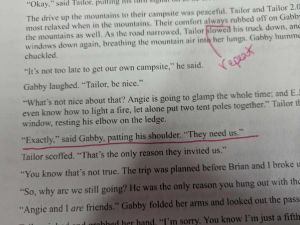
A few weeks later, so many people had come to the group meeting that we had to split into 2 groups, or not everyone would be able to get through their stuff. Megan immediately requested to be in the same group as me, and I had already been thinking the same thing! We both wanted to continue to read one another’s stories. From then on, we’ve always sat next to each other, and on the occasional night the group needs to split up, we stay together.
One thing that makes us such good writer friends and critique partners is that we both read and write romance. Since we understand the rules and expectations of the genre, we are the best at helping each other. In addition, we truly care about one another’s stories and success. I love Megan’s writing, characters, and plots. And she loves mine. But that love doesn’t prevent us from pointing out ways we can improve.
Create a system and schedule that works for both of you.
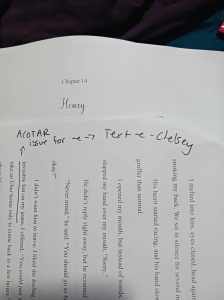
Our official partnership outside of group meetings started when Megan texted me follow up questions about some of my comments. That led to texts about plotting, foreshadowing, etc. Then she asked a question that I couldn’t answer in a text message because it was too long and I wasn’t the expert. But I had an hour long video clip that could help. I tried to email it to her, but my email couldn’t send that large of a file. So, I created a Google Folder and named it “Chelsey and Megan: Writing Buddies”.
Megan ran with it, and started uploading her manuscripts and notes from courses and seminars she’d taken. So then I uploaded my manuscripts. And now we read each other’s stuff well ahead of our bi-monthly group. She has been paramount in helping me edit episodes of The Wolf Whisperer for Kindle Vella. I have found a true friend in her. And I seriously cannot wait for her stuff to get published so I can tell you all about it!
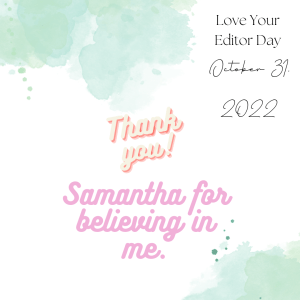
October 31 is Love Your Editor Day at The Wild Rose Press. My editor, Samantha Keating, is the reason why I even had a chance. I owe her so much. She has officially been my editor since August 2022, but I have been in contact with her since November 2021.
When I was ready to query Bondwitch, The Wild Rose Press was my first choice publisher. When you query TWRP, you send your query to a general query email, so I didn’t know who exactly would be reading my query. Thirteen days after I sent my query I received an email from Samantha requesting the first three chapters!
A little over two weeks after that, Samantha responded with a very detailed and helpful critique on what skills and style TWRP expects, which I did not quite meet. She explained that to improve my story to WRP standards would require a rewrite, so she couldn’t accept my full manuscript. She encouraged me to keep writing and not give up.
As more rejections came in from other publishers, and I had conversations with my fellow writers, I learned that Samantha’s helpful critique was a rare gem. I also learned that the suggestions she made to improve my writing weren’t unique to TWRP. Almost all publishers today want the same thing: show, don’t tell. I still really wanted to get a second chance with TWRP, so I got to work rewriting Bondwitch with the suggested improvements.
It took me four months to fix my manuscript. When it was ready, I emailed Samantha directly, and asked if TWRP allowed resubmissions. She responded that they normally don’t, but she was interested in finding the answer to a cliffhanger scene in chapter 2. She invited me to resubmit the first three chapters, and she would take a look at my improvements. Two weeks after that, Samantha requested the full manuscript!
I didn’t hear anything for three months – which, I understand, is pretty standard for a full manuscript request. Then, on my wedding anniversary, I was sitting at a table in Cafe Orleans, Disneyland when my phone alerted me to an email from Samantha. My heart rate accelerated tenfold. I looked across the table at my husband. “I’m scared to read it.”
“Just open it!” he said.
I clicked on the notification, read the first few lines of the email, and screamed in the middle of a Disney restaurant. Samantha had finished my story, and was pushing it forward to the managing editor, who has the final say.
A week after that, Samantha emailed me that Bondwitch was being accepted by TWRP, and the official contract would be sent to me within twenty-four hours. She also told me that she would be my editor. Once again, I was in a public place when this email came through. This time, I was in a hotel lobby for a work retreat, so I couldn’t scream out loud, but I definitely teared up.
Samantha and I are currently knee deep in editing, and I love working with her. Her style of editing is to approach it from a teaching angle. For the content editing, she made comments for the first one hundred pages with the goal that at that point I would have learned from her comments enough that I can find and fix the rest on my own. At first I was nervous about that. I didn’t think I could do it. I thought I would need her to hold my hand the whole time. But she knew exactly what she was doing – and that’s why she’s the editor! I’m three chapters beyond where Samantha stopped making comments, and I can “hear” her in my head pointing stuff out as I read over my words.
I owe this wonderful journey to Samantha. She went above and beyond by giving me detailed feedback long before she was my official editor. She believed in me and gave me a second chance. And she is an amazing teacher.
Happy Love Your Editor Day, Sam. I’m so grateful you are my editor. I look forward to our continued partnership.
 Chelsey M. Ortega