My Top 5 Reads of 2025

Okay, it’s technically my top 8 reads of 2025, but 4 of them are in the same series, so I’m reviewing them together. 

I read 41 books this year – 2 more than my goodreads goal! 5 (8) of them I loved so much, I need to share them with you.

Remember When We by Khardine Gray. 
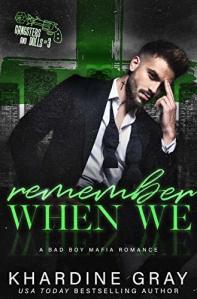
Khardine Gray also writes under the name Faith Summers. Whether she’s writing as Khardine or Faith, her series are all mafia romances. Remember When We is my absolute favorite of hers. It’s the third installment of her Gangster and Dolls series. It’s a second chance romance with the older brother’s best friend and secret baby tropes weaved into the plot. Lyssa and Gio haven’t seen each other in almost a decade. The death of Lyssa’s brother, Gio’s best friend tore them apart. Now they’re back in each other’s lives, and Lyssa owes money to the wrong man. Gio must not only win back her heart, but also save her from dangerous men who want to harm her.

Khardine/Faith write very spicy love scenes, and most of her MMCs are morally grey and very alpha-like. Several of her stories cross the line for me; but knowing that she has stories like Remember When We keeps me reading her stuff.

Queen Charlotte by Julia Quinn and Shonda Rhimes
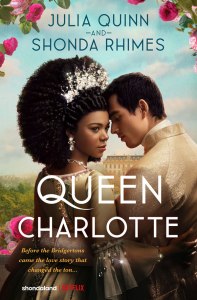
Unlike the other Bridgerton stories, Queen Charlotte the book was released after Queen Charlotte the limited Netflix series. But like most film-book comparisons, the book is better! What I love about reading is that we get to experience the characters’ emotions in their heads. On screen, we guess what they’re feeling by their body language and tone of voice. Like the mini-series, Queen Charlotte follows Charlotte and George’s early days as newlyweds, Brimsley and Reynolds’ relationship, and Lady Danbury’s fight to keep her children’s rightful status after her husband dies. The book also gets a couple of scenes that aren’t in the show. My guess is they are scenes that either got deleted from final edits, or were never filmed due to time. And finally, Brimsley and Reynolds’ love story is so much better in the book. I didn’t like their story in the show. I thought Reynolds was toxic and verbally abusive. In the book, Brimsley calls Reynsolds out on this unequal behavior, and Reynolds changes for the better by the end of the book.

I’m all for Julia Quinn and Shonda Rhimes continuing to give side characters their own story. 

The Rokesby Series by Julia Quinn

  • Because of Miss Bridgerton
  • The Girl with the Make-Believe Husband
  • The Other Miss Bridgerton
  • First Comes Scandal

These four books are considered the Bridgerton Prequels. The MMCs of each book are a son in the Rokesby family – the family whose countryside property is next to the Bridgerton’s Aubrey Hall. And three of the FMCs are a Bridgerton girl; either a sister or cousin to Edmund Bridgerton (Violet’s husband and father to the eight main Bridgertons). I argue that these four books are better than the original eight Bridgerton books. But I’m sure it’s because Julia Quinn started with the Bridgerton books, and simply improved her plot creativity and writing skills as she wrote and published more. Let’s dive in to a brief summary of each:
Because of Miss Bridgerton is about the oldest Rokesby, George, and the oldest Bridgerton Billie (Sibylla). They think they hate each other, but their mothers know better and hook them up with an elaborate scheme of dinner parties and visiting London.
The Girl with the Make-Believe Husband takes us to the colonies on the North American continent during the American Revolution. Edward, the second oldest Rokesby is serving the King in his Majesty’s army. Cecilia has traveled to the colonies to find her injured brother, who happens to be Edward’s best friend. In order to get the answers she seeks, Cecilia needs the Rokesby name, and pretends to be married to Edward.
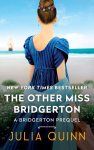
The Other Miss Bridgerton is about the third Rokesby, Andrew, and a Bridgerton cousin, Poppy. Andrew is a ship captain. His ship participates in some legit business and some pirate-level business. Poppy gets kidnapped by some of his crew, and he has to take care of her while they make an important and deadline-driven journey to Portugal. 
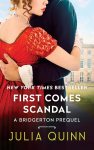
First Comes Scandal is about the youngest Rokesby, Nicholas, and the youngest Bridgerton Georgie (Georgiana). Georgie’s reputation has been compromised by a malicious young man who wanted to force her to marry him. Nicholas’ father asks him to marry her in order to save her from a life of spinsterhood and a soiled reputation. Their love story begins after their marriage. 

In usual Julia Quinn fashion, these four stories are full of witty women, temperamental men, and comedy. I love her writing, and this is my favorite series of hers (so far).    

Romney: A Reckoning by McKay Coppins
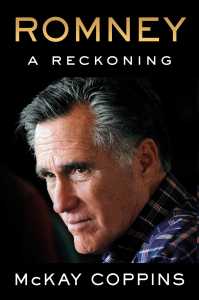
I didn’t know who Mitt Romney was before he became a real contender in the 2012 Republican primaries. Part of that is because I was too young to vote or care before then, and part because I took a political science class during that time, so of course my professor used class time to closely follow the campaigns. Over the years, I have grown to greatly respect Mitt Romney, especially during his time as a Senator representing Utah. Reading this biography that covers both his personal and political life was very enlightening, and I like him even more now. Mitt Romney always tries to do what he thinks is right, even when others disagree with and disparage him. I think he’s a great role model for future politicians. 

Zalis by Nancey Cummings

Nancey Cummings writes science fiction romances, and her longest running series is the Warlord Brides/Warriors of Sangrin series. Zalis is the 13th installment in that series (16th, if you count the three side stories, which I do). It popped up on my “Because you read…” recommendations on my kindle, and I bought it right away and started reading immediately. Zalis is an alien warrior, his species is called Mahdfel, and he is of the Sangrin line. He meets his human mate when he rescues her in a group of kidnapped human women to be sold on the sentient being trafficking market. Gemma does not want to go back to earth, so she accepts a match with Zalis in order to stay near her twin sister. What will start as a marriage of convenience, has the chance to bud into love. I love Nancy Cummings’ writing. She is creative in her world building. She develops humorous and witty characters. Most authors cannot continue a series for this long and keep it entertaining with readers still wanting more. But I do want more, and her acknowledgements at the end of Zalis do promise more in due time!

What were your favorite books that you read in 2025? Share them in the comments!

May 2025 Newsletter

Everyone says that March is the longest month of the school year for students and teachers. But I actually think April is. After spring break, there are no more holidays or teacher work days. My kids also have a million end of the year performances – though I do love attending those and watching my little performers. 

What do you think? Is March or April the “longest” month of the school year?

Writing News

A couple of months ago, I finished writing my first short story. It took me two years! Short stories are hard because you have to write a complete story with fewer words. And everything I attempt always turns into a full length novel. And I finished just in time to submit it to an anthology whose theme matches my story’s. A few days ago, I received an email from the publisher that they want to include my story in their anthology! As details get hammered out, I will be sharing them here in the newsletter.

The Wolf Whisperer and the Warrior won the Fiction from the Heartland contest put on by Mid-America Romance Authors! I know in the last newsletter I said being a finalist was exciting enough, but I am so thrilled to have won. It really helped with some imposter syndrome I’ve been feeling recently. A literary agent was the judge for the final three stories, and so, this makes me think that maybe I could get this traditionally published. I haven’t made any concrete decisions yet. I still think that because it’s a fated mates werewolf romance it has the potential to do well on a reading app. Plus, having some stories available for free is nice for readers. *sigh* Decisions. Decisions. (In Dakota Fanning’s Jane voice in the Twilight series.)

Book Reviews

I’ve been rereading a lot of favorites, but here are the new ones for the month:

Killing the Witches: The Horror of Salem Massachusetts by Bill O’Reilly is unfortunately not what it’s advertised. There are three sections: 1. The Salem Witch Trials, 2. A short biography of Benjamin Franklin, 3. The event that inspired the movie The Exorcist. Each section on its own was an interesting read. But from cover to cover as a comprehensive claim? The sections don’t connect. I would have loved if the author fleshed out the Afterward and made that part of the book instead of the Revolutionary War stuff and The Exorcist stuff. 3 stars.

Because of Miss Bridgerton by Julia Quinn is the first of the Bridgerton prequels. Billie Bridgerton, the FMC, is the oldest Bridgerton of Edmund’s generation, making her the aunt of the OG Bridgertons. She helps run Aubrey Hall and is jealous that Edmund will one day inherit it instead of her. George Rokesby and his siblings have grown up with the Bridgertons, and he’s always seen Billie as too free spirited, until one day, he realizes he loves her free spirit. This is one of the slowest slow burns I’ve ever read. And the payoff was so worth it. Billie’s version of “not like other girls” is refreshing and it’s more about going after her dreams than trying to be different. George is a better heir than Anthony, hands down.

Dear reader, be patient. It takes a while to get to their first kiss, but I promise, after that, it’s amazing. 5 stars.

I’m chugging along on my ACOTAR series reread reviews on TikTok. My latest is Ch. 22-28 of A Court of Mist and Fury.

@chelseym.ortega

ACOMAF Ch. 22-28. Sorry for the long video, but these chapters have to go together! #booktok #acomaf #archeronsisters

♬ original sound – Chelsey M. Ortega

Hang in there. It’s almost summer.

Sincerely,

Chelsey M. Ortega

4 Writing Tips from the Pre-Quills Conference

The last weekend of March, I attended the Pre-Quills Conference put on by the League of Utah Writers. It’s a one day conference whose sessions are geared toward beginner writers. And I honestly still consider myself a novice writer. I still have a lot to learn. There were four sessions, with three options per session. I attended a session on writing short stories, writing BIPOC characters with respect, Marketing for Beginners, and how to write a first Chapter. I want to share the highlights from each session with you.

Short Stories

The presenter for this session was Cassidy Ward. He writes science articles and short stories. He started the session by reading one of his short stories out loud, and then using the parts of that story as an example for what he taught us. (The short story in question is on his website here. Go read it. It’s amazing.)

I chose this class for session 1 because I have written a short story that I’m submitting to a contest, an anthology, and a magazine. Some of the feedback I’ve received in my critique group has really frustrated me, and I needed to better understand what I was doing wrong from an actual published short story author. 

Cassidy’s presentation was so wonderful. What he taught helped me see where I can improve, but I also got some validation in certain areas that I was convinced were okay despite my critique group’s comments. (I do think that a lot of their comments would have worked for critiquing a full-length novel. And to be fair that’s what I generally bring to the group.)

So, after spending way too much time on this introduction, here are the highlights from his class:

  • “Get words on the page and get rid of the ones that don’t work.”
  • Treat exposition like salt: enough to set the stage → as little as possible, as much as you need
  • Give the reader at least one character to root for
  • Every character should want something. The stakes don’t have to be huge, but they should feel huge → the reader should feel what the character feels.
  • Focus on feelings rather than events → zoom in one thing (i.e. 20 minutes of someone’s life)

BIPOC Characters

This session was taught by J.T. Moore. I didn’t take many notes because I was just enjoying listening to her. Ms. Moore’s presentation was about how representation is important, and should be done respectfully. And like with the short stories session, I had a personal reason to choose this session.

I have Black, Asian, Latino, and Gay characters in my stories (none of which were chosen for the sake of representation – I strongly believe that my characters are “alive” in a way, and they tell me who they are). And my beta readers have never picked up on my attempt at respectfully describing these characters, assuming everyone was white and straight. *sigh* So, I needed help from someone more knowledgeable than me.

This is what I learned from J.T. Moore:

  • Give your characters hobbies, personalities, and descriptions other than skin color
  • Give your characters unique and complicated back stories to inform who they are
  • In speculative fiction, your characters don’t have to reflect the current world
  • Still identify their race, just don’t use their race to be their only description and personality

Marketing 

Like most authors, marketing is my weak spot. So, any time there’s an opportunity for me to learn from someone successful to see if what they do works for me, I’m going to take it. 

Candace Thomas has successfully tapped into an engaging website, using influencers, and creating merchandise. I took a lot of notes, but I’m only going to share a few highlights – specifically the ones I’m in the process of applying to my marketing.

  • Have your most recent book be the landing page for your website
  • Make your newsletters short and sweet
  • Know which generation prefers your genre and what social media platforms they use (i.e. Gen Z loves Romantatsy and are mostly on Instagram and TikTok)
  • Make content that matches your books that isn’t “Buy my book!”
  • Utilize influencers (they do cost $$)
  • Create merchandise that brings people to your website (and hopefully buy your book as well)

First Chapters

Lindsay Hiller has won several first chapter contests, and now heads and judges first chapter contests. I picked her session because I’ve never placed in a first chapter contest, let alone won. And most readers who attempted The Wolf Whisperer and the Warrior when it was on Kindle Vella stopped after chapter 1. So, I clearly need some help. 

Lindsay broke it down into 3 main writing tips:

  1. Follow the 4 emotion beats: What is the character’s goal (both for the chapter and the whole story)? What are their motivations for those goals? What obstacle(s) will prevent them from meeting that goal (at least the smaller one)? And what are the stakes if they don’t reach their goal (at least the smaller one)?
  2. Organize the following aspects: Provide a setting, give the basics for character description, voice, and flaws, and create a hook to convince the reader to keep reading after chapter 1.
  3. Put it all together: Begin by introducing the character, describe the setting, and provide a status quo. Go into their goal and motivation. End with the inciting incident that launches the character and reader into the rest of the story. 

I am so grateful I got to attend this conference. (Last year I got sick and had to stay home and watch the virtual sessions, which really wasn’t the same as being there in person.) I’ve already started applying some of the lessons I learned, and I’m hopeful for positive results. 

Learning How to Read Novellas

Before I knew that there were more differences between a novel and a novella than just word count, a lot of my reviews of novellas read like this:

“The story ended too quickly for me.”

“I would have loved the resolution to have more details.”

“I wish the ___ plot was more drawn out.”

I read dozens like that. And then, one day, it hit me: these are meant to be short, which means the plotting is going to be structured differently than a full length novel. So, I googled “What is the difference between a novel and a novella.” Endless articles have already been written, so I’m just going to summarize three* of them:

  • Word count: A novel is 40,000+ words, a novella is 17,500-40,000 words (I don’t know where the 17,500 comes from or why it’s that specific. If you know, feel free to share in the comments!)
  • Characters, events, themes, and subplots: There are more of all of those in a novel than a novella. If there are any subplots, very little time is spent on them. In fact, it’s easier to not have a subplot. Character development happens for the protagonist only.
  • Plot and Pacing: A novella has a singular event that is the central crisis and focus of the plot, allowing it to be faster paced. A novel has several points of rising and falling action and interconnects subplots with the main plot.

*Sources: https://www.uobabylon.edu.iq/eprints/publication_10_21876_1383.pdf , https://kindlepreneur.com/novel-vs-novella/ , https://www.firstediting.com/blogs/difference-between-a-novel-and-a-novella/  

Now that I better understand the organization of a novella, I’ve had a much better experience reading them. And those authors are also getting better reviews from me! 😉 I also really enjoy reading a couple light hearted and spicy novellas in between the longer and darker fantasies I’ve been reading (ACOWAR I’m talking about you). And I’d like to share with you my favorite Novella series and authors:

  • Warriors of Sangrin (a.k.a. Madfhel Brides) by Nancey Cummings – First book: Paax
  • Tail and Claw by Nancey Cummings – First book: Have Tail Will Travel
  • Any of Carly Phillips’ series. So far I’ve read: Billionaire Bad Boys, Dare to Love, and The Knight Brothers series.
  • Any of Aurelia Skye’s series. 

I’ve read plenty of others, but those are my top three novella authors.

And in learning more about Novellas, I decided I want to be able to write some as well. So, I tried to write one, and *sigh* it turned into a 99,000 word novel. (It was The Wolf Whisperer) But I haven’t given up. I’m going to keep working on concise writing and shorter plots. And hopefully, one day, I’ll have some Novellas under my belt. 

Are you a fan of Novellas? What authors/series would you recommend? Let me know in the comments!

My Top 5 Reads of 2024

On Goodreads I read 38 books in 2024. But when I count the 16 books not registered on Goodreads and the 4 unpublished books I beta read, I read 58 books in 2024. Regardless, I didn’t meet my Goodreads goal of 76 books. But that’s okay. My Goodreads goal is always one more than I read the previous year. So, that means my 2025 goal will be 39 books. 

Of those 58 books, here are my favorites: 

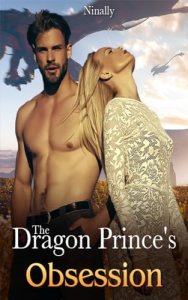
The Dragon Prince’s Obsession by Ninally is the sequel to The Dragon King’s Obsession. Both books are about dragon shifters falling in love with the enemy: humans. In this series world building, dragon shifters live high up in the mountains. Human hunters down the mountain hunt them, and have hunted female dragons almost to extinction. In the first book, dragons capture the daughter of the leader of the hunters, and the king of the dragons falls in love with her while she is their captive. Of course there’s lots of drama, witches get involved, and the final battle is epic. And then the sequel begins. 

New couple. New story. One of the best enemies-to-lovers I’ve ever read. Adela is a human servant in the king’s palace. She serves the king’s sister, Princess Lucille, and the queen, Mystique. Prince Mikhail is the king’s brother. Mikhail was one of the villains of the first book. He kidnapped Mystique and tried to kill her.

Adela stumbles across Mikhail being imprisoned by witches while she is on an unwilling adventure with the spoiled Lucille. In Lucille’s inability to see anyone other than herself, she returns to the palace safe and sound without Adela. Mikhail and Adela fight their way out, and Mikhail takes Adela to his palace. Because she saved his life, his dragon now owes her. Mikhail begrudgingly takes care of her as he fights his dragon’s attraction to her. He hates humans, but he also opens Adela’s eyes to how she is treated back at the main palace. Adela is “friends” with the royal women, but yet still has to serve them and sleep in cramped quarters with the other human servants. Adela also thinks she’s in love with the king’s right hand man, Blaze. Lucille and Blaze are secretly in love and having a secret affair. The problem, is that in order to keep her secret, Lucille encourages Adela’s crush on Blaze to hide her own feelings, knowing Blaze will never look at Adela like that. So, she’s setting Adela up for romantic failure for her own selfish agenda.

When Mikhail cracks everything open for Adela, she refuses to return to the king’s palace. Mikhail keeps her in his, where she is not a servant, but an equal resident. They grow closer and have one of the most delicious slow burns I’ve ever read. During her time there, Adela also discovers she is not truly human. Her mother was human, but her father was something else (which I’m not going to give away – read the book!). Her newfound abilities call evil witches to them, and she and Mikhail will have to literally fight for their survival and love.

It’s beautiful. It’s spicy. I LOVE this story.     

The Woman They Could Not Silence by Kate Moore is a biography of Elizabeth Packard, whose story takes place in the 1860s in Illinois. Elizabeth held different religious and political beliefs from her husband, who was a preacher. She vocalized them in public, and her husband responded by getting corrupted doctors to certify Elizabeth as insane, and locked her in an asylum. Kate’s research of Elizabeth’s experience teaches four main historical facts:

1. What was considered “insane” in the 1800s – Women could be diagnosed with insanity if they disagreed with their husbands, disobeyed their husbands, or stopped loving their husbands. Elizabeth was guilty of all three.

2. How deep male ownership of women was –  Several doctors who “diagnosed” Elizabeth with insanity never saw her in person. They listened to her husband’s description of her, and wrote a certificate of insanity! Also, Elizabeth couldn’t divorce her husband because he would automatically get their six children if she did.

3. Treatment of patients in asylums – Elizabeth women with less money and social status than her slapped, starved, choked, and drowned. When Elizabeth disobeyed her doctor, he took her possessions and moved her from her private room into a shared room. While the employees didn’t physically abuse Elizabeth, they allowed the more violent patients to do so instead.

4. The amount of research and lobbying needed to change the law – When Elizabeth was released from the asylum, she went to work to change the law so that some of the friends she’d made could also be released, and future women didn’t go through the same thing. It took her a decade, which included a nationally followed legal battle against her husband and doctor. She was successful in getting the laws changed across the state, which would end up saving her daughter in the future when she also suffered mental health problems in her adult years. 

Elizabeth Packard’s story is one that needs remembering for both mental health laws and feminist ideology. I have always enjoyed biographies about strong and powerful women, and Elizabeth makes it on that list. 

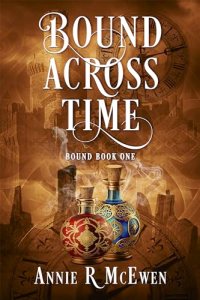
Bound Across Time by Annie R. McEwan was my first experience where an author reached out to me and offered me a free copy of their book to read and review. And it was amazing. Of course, Ms. McEwan got the royal treatment: an unboxing video, a blog post, and a YouTube review. 

Bound Across Time is the first of a paranormal time-travel romance series. Patrick O’Loinsigh died in the 1700s in Wales. His ghost as been stuck in the castle he perished in. In modern days, the first living person, Cece Gowdy can see him. She’s a witch and they embark on a passionate love affair. But loving a ghost comes with risk and danger. Cece is not made for Patrick’s limbo world, and Patrick isn’t made for Cece’s living world. They are going to have to rely on the help of other witches to fight against the magic of time that is separating them.

I always find magic system world building interesting, and the rules of magic for this world were really cool. This was also the first ghost-human relationship that followed the rules of the romance genre. The sequel, Bound to Happen will be released early this year!

The Haunted Purse by Kimberly Baer is my tried and true “don’t judge a book by its cover.” I thought the title sounded juvenile and the cover didn’t pull me in. Then it ended up being the book of the month for the book club I was in. I inhaled it.

Libby is a 15-year-old high school student who lives on her own while her mom dates around, pretending she doesn’t have a daughter. Libby purchases an old purse from the secondhand store. The purse makes things disappear, and provides extra things to the purse. As Libby gets used to her purse’s abilities, she notices a connection with some of the objects that appear. They are all connected to a 20-year-old cold case. Convinced that the purse holds the ghost of the missing girl, Libby puts on her detective hat and works to solve the case.

In addition to the murder mystery plot, there are three other themes that provide great lessons for young adult readers:

  1. How educational professionals treat each student is important – Libby’s math teacher bullies her, and her counselor looks down on her for being poor.
  2. See something, say something – A big part of what keeps the plot moving is teenagers keeping secrets. Obviously, the secrets need to exist for a great story, but in real life, keeping secrets like these are dangerous.
  3. Honesty really is the best policy – This connects with number 2. Teenage characters lying to adults helps the plot, but in real life, telling a trusted adult the truth can always help. 

The Haunted Purse is the best YA story I’ve read in a while.

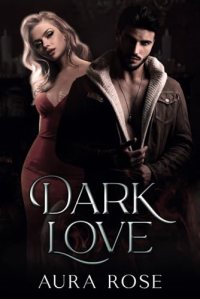
Dark Love by Aura Rose is the second in a fated mates romance trilogy. Each book features a different couple. The first book is called The Last Alpha. To be honest, I didn’t much care for the first one. Some authors who write fated mates stories use the mate bond in their plot to have a – what I call – justified cheating subplot. That is in The Last Alpha, and left a bad taste in my mouth for the rest of the book. Luckily, the end of the first book lets the reader know who the couple will be for Dark Love, and I was fully on board for their love story.

Madeline is a werewolf, Arius is a witch-vampire hybrid. Arius is not supposed to exist per the council’s rules, and they’ve been trying to kill him since he was born. Arius is also the son of the vampire king who tried to kill Madeline’s pack in the first book. So, she and Arius get a very steamy enemies-to-lovers and forbidden love arc – which, in my opinion, is the best combination of romance tropes. Trigger warning: Arius does kidnap Madeline at the beginning of the book, but he doesn’t torture or SA her.

Once Madeline and Arius accept the mate bond, they combine forces to take down the bigoted council so they can live in peace. Arius is my favorite book boyfriend

It ends on a pretty dramatic cliff-hanger. I’m about a third of the way through the third book, His Lost Tribrid. It’s also really good. Unfortunately, the platform it’s on (Dreame) has tripled their prices over the past year. So, I won’t be able to finish it there. So, I’ve subscribed to Aura Rose’s Amazon page, and as soon as it’s available on Amazon, I’ll buy it there and finish it. 

What notable books did you read in 2024? Share them in the comments!
Resolving Sociopolitical Issues in Fiction: One Reader’s Perspective

It’s very common in fantasy and science fiction for the authors to mirror real issues that human history has gone through or is currently going through. In ACOTAR, humans used to be slaves, and once freed, became segregated from their previous masters, the fae. The First Order in Star Wars is obviously the Third Reich. Voldemort in Harry Potter is clearly Hitler. House Elves are slaves. Every single creature that isn’t a wizard are all of the colonized nations around the world. A wizard and a no-maj not being allowed to marry mirrors U.S. anti-miscegenation laws. The list goes on. 

In each of those issues, the protagonist or one of the sidekicks fight against those issues. And enough progress is made that even if it’s not fully resolved by the end of the series, the reader is able to believe that it will be soon – or the main characters physically move away from the corruption to a new kingdom/world/etc.

So what happens when an author creates social injustices for their plot, but doesn’t resolve them by the end? 

I recently read a series that did just that.  

It was a paranormal romance series that had 10 books in it. The majority of the world-building centered around sexism. The female characters had no rights, and so their only way of a decent life is to accept a mate bond with a strong male. Children also had no rights until they shifted into their animal for the first time. And half-breeds (one human parent, one shifter parent) were the lowest of the low. 

The main character for the first three books leaves her community and tries to fit into the human world because of this. She gets sucked back into her old life, where she meets her fated mate. He also doesn’t agree with the traditional way of their species, so together, they create a refuge for others like them. So, things are looking good for a traditional fight-the-corruption plot line that I love in fantasy series.  

For the next three books, one of the side characters becomes the main character, and her love story commences. She and her fated mate spend three more books fighting the system, and win. They also create a second pack for outcast shifters to escape to. 

The final four books take place roughly fifteen years after the sixth book ended. And this is where the plot goes in a completely different direction. There were very strong hints at the end of the sixth book that things were changing drastically. So when chapter 1 of the seventh book started and things had not only failed to improve, but even regressed beyond the first book, I was confused. However, as I continued reading, I realized it’s okay if society got worse. The Force Awakens does the exact same thing, and I enjoyed that movie. The author had to come up with something for the main character to fight. But as I got to the end of the tenth and final book, there were no hints that the corruption was going to be defeated. And sadly, it wasn’t. The two love interests got off on a technicality within the corrupted legal system, and continued to live in that evil world. 

The series would have felt more complete, for me, if the corruption had truly been defeated and social and political change was evident – even if it wasn’t perfectly gone by the final sentence.

Now, I need to make a note here. I think that the author created an incredible world with relatable characters. I obviously was invested enough to read all ten books. The romance plots – which were the main plots – were well executed. And there were plenty of readers who loved the whole series. I think the author is a talented writer. They have a great imagination. I gave each individual book between 3-5 stars on Goodreads.

I also acknowledge that the end of this series is more realistic. To quote Anita Hill, “Progress isn’t measured in days. It’s measured in decades.” That being said, I don’t want fantasy to be realistic. I want the final battle to magically change everything (or put society on the first few steps of changing everything).  

This is similar to what I said in my historical fiction post. Some readers don’t care if the characters are eating chocolate too early for historical accuracy, while others care very deeply. Some readers will be fine if the characters don’t take down the corrupt system, while others will want to see exactly that.

So, my opinion is simply mine. This is a decision that all writers have to make. As they build worlds and create characters, writers need to figure out which plots need to be resolved by the end – or at least a hint of a resolution. 

For me, resolution is important.

I’d love to hear your thoughts. Do you think all – or close to all – the problems in a story need some type of resolution by the end? Let me know why or why not in the comments.  

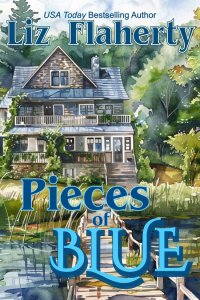
New Release: Pieces of Blue by Liz Flaherty

At the beginning of this month, USA Today’s best selling author Liz Flaherty released Pieces of Blue. Normally a romance author, Liz has dipped her toes into women’s fiction with her latest release, and is here to share her thoughts on her recent writing and publishing journey.


Hi, everybody. Chelsey, thank you so much for having me here today. 

I’m not sure when the term women’s fiction entered my consciousness. I don’t recall whose I read first or even if I liked it. The words Woman’s Journey had been bandied about most of the years I’d been writing romance, and I thought that’s what we should do with romance and women’s fiction—just make them into one huge glorious genre known as The Woman’s Journey. 

The idea didn’t catch on. 

But I read CurtissAnn Matlock’s Lost Highways and Robyn Carr’s Deep in the Valley and Cheryl Reavis’s Blackberry Winter and Elisabeth Ogilvie’s Bennett’s Island series. I kept thinking yes, this! They’re all women’s fiction, but they’re all love stories, too. They’re all women’s journeys and I’ve read most of them more than once. While I love the relationship that grows between the heroine and hero, I also enjoy the ones between girlfriends, between sisters, between work friends who are there for each other. The romance is important, but it’s not always most important. 

Because it’s the story that’s important. The journey. How you feel when you finish reading. To a lesser degree, as a writer, how I feel when I finish writing is important, too. 

Of course, none of that was in my mind at all when I got a two-word start that wouldn’t get off my mind and stay there. Then I had a trip back a skinny, curvy road to a small lake I’d never known existed but made me type Chapter One above those initial two words. Later still, Maggie North invited me on her journey. It took her a while, and writing it took me a while, but…gosh, I loved Maggie. And Sam. And her adoptive parents. And Pastor Cari Newland. Oh, and Ellie and the dachshund named Chloe, too. 

Pieces of Blue has some romance, a setting I never wanted to leave, and, most of all, it has friends and family and community. Their dialogue was so much fun to write. The house—the Burl—is a character unto itself. 

How did I feel when I finished writing it? Oh, good. Sorry it was over and slapping back thoughts that maybe it wasn’t over…maybe there was another story at Harper Loch. Or two.

We’ll see. In the meantime, it’s a story from the “huge glorious genre” I mentioned above. I hope you like it.


For all of her adult life, loner Maggie North has worked for bestselling author Trilby Winterroad, first as his typist, then as his assistant, and finally as his ghost writer. Throughout her first marriage, widowhood, remarriage, and divorce from an abusive husband, Trilby was the constant in her life.

When he dies, she inherits not only his dachshund, Chloe, but a house she didn’t know existed on a lake she’d never heard of. On her first visit, she falls in love with both the house and the lake. Within a few weeks, she’s met most of the 85 inhabitants of Harper Loch and surprisingly, become a part of the tiny community. Her life expands as does a new kind of relationship with her friend Sam Eldridge. She finally feels not only at home, but safe.

Until her ex-husband is released from prison. The fragile threads of her new life begin to fray, and that feeling of safety is about to shatter into a thousand pieces.

The drive took me farther into the country than I’d ever been—at least that I could remember. While the temperature didn’t drop, the wind did increase, blowing snow from the roadsides across in front of me in gusty swirls of white. I was surprised that Gladys, the elegant voice of my GPS, didn’t sound either confused or disdainful even when it took me three tries to see the little green sign that indicated Harper Loch Road.

Canopied by naked February trees and lined with animal-tracked snowbanks, the road was one and a half lanes wide. I hoped it would be wider when there was no snow, but I wouldn’t bet on it. It was hilly, with serpentine curves that reminded me of a Chutes and Ladders game board minus the ladders. Gladys didn’t enlighten me as to how far it was to the lake itself, and two miles in, I was starting to wonder if it was all a bad joke. 

Trilby had been the master of bad jokes.

A barnwood sign at the side of the road encouraged me to Keep Right! I inched over, flinching when the snowbank brushed the side of my car, my pride and joy. Chloe looked my way, wide eyed.

Apparently, it was a popular meeting spot on the road, because I met a pickup immediately, going at least twice as fast as I was. The driver waved cheerfully and missed me by what I was certain was the hair’s breadth Trilby used to insist was purple prose if used in a book. I would have waved back, but my hands, white knuckled, didn’t want to let go of the steering wheel.

“Trilby,” I said, “what in the hell were you thinking?”

Pieces of Blue is available everywhere books are sold online:

https://books2read.com/FlahertyBlue

https://a.co/d/eyEjPDA

Liz Flaherty has spent the past several years enjoying not working a day job, making terrible crafts, and writing stories in which the people aren’t young, brilliant, or even beautiful. She’s decided (and has to re-decide most every day) that the definition of success is having a good time. Along with her husband of lo, these many years, kids, grands, friends, and the occasional cat, she’s doing just that.

She’d love to hear from you at lizkflaherty@gmail.com or please come and see her at  https://linktr.ee/LizFlaherty 

New Release: Fox Tale by Karen Hulene Bartell

Karen Hulene Bartell is back to talk about her newest release: Fox Tale. Before we dive into this captivating title, let’s get to know Karen.

Plotter or Pantser: I’m a pantser, no question about it. I do make short outlines of what happens next, but I’m too spontaneous to follow any extended framework. Besides, when I “play dolls” with friends, that is, brainstorm my plot, I often prefer their ideas to mine, which makes for far more interesting plot twists than I’d devise.

Does It Come to Me, or do I Struggle?: It’s usually a combination of the stories coming to me and me struggling to conclude the chapters. I’m inspired to begin each book, but occasionally I grapple with twists or turns of the novel, trying to patch the sections into the greater story, as well as smoothly transition the reader to the next chapter.

When did I Start Writing?: An only child, I began writing my first novel at the age of nine, learning the joy of creating my own happy endings…However, I got four pages into my first “book” and realized I had to do a lot of living before I could finish it! 

Reading is the entry to writing. Born to rolling-stone parents who moved annually–sometimes monthly–I found my earliest playmates as fictional friends in books. Paperbacks became my portable pals. Ghost stories kept me up at night–reading feverishly. Novels offered an imaginative escape, and the paranormal was my passion.

So here I am all these decades later, still creating my own happy endings…

What is the Most Powerful Challenge of Authoring a Novel?: IMHO, marketing is the nightmare to the dream of writing! Promoting my books is the hell to the heaven of authoring them. I’d much rather keep “plugging away” at finishing a chapter than “plugging” myself on social media 😉

Background of Fox Tale 

My husband works for a Japanese company. When he was instructed to meet with his Tokyo team, I leapt at the chance to accompany him. The next thing I did was research Japan’s cryptids. What appeared were Inari’s kitsunes or fox spirits—and voilà, the idea for Fox Tale was born.

What are Inari’s kitsunes? Japan’s history of foxes is complex. According to Fox Tale’s leading man, Rafe, “Originally, Inari was the concept of a successful rice harvest. Over time, devotees fleshed out that belief, and Inari became the androgynous god of wealth.” 

“And the kitsunes?” asked the protagonist, Ava.

“The relationship has always been cooperative…Initially, foxes kept rice fields free from rodents, ensuring good crop yields. Eventually, people humanized the foxes into guardians and agents.”

While my husband attended meetings, I explored Tokyo, sometimes alone on foot and sometimes with a group tour. I took copious notes, and each site I visited became part of my developing story. With the supernatural element, as well as the locale established, my imagination began taking flight.

I spoke to locals as often as possible, asking if they believed in kitsune–or if their neighbor or grandmother believed in them. (Luckily, many Japanese speak English!) Not one admitted to believing in the old superstitions, but almost all knew of someone who did. 

Said Fox Tale’s antagonist, Ichiro, “Most Japanese live in concrete canyons, and rational university educations replace superstition. Still, fox stories persist through theater, festivals, language, and literature…or kiterature as I call it.” 

“Despite a waning belief?” I leaned closer. 

“Even today, some believe in fox possession…although believing in kitsunetsuki might not be fashionable in this age of supercomputers and artificial intelligence, stories still circulate in the tabloids and mass media.”

“For example?” 

“In 2019, a doomsday cult member rammed his car into pedestrians on Takeshita Street, then pled not guilty on the grounds that the cult was fox possessed. And as recently as 2022, the Sessho-seki split in two.” 

Skeptical, I squinted. “The what did what?” 

“The killing stone…according to legend, it imprisoned an evil nogitsune vixen. Her spirit escaped when it split in half and began spewing sulfur fumes, killing anyone that approached…For over a thousand years, Japanese medical practitioners considered kitsunetsuki a disease. Even into the twentieth century, psychologists believed fox possession caused mental illness.” 

“But not anymore…” Crossing my arms, I hugged myself, seeking reassurance. “Right?” 

“Today, therapists consider kitsunetsuki a psychosis or a culture-bound syndrome. Although”—he shrugged—“its symptoms can extend to people familiar with the Japanese culture.”

Gathering all the information I could from locals, as well as researching online, the plot for Fox Tale began to take shape. Once I had the realistic component that tied the supernatural to the natural, I had the storyline. Then the characters emerged as the story unfolded in my mind.

When my husband finished his meetings in Tokyo, we visited Kyoto, where we toured Fushimi Inari. The mountain is sacred in the Shinto religion, a place where “deities coexist with nature” and where, some believe, Inari resides. Fushimi Inari has an ethereal presence. Its otherworldly aura and scenery are difficult to describe, but if anything supernatural could occur, it would happen on that mountain. While at that shrine, the various parts merged into the basis of Fox Tale: the supernatural element, general locale, plot, characters, and finally the specific location for the otherworldly activity. 

Lo and behold, a novel was born.

Chase is seemingly the villain of Fox Tale, yet from his perspective, he’s… 

“A guardian? Yes, but an angel…?” His lips rose in a sly smile. “I’m also a male with physical needs.” The smile faded. “I’m lonely without a woman’s company. I yearn for a woman’s touch.” The corners of his mouth drooped, and he spoke in a flat monotone. “Which brings us full circle to where this conversation began. You remind me of a woman I almost married—” 

Chase has objectives, but he acts and reacts according to his own code of honor.

The true villain is Atsuki, however, with his expensive suits, chauffeured cars, and Yakuza tattoos. Atsuki is an old adversary of Chase. Though his superficial generosity and lavish gifts fool many, Atsuki bends time and shapeshifts to attain his goals, then lures his pawns to their demise.

Meet Karen: Author of the Trans-Pecos, Sacred Emblem, Sacred Journey, and Sacred Messenger series, as well as Kissing Kin, Fox Tale, Wild Rose Pass, The Keys: Voice of the Turtle and more, Karen is a best-selling author, motivational keynote speaker, IT technical editor, wife, and all-around pilgrim of life. She writes multicultural, offbeat love stories steeped in the supernatural. Born to rolling-stone parents who moved annually, Bartell found her earliest playmates as fictional friends in books. Paperbacks became her portable pals. Ghost stories kept her up at night—reading feverishly. The paranormal was her passion. Novels offered an imaginative escape. An only child, she began writing her first novel at the age of nine, learning the joy of creating her own happy endings. Professor emeritus of the University of Texas at Austin, Karen resides in the Texas Piney Woods with her husband Peter and her mews—three rescued cats and a rescued *Cat*ahoula Leopard dog.

Follow Karen at her website: https://karenhulenebartell.com/

Fox Tale can be purchased here.

Heights terrify Ava. When a stranger saves her from plunging down a mountain, he diverts her fears with tales of Japanese kitsune—shapeshifting foxes—and she begins a journey into the supernatural.
She’s attracted to Chase, both physically and metaphysically, yet primal instincts urge caution when shadows suggest more than meets the eye.
She’s torn between Chase and Rafe, her ex, when a chance reunion reignites their passion, but she struggles to overcome two years of bitter resentment. Did Rafe jilt her, or were they pawns of a larger conspiracy? Are the ancient legends true of kitsunes twisting time and events?

New Release: Kissing Kin by Karen Hulene Bartell

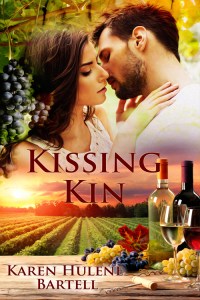
Maeve Jackson is starting over after a broken engagement—and mustering out of the Army. No job and no prospects, she spins out on black ice and totals her car.

When struggling vintner Luke Kaylor stops to help, they discover they’re distantly related. On a shoestring budget to convert his vineyard into a winery, he makes her a deal: prune grapevines in exchange for room and board.

But forgotten diaries and a haunted cabin kickstart a five-generational mystery with ancestors that have bones to pick. As carnal urges propel them into each other’s arms, they wonder: Is their attraction physical…or metaphysical?

The idea for Kissing Kin first came to me during 2020 because of the striking similarities between Covid and the Spanish Flu of 1918, but publishers convinced me no one wanted to read about pandemics. Time passed. 

Then I noticed a handmade cookbook my grandmother had constructed during the depression. It’s made of two cardboard flaps reinforced at the edges with duct tape and held together by two metal ring binders. That book inspired me. (I used some of its recipes in Kissing Kin, for instance, Simple Sponge Cake, Mother’s Soft Gingerbread, and…the treatment of chicken lice with nicotine-sulfate.)

The general tone of the cookbook, which was meant as a Christmas present during the 1930s, was chatty. It read more like a diary than a book of recipes, and it motivated me to begin writing Kissing Kin.

If wishes were fishes, Kissing Kin would be made into a movie. I realize that’s a longshot, but it never hurts to dream. On that note, Maeve, the female protagonist for my Kissing Kin dream cast would have to be Millie Bobby Brown because of her amazing acting range. With her talent, she could pull off being an M2 Bradley driver in Afghanistan and the unwitting spectator to specters. 

The male protagonist would have to be Timothée Chalamet. Not only is he a heartthrob, but he’s a versatile actor, whether the genre be drama, comedy, or action. I can see him as the struggling vintner, who makes Maeve a deal. On a shoestring budget to convert his vineyard into a winery, he offers her room and board in exchange for pruning grapevines.

And for your enjoyment, an excerpt:

Grandma’s bedtime stories echoed through my mind as I sped west on I-10. At an early age, family history had merged with myth until the name Fort Lincoln was as legendary as Avalon or Middle Earth.

But when the snow-covered peaks loomed closer, their reality was undeniable. Maybe her stories weren’t tall tales…

And what about her proverbs? “Idle hands are the devil’s workshop.” I winced. No job and no prospects. Mustering out after a five-year Army stint, I had to ask myself: What next? Where next?

Cody slipped into my thoughts, but I dismissed him, refusing to romanticize our breakup.

A troop of cavalry soldiers galloped toward me from the nineteenth century, but a second glance proved the images were metal cutouts–two-dimensional illusions that resembled an officer and guide leading two columns of cavalrymen.

The silhouettes evoked tales of my great-great-grandfather, Ben Williams. Beginning his military career as a scout, he’d been field promoted during combat, then commissioned as Second Lieutenant at Fort Lincoln.

I smiled, proud of our similar career paths. Maybe Grandma’s stories influenced me more than I realized.

Leaving the Interstate, I turned south. Road signs noted towns that sounded familiar from family stories but seemed as mythical as Camelot or Tintagel Castle.

Closer now, the mountains’ features came into view. No longer mere outlines on the horizon, each craggy palisade and butte towered over the highway. Fluffy hoarfrost transformed the landscape into an icy spectacle, with flaky, crystal shards overlaying each leaf and every blade of grass. A frozen fairyland! Just the way Grandma described it. Inspired by the raw beauty, I straightened my shoulders. Maybe I’m viewing my discharge the wrong way. Instead of adrift, maybe I’m free…

Kissing Kin can be purchased here: https://books2read.com/u/boXl10

Author of the Trans-Pecos, Sacred Emblem, Sacred Journey, and Sacred Messenger series, as well as Kissing Kin, Fox Tale, Wild Rose Pass, The Keys: Voice of the Turtle and more, Karen is a best-selling author, motivational keynote speaker, IT technical editor, wife, and all-around pilgrim of life. She writes multicultural, offbeat love stories steeped in the supernatural. Born to rolling-stone parents who moved annually, Bartell found her earliest playmates as fictional friends in books. Paperbacks became her portable pals. Ghost stories kept her up at night—reading feverishly. The paranormal was her passion. Novels offered an imaginative escape. An only child, she began writing her first novel at the age of nine, learning the joy of creating her own happy endings. Professor emeritus of the University of Texas at Austin, Karen resides in the Texas Piney Woods with her husband Peter and her mews—three rescued cats and a rescued *Cat*ahoula Leopard dog.98

Connect with Karen at her website: https://karenhulenebartell.com/