Interesting WWII Facts from the Warhawk Air Museum

Last week I traveled to Nampa, Idaho for my great-grandmother’s funeral. Whenever we have visited, I have always seen an advertisement for the Warhawk Air Museum. This time, I decided to finally go since I don’t know when/if I’ll go to Nampa again. As a history buff, I thought I’d share what stuck out to me in the museum.

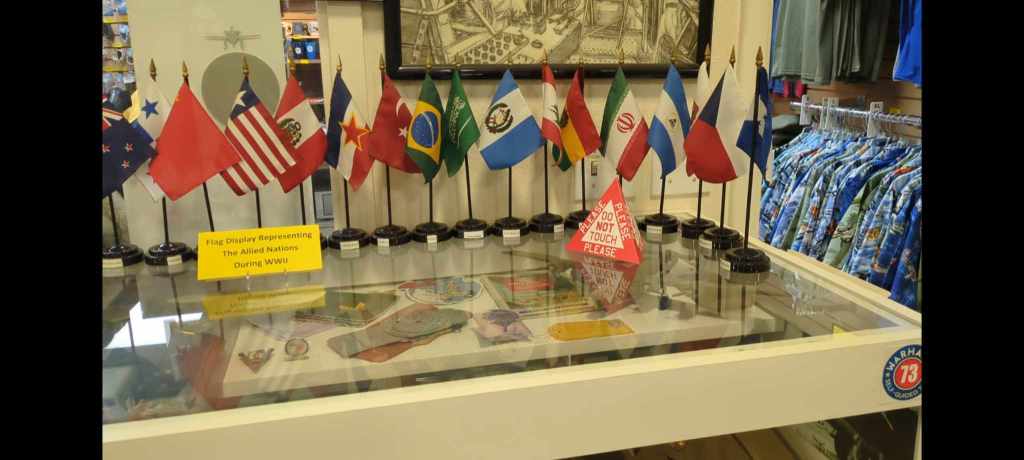
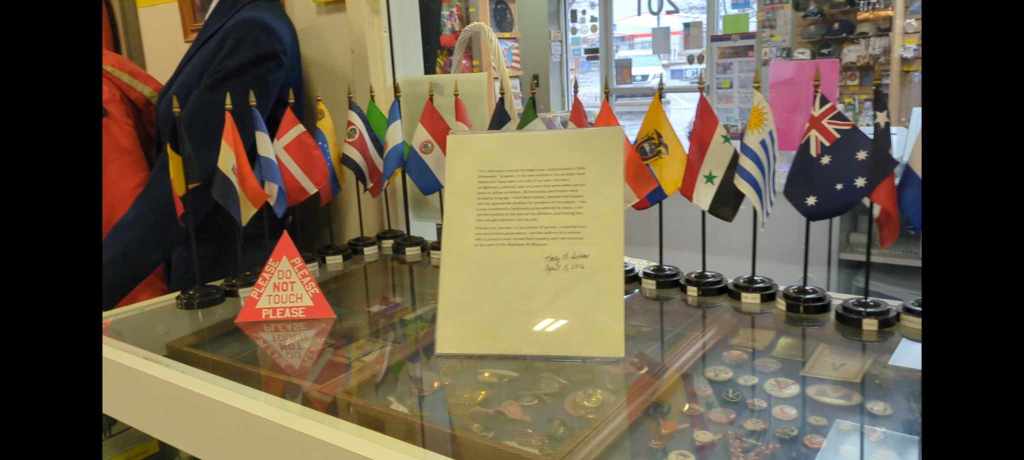
Who were the Allies?

In school, most history teachers focus on the U.S., Great Britain, France, and the Soviet Union fighting for the Allies. But in reality 47 countries allied together against the Axis powers.

War Propaganda

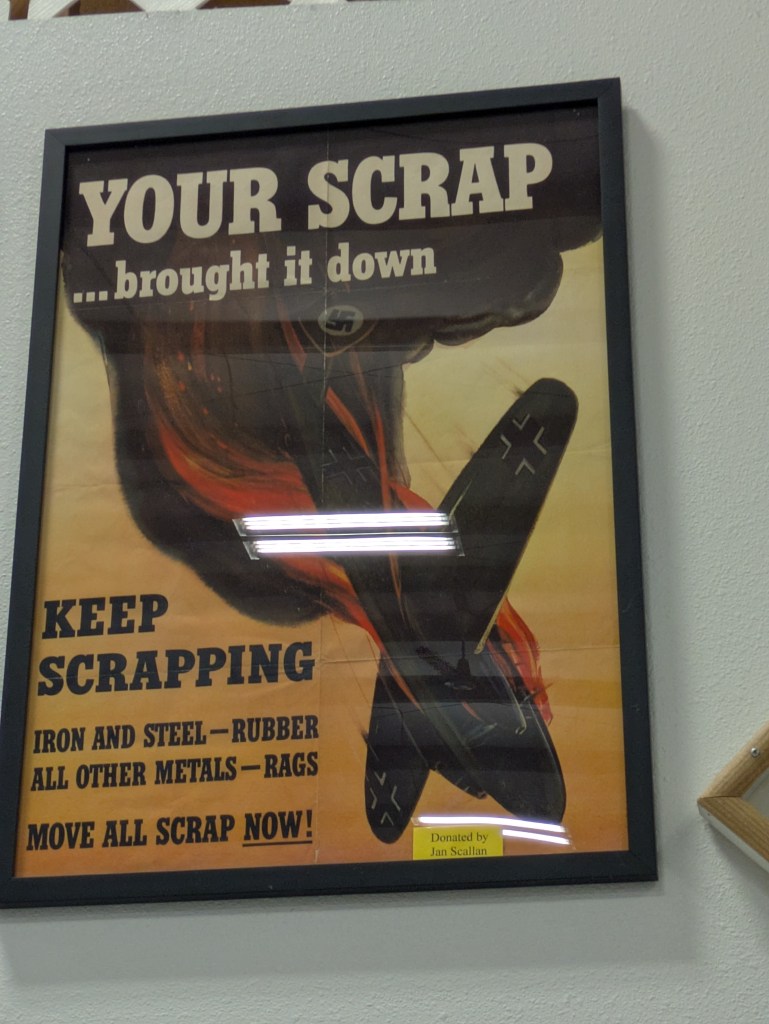
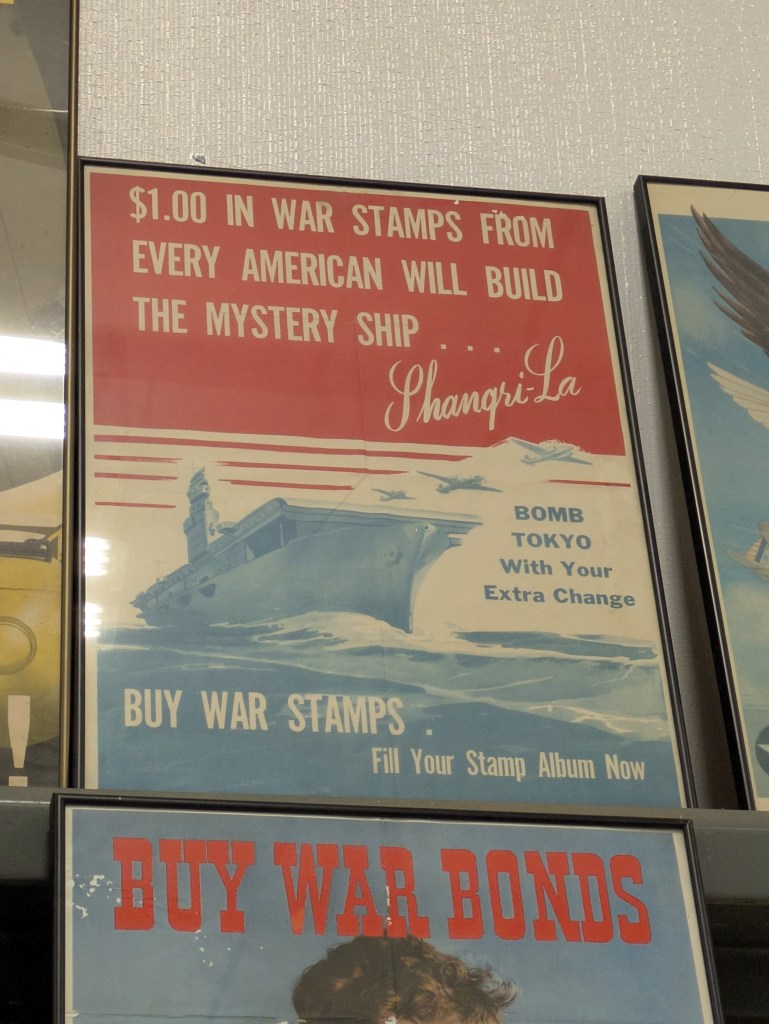
There was a plethora of war propaganda to encourage American citizens to help with the war effort. Most of the propaganda is about being frugal with food and resources and buying war bonds. War bonds were debt securities. Basically, you gave the U.S. money, and it would grow in interest. The government would pay you back in interest when the bond “reached maturity,” which was several years after the bond was purchased. This allowed the government to get more money for the war without raising taxes. Below are the posters that stuck out to me. 

“Spoils of War” decorations

Starting in WWI, using shell casings to create home decor became popular:

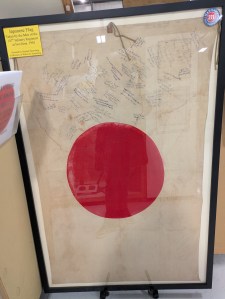
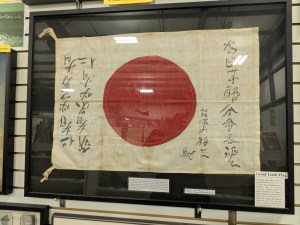
American soldiers were allowed to take and keep whatever they could carry home or pay to send home from conquered areas. Three examples in the museum were two Japanese Flags and a silk Japanese parachute.

The flag below had flown at Iwo Jima, and when U.S. forces won the island, they took the flag down and signed their names. Whoever ended up with the flag in their possession, donated it to the museum. 

The flag below was a personal flag for a Japanese soldier who had it blessed by a Buddhist priest and signed by his loved ones. It’s sobering to guess that the original owner died at the hands of an American soldier, and that’s how it ended up in a museum in the U.S.

The silk parachute was mailed home by an American soldier who ended up in Honshu, Japan. When he returned home and met his future wife, his mom used the silk parachute to make her daughter-in-law’s wedding dress. The info cards explained that his parachute hadn’t been used. It was found in a warehouse taken over by the U.S. military during the mainland invasions.

The News Doesn’t Always Get Their Facts Right

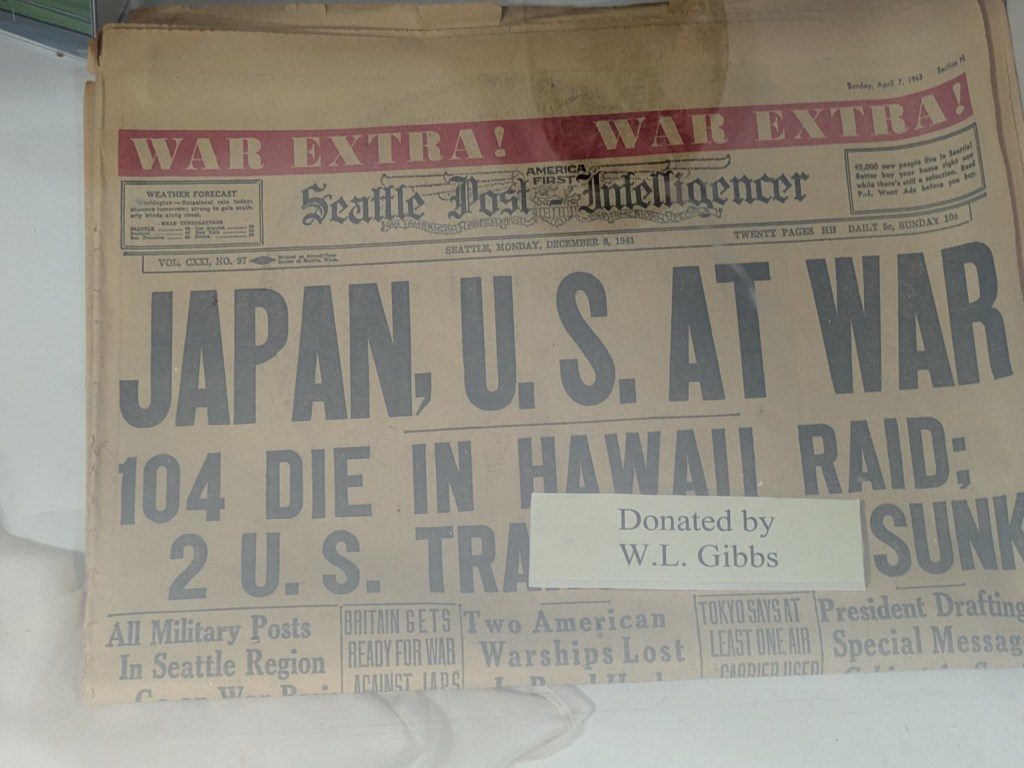
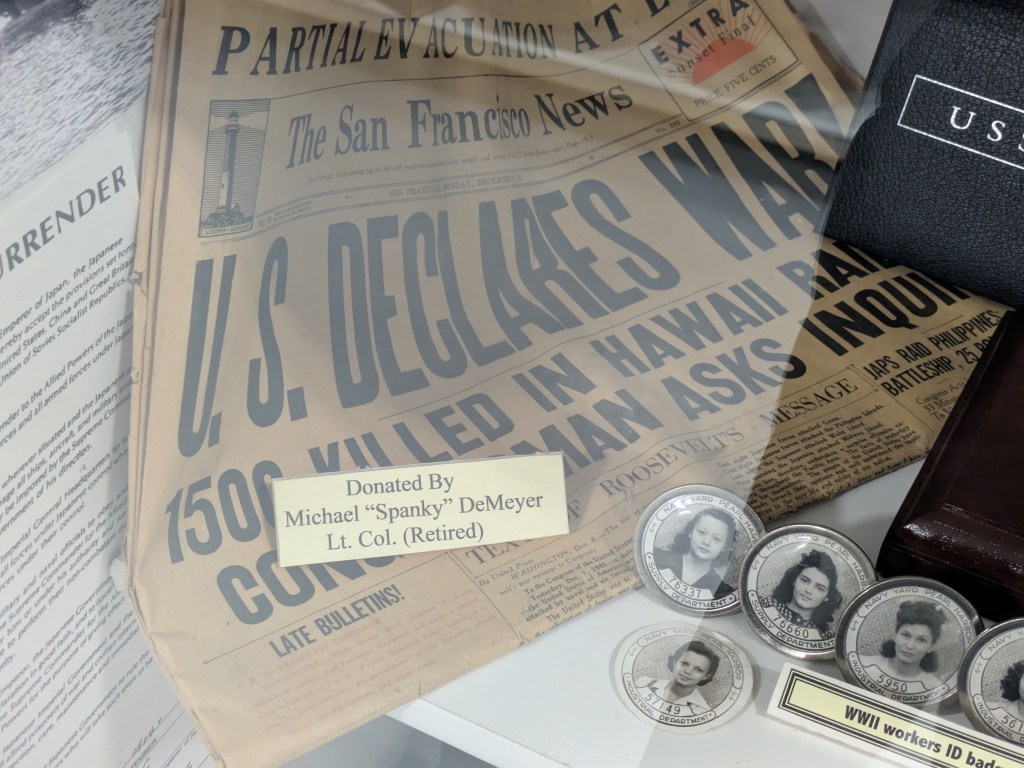
Below are two newspaper headlines announcing the attack on Pearl Harbor. The one from Seattle reported that 104 died while the paper from San Francisco reported 1500 died. Of course, getting fast and accurate information during that time wasn’t instant or easy. But it’s a good reminder to look at multiple sources when forming an opinion or making a decision.

Pieces of the Berlin Wall are scattered around the world

About ⅔ of the museum was dedicated to WWII, and the rest covered the other modern wars that the U.S. has been involved in. There was a small section dedicated to the Cold War, starting with pieces of the Berlin Wall. When I teach the Cold War, I show a newsclip showing Berlin residents hacking at the wall. I’ve watched that clip 8 times a school year, and it still makes me tear up.

Living on a battlefield was not glamorous

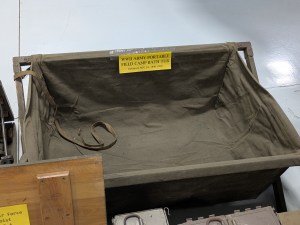
The picture below is a portable bathtub. I’m no good at guessing measurements, but one would definitely have to spend their bath with their knees bent into their chest, and the horizontal sides would only cover the waist and feet. 

WWI was originally called The Great War

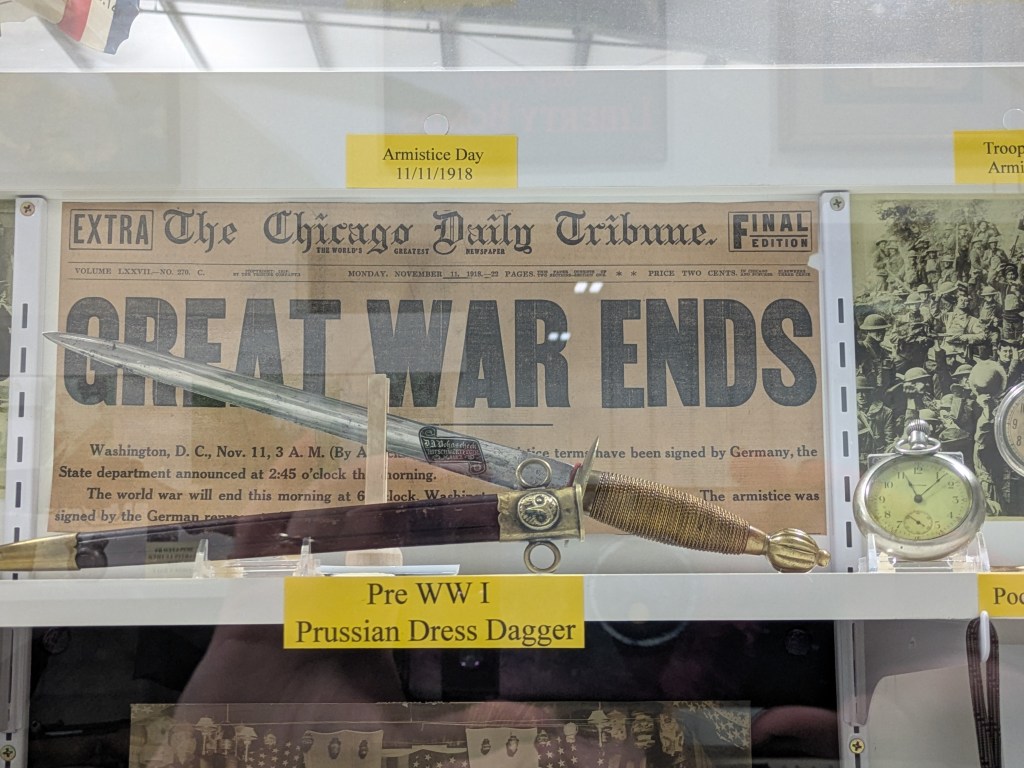
While I did know this before going to the museum, seeing the headline below was a great reminder. As a history teacher, we call The Great War by its new name because that’s its new name. While I do mention to my students that it was originally called The Great War, it’s not a fact I test them on. We focus on U.S. involvement and the changing technology from the first year of the war to the last year of the war. But it is good to know this if you’re going to study primary sources because this is the language that will be used during the time period.

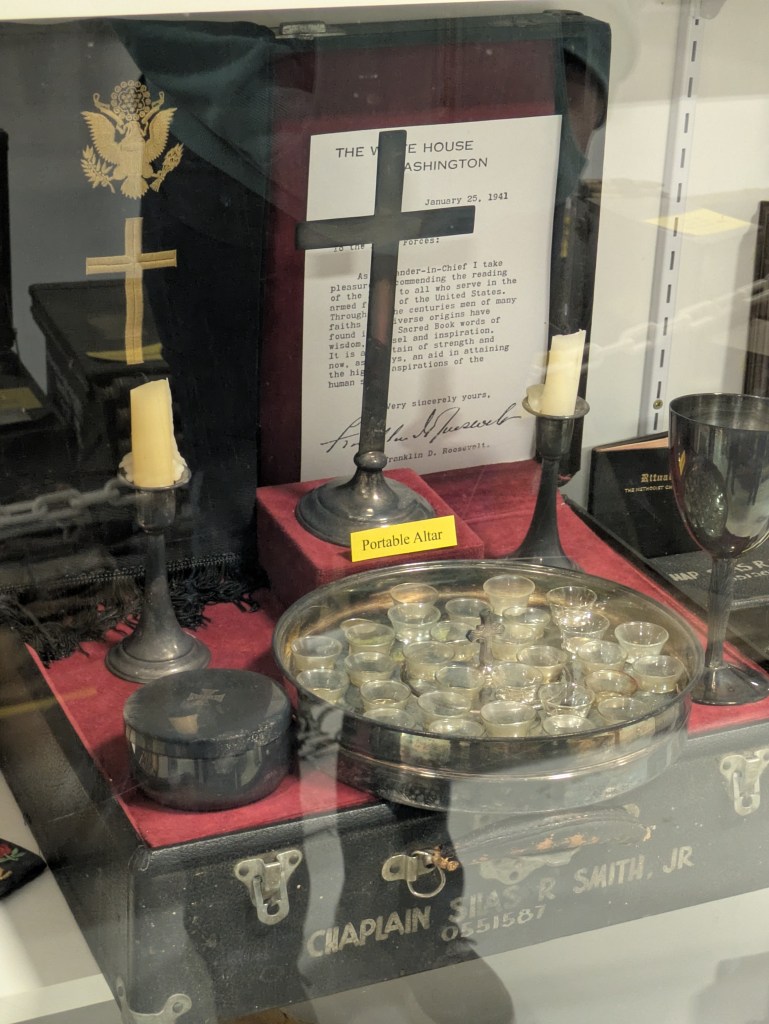
Soldiers have access to religious ceremonies while serving

I have a childhood friend who is now a military chaplain. And him choosing this career path is the only reason I know this position in the military exists, and thus I actually noticed these kits and took pictures of them to send to him. 

The Controversy of Vietnam

With each war that I teach my students, I ask the questions: Was entering this war justified? Did the U.S. stay true to their original goal? Did the U.S. fight fair? I keep my opinion out of the lesson. I am teaching my students to take the facts they’ve learned and form their own opinion in answering those questions and defending their opinion with evidence. We watch a short video about the Veterans Against the War gathering at the White House. But I’m going to add this banner to the lesson to show that just like civilians and politicians were divided about Vietnam, so too were the veterans sent there to fight.

The museum also has a section for the most recent occupation of Afghanistan. Overall, the feel of the museum is simply to educate. I didn’t get any pro or anti U.S./war vibes. It’s just simply “here’s what veterans have donated and this is what this donation teaches us.” I really enjoyed my visit.

What is an interesting fact about any war that you know? Share it in the comments! 
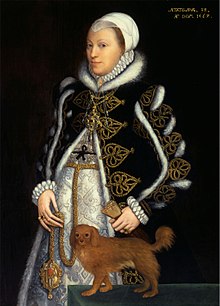
Meet Elizabeth Packard: Women’s Rights Activist

Elizabeth Wells Packard is not on the list of “25 of the Most Influential Women in American History” She’s not on the list of 41 women, 50, or even 125 women. But her name needs to be known. And you need to know what she did for you, your mothers, your wives, your sisters, and your daughters.

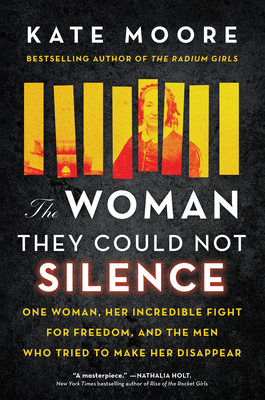
On a recent trip to Barnes & Noble, this title caught my eye:

After reading the blurb, I didn’t hesitate to purchase this gem of a biography. Kate Moore weaves an emotional and beautiful narrative of Elizabeth Packard’s strenuous life during the 1860s. A woman whose only crime was to have a different religious and political opinion from her husband. Such absurdity at the time was medically considered insane, imprisoning Elizabeth behind the walls of the Jacksonville Asylum. Elizabeth spent several years trying to get out, and once she was out, she was not done fighting. Her next goal was to get the laws changed that put her there. Ms. Moore writes in the style of narrative nonfiction, giving us the facts in the form of a story. My blood boiled for the majority of the book, but Elizabeth’s triumph made the emotional rollercoaster worth it.

So, let’s meet Elizabeth Wells Packard. (Note: Everything written below comes from what I learned in Kate Moore’s book. All credit for deeper research goes to her.)

Elizabeth married a man fourteen years her senior – which wasn’t a cause for raised eyebrows at the time, but certainly led to her husband’s erroneous belief that he could spend his marriage days controlling her. 

Theophilus Packard was a preacher, which allowed Elizabeth a religious education. Shouldn’t the preacher’s wife know the Bible? In her studies, Elizabeth went beyond her husband’s teachings and explored other philosophies (this is at the tail end of the Second Great Awakening, afterall). Elizabeth thought it would be okay to share her new thoughts in her Bible Studies class. What Elizabeth didn’t know was Theophilus was receiving pressure from his financial backers to preach certain agendas in the wake of the looming Civil War. (Isn’t communication in marriage a beautiful thing?) Those agendas were the exact opposite of Elizabet’s new beliefs.

As tensions in their home rose, Elizabeth left her husband’s church, and began attending a church across town. This was the final straw for Theophilus. He locked Elizabeth in the nursery, and got two doctors to sign a certificate stating that Elizabeth was insane. On the day he planned to move her, he sent their 6 children on different errands and to different babysitters so they would not see their mother cartered off, and so the older ones could not come to her defense. He then brought in several trusted minions to manhandle Elizabeth out of her home, to the train station, and onto the train. Elizabeth was smart. She knew if she fought, then the unintelligent society she lived in would believe her insane. So she remained calm, stoic, and gave her kidnappers her dead weight as they carried her through the town. 

Theophilus accompanied Elizabeth to the Jacksonville Asylum in Illinois, and after dropping her off, would not see her again for quite some time. Theophilius placed her in the hands of the resident doctor, Andrew McFarland.

Dr. McFarland was smarter than Theophilus. After meeting with Elizabeth, he led her to believe that he did not think her insane, and that she would be out in a few months. During those few months, Dr. McFarland met with Elizabeth every day, letting her talk herself into a deeper hole (unbeknownst to her). 

According to Dr. McFarland, Elizabeth was not insane due to her religious beliefs. She was insane because she hated her husband. A sane woman would obey her husband. A sane woman would love her husband. A sane woman would forgive her husband for putting her in an asylum and agree to obey him in order to be released from the asylum. Elizabeth would do no such thing, so she remained there for about three years. 

During her time there, Dr. McFarland tried to break her by preventing her letters being delivered (both written to and by her), taking away her nice clothes, books, and writing supplies, and eventually moving her to the worst part of the hospital for women: 8th Ward. While in 8th Ward, Elizabeth experienced emotional abuse from the staff, and physical abuse from specific patients (these were the only patients that Elizabeth truly believed were insane). She also witnessed horrible physical abuse given to the other patients. 

Elizabeth was really good at making friends. And so, over time she was able to convince staff members to sneak her reading and writing materials into her new room. And during this time she wrote two full length books. One was all about the sins of Dr. McFarland, the other about the problems of her modern-day mental health system, religion, and women’s rights.

Elizabeth requested a meeting with the Board of Trustees, and was surprisingly granted a presentation with them. Dr. McFarland came, and so did Theophilus. But just like with the other patients and staff, Elizabeth won the Board over, and they commanded Dr. McFarland to release her within the next few months. Her release date came and went, but Elizabeth continued to write and pester Dr. McFarland. 

Eventually, Dr. McFarland admitted she was more bothersome inside the Jacksonville Asylum than he could handle, and he released her. Theophilus dropped her off with her cousin and forbade her from visiting him and their children. Elizabeth planned to do no such thing, and took out a loan from her friends to take a train to her hometown. She walked right into her old house, and it was a giant mess. Her only daughter was forced to become a homemaker at 11 years old, and is now a traumatized 14 year old. Theophilus had brainwashed their children against her, and they would only obey their father. Elizabeth became an invisible nuisance in her own home. 

Theophilus locked her in the nursery again, and she discovered he’s preparing her a place in another asylum, this time, for life. If she enters those doors, she isn’t coming out until she is dead. Her friends got the legal help that was denied her three years prior, and her sanity was officially on trial in the county court. 

This is one of the most amazing court cases I’ve ever read. And I can’t do it justice. Just read the book. In the end, Elizabeth won. She won against all those men who wanted to lock her away for life. BUT she is only free in the state of Illinois, and Theophilus still has legal control over their children. Ever the sore loser, Theophilus took off with their children and moved to Massachusetts. 

Elizabeth would then spend the next several years lobbying state government after state government to get the laws changed across the country. After another showdown with Dr. McFarland, she was successful. And because of Elizabeth Packard, women cannot be placed in asylums just because their husbands wish it. Because of Elizabeth Packard, women received a huge step in progress to their legal rights over their mental health and personal property. Because of Elizabeth Packard, the treatment of mental health patients started the process of improving. 

Elizabeth would get reunited with her children, and begrudgingly, her husband. They never divorced, but they also remained in separate dwellings for the rest of their lives. They stayed cordial in order to both have access to their children. The two books Elizabeth wrote while imprisoned got published and she lived off the sales of those popular volumes and the charity of her adult children. She is an amazing example of determination, passion, and perseverance.

Have you read about Elizabeth Packard before? What are your thoughts on her accomplishments? What other biographies would you recommend? Let me know in the comments!   

Historical Fiction: How Much Fiction is Okay?

I recently enjoyed following a discussion among historical fiction authors about accuracy and research. Probably my favorite thing I learned is that the food the ton eats in regency novels is often inaccurate to real life. I learned that bacon and eggs was a lower-class breakfast, and chocolate wasn’t a commonly accepted dessert yet. And when authors make such errors, readers who are educated in the time period they love are going to get upset. 

To be honest, learning that didn’t turn me off to any of the regency novels or authors I’ve read that have been inaccurate. As a high school history teacher, I don’t teach what type of food a specific socioeconomic class ate in a specific time period. I teach the impact people, events, and movements had on society and progress. And so it is those details that I’m hyper aware of when I read historical fiction. And yet, other people clearly do care about the minute details, which is completely valid. So, how does an author decide how much fiction to put into historical fiction?

Let’s use my favorite historical fiction author, Philippa Gregory, as an example. Readers either love her or hate her. I am in the camp that loves her. She makes a lot of risky moves with her historical accuracy, but I don’t always agree with all of them even though I love reading her books. Let’s take a look at The Other Boleyn Girl as our main example. (Mainly because I know both the book and historical facts very well.)

In several interviews, Ms. Gregory has stated that when she writes a royal court story, she has a timeline up on her wall that shows the movement of the court, so that she can put the characters in the right geographical location in the right month/season. From there, depending on who you talk to, things can get murky. 

In The Other Boleyn Girl the 4 main deviants from other accepted sources are:

  1. The birth order of the Boleyn children
  2. The publicly known father(s) of Mary Carey’s children
  3. Mary’s role in the court after her second marriage 
  4. George Boleyn’s sexuality 

The birth order of the Boleyn children

Every historical source I have ever read puts Mary Boleyn as the oldest, Anne Boleyn as the middle child, and George Boleyn as the youngest. Philippa Gregory switches the characters around completely: George, Anne, Mary. I do understand why (I think) she did it. The relationship she created for the two sisters – Anne as a bossy bully and Mary as passively compliant (which she grows out of over twenty years) – works better for Anne being “the mean older sister”. Despite me understanding what is most likely her reasoning for doing this, it still bothers me.

Who fathered Mary’s children?

When Mary Boleyn became Henry VIII’s mistress, she was married to William Carey. She became pregnant during that time, and the court believed – as well as historians – that the king was the father of Mary’s oldest child, Catherine Carey. Surviving portraits of the oldest Carey child do hold similarities to other known Tudor children (according to those with the eye to see such details). According to historical sources, Henry had set Mary aside well before she became pregnant with her second child, Henry Carey. Historically, there was no doubt in anyone’s mind that William Carey was the only possible father to baby Henry. Philippa Gregory, however, made the decision to keep Mary as the king’s mistress longer than is accurate, and to make the father of her second child Henry VIII. Once again, there is a method to her madness. Later on, Anne adopts Henry so that she would be the “mother” of a biological son of the king, so he would be more inclined to marry her. But once again, the inaccuracy doesn’t sit well with me. The rest of the plot can continue as normal without this change.

Mary’s role in court

After Henry VIII set Mary aside, she’s a background character in the main historical record. We know she gave birth to a boy named Henry, and her first husband, William Carey died during one of the sweat summers (a type of plague disease that killed thousands of people every year). At some point after Princess Elizabeth was born, and during Anne’s unsuccessful pregnancies, Mary married a man well below her station, William Stafford. She kept her marriage a secret until her third pregnancy became too noticeable to hide (or perhaps, they married because she became pregnant). Queen Anne banished her own sister from court, and Mary’s remaining family followed their queen and shunned her. Mary moved to Calais, and that’s where they were living when Anne was beheaded for false accusations of adultery. 

In The Other Boleyn Girl, Philippa Gregory condenses Mary’s banishment to less than twelve months, and she’s back at court as the queen’s sister. How does Ms. Gregory justify this very obvious discrepancy? An actual primary source states that during Anne’s last miscarriage, she let no one in her chambers besides her mother and her sister. Now, this sister could have been Jane Parker, George’s wife. But it was also well known that Jane and Anne didn’t like each other. In fact, Jane and George didn’t like each other. But still, how can Mary be at court if the historical record puts her in Calais? Or was it a misunderstanding on who was actually in the room? (Especially since this is a time where false accusations of adultery were being prepared.) Either way, Philippa Gregory has one source to validate her decision to keep Mary at court for the story. 

And this is actually how she does it in all of her books. As long as one source records a guess, rumor, etc.; she can put it in her book and says that she is exploring what the story would look like if that source were true. Which, I think, is fine. Provided she justify it in her Q&A section she puts at the end of each book. And she does, most of the time.

George’s Sexuality

A major side plot in The Other Boleyn Girl is George Boleyn falling in love with Francis Weston, and embarking on a love affair with him. Once again, Philippa Gregory uses an obscure source that claims George’s pre-execution speech included an apology for sodomy. This claim can’t be combatted the way that the others were. Historians can’t discover the thoughts and feelings of long dead people. So, if a historical fiction author wants to make someone gay, they can do so. 

Any other Philippa Gregory book is going to have similar changes. She uses the lack of perfect records to fill in the blanks with her own imaginings. She uses the very real beliefs of the time in witches to include spells, curses, and fortune telling. And she finds obscure (but real) claims to further dramatize an already dramatic era. 

But even though she does her homework to justify the changes she makes, the real question is: Do you readers support these changes? Enough that she is still writing and selling books, and Starz is slowly turning her more popular books into mini-series. But the naysayers are still quite loud. 

So, at the end of the day, if you’re going to write historical fiction, just know that any changes you make will be noticed by some while unnoticed or ignored by others. It’s still your choice to make, but it will affect your readership. As for me, I’m going to continue to read regency romances regardless of what the upper class eats; and I’m going to continue to enjoy Tudor era stories – though I will grumble internally when things are too wrong for my taste. 

What’s your favorite time period for historical fiction? Let me know in the comments!

My Grandparents’ WWII Love Story by Lee Ann Sontheimer Murphy

She was a widow with four children, ages sixteen to three, struggling to make ends meet after losing her husband in 1943. Edna Neely had grown up in a fine house, with a fur coat, and her own car at 16 but her world crashed when the stock market did. Everything was liquidated to pay her father’s debts when the banks failed. 

He was a farmer, older than the average soldier, and the “kids” serving in his unit called him Pop. Until he joined the Army, because he didn’t wait to be drafted, Claude Roberts lived near the small farming community of Fillmore, Missouri. Fillmore has fat farmland; fertile fields raise some of the state’s finest corn and soybeans. Surrounding farms produce cattle and hogs for the livestock market. In my grandfather’s day, nearby St. Joseph, MO still ranked as the third largest packing site in the nation.  He came from a large family but my grandmother was an only child.

After she married, my grandmother found a lifelong best friend in neighbor Margie Violett. The two young woman both had young children at home. They bonded over recipes, shared neighborhood gossip, and the age-old effort to understand the men they married.

After my grandmother was widowed, she joined the war effort. She volunteered her time at a local USO canteen and even though she hadn’t planned to find another husband, she was soon dating young men stationed at Rosecrans Field, an Army Air Corps based nearby. More than one proposed marriage but she declined, satisfied with her children and life.

Several of her cousins were away serving in the war and she wrote letters to each of them. When Margie suggested she add her Uncle Claude to her pen pal list, she did. Edna and Claude wrote numerous letters. She detailed her everyday life on the home front and he shared what he could of Army life in the Pacific Theater of war.

Despite the differences in location and background — she was raised in the shadow of the Missouri Capitol in Jefferson City, Missouri and he came from an Andrew County farm – they found common interests. My great-grandmother, Edna’s mother, also hailed from the Fillmore area. They poured out their hearts about music, life, and fell in love by letter.

When V-J Day came, the war ended and Claude would be coming home. They wrote about meeting in person but my grandmother never expected it to play out the way it did.

She woke up one winter morning to find a man, rolled up in his overcoat against the cold, on the porch asleep. It turned out to be Claude. When he’d gotten as far as St. Joe, he headed for the address he knew from the letters but since it was late at night, he decided to wait until morning. By the time my grandmother opened the door, he was nearly frozen.

Grandma invited him in, served him breakfast, and fell the rest of the way in love. They married a few months later and he became one of the best grandpas a child could have.

That’ s a real life love story. I write romance, from sweet to heat but I often draw on actual inspiration from my long relationship with my late husband or other family tales.

You can find my books on Amazon and elsewhere. https://www.amazon.com/stores/Lee-Ann-Sontheimer-Murphy/author/B004JPBM6I

And you can read my ramblings and writings on my blog here: https://leeannsontheimer.blogspot.com/

Real Life Romance: Of Love and War by Annie R. McEwen

May 16, 1938

Dear Albert,

The joke is on you this time. I bet a friend that you would never write to me twice in succession. As it happens, you did!

That was the start of a letter from Jean Morlach to Albert Patrick, my parents. Jean, known then as Gina Morlacci, had emigrated from Italy to the U.S. with her parents in 1921. Albert, whose family was already established in America, helped the Italians as they struggled to set down roots in Pennsylvania. Albert, born in 1915, and Gina/Jean, born in 1912, became best friends before they even had a common language. 

You see, it was my turn but I was so darned busy with my hobby show that I neglected to write. You wrote again, thinking it was your turn. I’m so glad you did. 

When Jean and Albert got engaged in 1939, it surprised absolutely no one except Jean’s parents. Still struggling to make a success of their Italian grocery, they’d expected that Jean, their oldest child, would stay at home to help. Jean and Albert had other ideas. Jean was so worried about her parents’ reaction that she wrote Albert about it. She was considering abandoning her devout Catholicism so her marriage to Albert could take place quietly and fast. 

You know, I’ve been thinking (I do it sometimes) that perhaps we’d better marry in a Protestant church. I don’t mind.

Albert, who’d divided his growing up years between Florida and Pennsylvania, got an apartment in Tampa and set about furnishing it for his bride. Jean industriously, but on the sly, added to her stock of soft goods. Knowing nothing of the Florida climate, she worried about heating. 

Are you getting gas in the house, or are you getting an oil stove? I just was wondering about it. 

Last night, I embroidered for a while and made napkins. I have four sets, now. 

When she wasn’t making linens, working at her new job as a grade school teacher, or slaving at her parents’ grocery, Jean longed for Albert.

It seems ages since I saw you last. You seem so very far away—almost unreal. There are ever so many things I’d like to talk over with you, but I guess they will keep. Only, I do miss you so very, very much. 

In 1940, while World War Two loomed and Albert was sure he’d be drafted, Jean and Albert married, not in a Protestant church but in the vestry of a Catholic one. Jean’s parents were as angry as she’d feared. She fled with Albert to Florida, leaving her trousseau—all those embroidered linens—behind. The newlyweds had just enough time together in Florida to conceive their first child when Albert was drafted. He went off to train with the U.S. Air Force. The young airman was shocked by the unreadiness for War he saw in his first posting to Atlanta. He wrote Jean about it.

I don’t think these people realize a war is going on, so much waste and complaining. Several plants and a dairy are on strike, 325 fellows here just sentenced for draft evasion. There was an air raid drill the other day and officials complaining about poor cooperation from people. 

War and loosening social mores were producing changes in American society, and not everyone was comfortable with them. Albert was appalled by local women. Or maybe his letter was an attempt to reassure his lonely bride back home that his eyes weren’t wandering.

The girls up here are awful. Their skirts are 3 to 4 inches above the knee and they smoke more cigarettes than men. More imitation blondes than I ever saw in my life. I’m not laying it on thick, it is the truth with no exaggeration. 

Jean had her own complaints, mostly about her rowdy students. She’d gotten a job in a rural community outside Tampa, teaching eight grades in a one-room schoolhouse.

I’m just a bunch of nerves. You know it’s difficult to keep smiling all day in front of the students when I feel like throwing some of them out on their heads.

As difficult as those war years were, Jean and Albert were sustained by their love letters. Jean’s always closed like this one. 

All my love to you alone. 

Jean

Jean and Albert were married sixty-two years. After Albert’s death, Jean lived another nine years, but she was never truly happy. Her last utterance before her own passing was Albert’s name.

As Albert’s ended like this, from 1941.

I love you, sweetheart.

Your husband

Annie R McEwen is an award-winning author of historical romance, paranormal romance, and romantic suspense. Her Bound Trilogy from Harbor Lane Books launches on May 7, 2024 with Bound Across Time, a love story that transcends death itself. Annie also has upcoming titles from Bloodhound Books (UK) and The Wild Rose Press. For release dates, giveaways, Annie’s quirky blog, and more, go to www.anniermcewen. Be sure to Subscribe for her fun newsletter and a free Regency Romance story. While you’re at it, visit Annie on Instagram: https://www.instagram.com/anniermcewen/ and Facebook: https://facebook.com/Quillist/ 

My Favorite Christmas Decoration is the Nativity Scene

I would be remiss if I didn’t get at least one Christmas post up this holiday season. Life is super crazy right now between my day job, my kids’ extra curricular activities, and other duties. And with 2 days until Christmas, I really want to take a break from all of that and write. So I’m going to take the time to write about my favorite Christmas decoration: Nativity Scenes. 

Nativity Scenes show the core of the Christmas season for those who are religious: the birth of Jesus Christ. According to the Smithsonian Magazine, the first Nativity scene was displayed in 1223 in Italy. St. Francis of Assisi set up a manger with hay, an ox, and a donkey in a cave and invited people to come and view the display. During the viewing, he preached about the birth of Christ. From there, Nativities spread, eventually including live performers as Mary, Joseph, shepherds, angels, and the wise men. My own family has the young children perform the Nativity each year. 

Growing up, my mom had a frosted glass nativity set that sat in the center of the dining table every Christmas season. I thought it was so beautiful. It was my favorite decoration. I positioned it so the figurines faced me where I sat to eat. And as I studied those glass followers of Christ, I began to plan and dream. 

I have envisioned and designed the perfect Halloween House and perfect Christmas House since I was a preteen. Now that I have been in my own home for four years, both are slowly coming to fruition. 

The inside of my home will be covered in Nativity Scenes. All available space will one day sport a nativity scene, and no number is too many (though my husband may disagree with that second statement, but he just sighs and lets it happen). I currently have 21 and counting! 

I enjoy a diverse style and size. I have “traditional” sets, themed sets (i.e. snowmen), large sets, and small sets. Each one makes me smile as I unbox them, and throughout the month look at them. 

What’s your favorite Christmas (or other winter holiday) decoration? Let me know in the comments! And have a wonderful holiday season.
Follow Your Man by Helen C. Johannes

1947 Germany…

WWII has been over for nearly two years, but the Occupation is ongoing. Americans hold Bavaria and the small city southwest of Munich where my mother lives. She’s 26, still living with her parents. She’s lost a brother in the submarine corps. Her sister’s husband was shot down on the Russian front, but he somehow made it home. Rationing and curfews are the stuff of their daily life. She works the late shift as a nurse’s aide. She and her coworkers must be escorted home by the US Military Police.

Drafted at his high school graduation on VE day, my father is barely 20, one of the lucky ones posted to Occupation Europe. It’s cold, damp, and the rations are nothing to write home about, but he grew up in the Northwoods without indoor plumbing or electricity, and he worked his way through high school milking cows. Life in the Army is pretty good for a smart kid who doesn’t drink or smoke. He’s already a sergeant in the MPs. 

One night he and his partner escort local nurses’ aides home after curfew. They pick them up in their jeep and drive the women home through darkened cobblestone streets. One of the women, a pretty brunette with long, wavy hair smiles at him. He remembers that smile. She only speaks German, but he can fix that. The army offers courses in German. Soon, he’s teaching her English with comic books while he practices his German.

By 1948 he and his buddies all have German girlfriends, and some couples want to marry. Regulations say anyone who marries a foreign national must return stateside with the spouse within a month of the wedding. Decision time. Will my mother leave everyone she loves, the city she grew up in, her entire culture to follow this American soldier to a country that defeated hers? Will she step into the unknown with only the man she loves to keep her company? Will the new world be better than the current one?

It’s a life-changing choice, but she makes it. In a whirlwind they have three weddings over two weekends: one to satisfy the German government, one to satisfy the American government, and one to satisfy the church. Then they’re on a train to Bremerhaven for her first ocean crossing. As she stands on deck, she says goodbye to her homeland, her continent, wondering if she’ll ever return, if she’ll ever see her family again.

She’s followed her man to New Jersey, then to his home in the Northwoods while he serves in Korea, then to Illinois when he returns. On to Ft. Lewis, Washington, traveling across this vast nation by car in 1956, then back six months later all the way to the port of NYC for a much-desired return tour of duty in Germany for three years to spend reconnecting with family. Then to West Texas for three years, then back to Illinois, then on to the Northwoods when he retires. Now she has a new role, wife of a teacher. Later, when he retires from that, she’s the wife of an alderman.

Seventy-two years she’s followed her man, become a citizen, adapted to a new culture, worked and played and made friends, raised a family. Together, she and my father have created a legacy of love, hard work, and adventure for those of us that follow. When love calls, they’ve shown us, take a chance.

After growing up following these parents around this country and Europe, I couldn’t help but take their example to heart. I’ve followed my man in government service from Montana to the Midwest, and we’ve traveled together to three continents and dozens of countries. Everywhere I’ve lived or visited has informed my writing, and the love I’ve seen and shared inspires my work. My author tagline is “Hearts in Search of Home” because I’ve learned that home is wherever those you love choose to make it: https://helencjohannes.blogspot.com/

In celebration of the Month of Love, I’ve put my first book on sale on Amazon Kindle for 99 cents. An enemies-to-lovers fantasy romance, THE PRINCE OF VAL-FEYRIDGE, Crown of Tolem Series #1, is loosely inspired by that sense of adventure and willingness to take a chance my parents imparted to me.

She’s all wrong for Prince Arn, this lowborn healer who keeps meddling in his march to conquer her homeland. If only she hadn’t helped him, and he hadn’t kissed her, he could stop looking for her everywhere, hoping to find her…again.

Check it out here: https://www.amazon.com/Prince-Val-Feyridge-Helen-c-Johannes-ebook/dp/B003JH8CO2?ref_=ast_author_dp