The adult version of Sleeping Beauty involves sensual dreams with a sexy, but faceless hunk; who also happens to be a beast – at least, that’s how others view him.
In Bloodstone by Helen C. Johannes, the heroine Mirianna has a dream lover who makes the men in her village pale in comparison. So Mirianna has saved herself for this dream man, constantly searching for him during the day.
Durren has been cursed for fifteen years. No one can look upon his face without dying. So he completely covers himself in black clothing from head to foot, earning the feared nickname of the Shadow Man. He also dreams of a beauty who shudders under his touch for reasons other than fear.
“And I know it’s true
That visions are seldom
As they seem.
But if I know you
I know what you’ll do.
You’ll love me at once
The way you did
Once upon a dream.”
Except that’s not what happens when Mirianna and Durren finally meet in person. Durren is in possession of the legendary bloodstones (gems made from dragon blood), and Mirianna’s father needs them to make jewelry for a client. Mirianna fears the Shadow Man and feels manipulated by him when she learns her dream lover is the legendary beast of the land. And Durren feels unworthy of Mirianna’s affections. But he gives in to his urges, and uses the threat of the real beast, Krad, to take Mirianna home with him. If she agrees to live with him, he’ll save the rest of her traveling party from the Krad.
“Tale as old as time
True as it can be
Barely even friends
Then somebody bends
Unexpectedly
Just a little change
Small to say the least
Both a little scared
Neither one prepared
Beauty and the beast.”
Mirianna and Durren will navigate treachery, past mistakes, and life threatening plots with the help of a lioness and a blind boy. Amongst the danger and drama, they will be given the opportunity to fall in love and save the world.
I’m excited to introduce you to Helen C. Johannes, who has agreed to an interview. Helen is the author of three fantastic high fantasy romances: The Prince of Val-Feyridge, The Lord or Druemarwin, and Bloodstone. And a mid-grade fantasy Frederick Fly-Catcher. Helen lives in the Midwest with her husband and grown children.
How did you come up with bloodstones? Are they based on any existing jewel or gemstone?
They are loosely based on the Apache tear and obsidian. The Apache tear is darkly translucent, and obsidian is such a deep, glossy black, like clotted blood. I wanted something that would both be petrified hard and yet capable of radiating light when struck by the sun.
How I came up with the idea goes back to my father’s expeditions to Alaska to dredge for gold, and the stories he told about finding garnets among the gold flecks while panning. That’s the inspiration for the Shadow Man panning the stream in the early chapters and encountering the she-lion. My father and his friends, fortunately, never encountered anything larger than Alaskan ground squirrels.
I really admire your worldbuilding creativity in not just Bloodstone, but The Prince of Val-Feyridge and The Lord of Drumarwin.How do you come up with these lands, histories, cultures, and names? How much time does it take to create such extensive worlds?
This is challenging to answer since I’m very much an “into the mist” writer, and I create what I need when I need it, seemingly out of the stuff of my imagination. However, I’ve been fortunate to have traveled widely in Europe and the UK and to have studied medieval history before I concentrated on German and English language and literature. That connection to very old places and the treasure trove of myths, legends, and fairy tales, along with a love of tramping through castles, has given me a pretty solid grounding. You’ll probably recognize some Germanic as well as Old English in my names of people and places. And I must not forget mentioning how much The Lord of the Rings affected me when I read the books as a high school senior.
As far as names, some come almost instantly along with the full character (Rees and Pumble), some require refining or changing entirely (Syryk, Brandelmore), and some take half the book to decide what they want to be called (I’m looking at you, Shadow Man).
Were the connections to beloved fairy tales deliberate?
Having a big, illustrated collection of fairy tales as my first remembered childhood book probably is the reason fairy tales resonate with me. That and growing up on Disney’s animated versions of those tales. I don’t know that the connection is always deliberate so much as that the tales are archetypal stories embedded in our culture.
Bloodstone at its heart is a Beauty-and-the-Beast-type story, and I had that in mind from the beginning, but for The Prince of Val-Feyridge and Lord of Druemarwin, the Cinderella and Princess and the Pea connections arose organically from the characters and their journeys.
What are you currently working on? Do readers get to return to any previous worlds? Or are you bringing us someplace new?
I’ve just published my second children’s book, The Dis’Aster Family’s Halloween, a picture book based on characters my children created. My first children’s book is Frederick Fly-Catcher, a middle grade fantasy chapter book. Currently, I’m working on a throwback 1960’s YA romantic suspense/gothic (there’s something freeing about a setting that’s pre-computers and cell phones). And I’m mulling a return to a novella in the Crown of Tolem world. I gave myself plenty of characters to work with there.
Helen C. Johannes is one of my favorite fantasy authors. She has such an amazing imagination when it comes to world building, and a talent with words to show the reader that magical world. The clear connections between beloved fairy tales made the foreshadowing and guessing that much more fun. If you like your high fantasy intertwined with romance, then Bloodstone is for you.
When a book is close to its release date, the author usually offers ARCs (Advance Reader Copy). Readers get a FREE copy with the hope that they will provide an early review. I’m so excited and honored to have read Stone Heart by Kitty Shields early.
Stone Heart combines my two loves: history and magic. I actually haven’t read a lot of fantasy stories that take place in the past, and I found I really enjoyed such a combination.
Our hero, Edward, the Marquess of Winchester has struggled for the past decade. His father died in the colonist rebellion (a.k.a. The American Revolution), thrusting the noble mantle on him much earlier than anticipated. He thought he found love with his best friend’s cousin, Phoebe, but knowledge of her past causes him to end things. The story opens with Edward attending the opening night of a new opera, accompanied by his mother and a new young woman his mother wants him to court. The lead singer dies on stage in front of the entire audience.
Edward gets wrapped up in the investigation and learns that Phoebe is in danger of dying in a similar way. Although he is still convinced that their relationship is over, Edward isn’t so cold he would allow Phoebe to die, so he races to the continent to save Phoebe. On his journey, Edward will learn to accept help from old friends, new friends, and unexpected allies. What true love is and what lengths one goes to get that love is the center of all characters’ motivations and actions. Different types of love are explored throughout the story that gives hope for a happily ever after.
When it comes to the historical aspects of the story, Kitty Shields does an excellent job of weaving the aftermath of the war into her characters’ lives and conversation. She also puts several real people and places into the story as side characters. I didn’t know about any of them, and so I appreciated the appendix at the end of the book that gave the factual history of each person and why Kitty chose to put them in her story.
The magic in Stone Heart was really unique. There are descendents of a mythical creature called a stone giant. The stone giants had the ability to remove their hearts from their chests to prevent themselves from dying in battle. Their descendants can grow their heart into a red diamond and give it to their love for safe keeping. Phoebe does this and gives her heart to Edward. He doesn’t fully understand or believe, so he unintentionally literally breaks her heart.
While Edward is racing to save Phoebe, he runs into Roma travelers, who also participate in different forms of magic. The types of magic the reader gets to experience with the Roma are sending nightmares to their slumbering victims, reading tarot cards, listening to the wind, and using flowers for spells. There is even one paranormal monster that Edward has to fight in a cemetery.
The third and final plot line that makes Stone Heart so great is a side character who stole the show: Tilton. Tilton is a young aristocrat going on his rite of passage tour of Europe. Tilton is energetic and friendly, two things Edward is not. Tilton inserts himself into Edward’s quest and ends up going on an adventure. Tilton is my absolute favorite part of the story.
In reviewing this lighthearted adventure, I couldn’t pass up the opportunity to interview the author, and she agreed! So, without further ado, I present Kitty Shields.
Introduce yourself as a person and a writer.
Hello, Gentle Readers. I am Kitty Shields. I live outside Philadelphia with a black cat named Jinx who is plotting to kill me. I started writing as a way to cope with insomnia when I was a kid. When I couldn’t fall asleep, I’d sneak downstairs, hop on a computer, and write weird stories. Well, first I’d go down and play video games, but after a while I beat all the games and turned to writing.
As a writer, I start with a nugget of emotion and a scene. So Stone Heart came from the opening scene of Edward on the docks heading to the ship filled with regret. My book Pillar of Heaven, which is like The Devil Wears Prada as an urban fantasy, began with the main protagonist dealing with crappy customers at her barista job and her planning to sabotage all their lattes. The story Star Eater, which is about a sleep-walking teenage boy and his demon, began with him waking up on a golf course in the middle of the night.
I imagine these tiny scenes and from there I build the stories forwards and backwards, adding a dash of magic as I go.
What inspired Stone Heart?
Like I said, Stone Heart evolved from that opening scene. I clearly saw this guy on the docks heading towards a ship and weighed down with regret because of something he had done, so much so that he wasn’t sure he would sink the ship or not. I really liked the notion of emotions manifesting to the point where it brings about this leap of faith moment—is he going to survive getting on the ship or not?
At the time, I was in grad school getting my writing degree and I was experimenting with different genres and voices. I had never tried historical fiction before so this was an initial experiment. My cohort hated it. They hated everything about it: the voice, the scene, the allusions to mythology, the flowery language. They ripped it apart.
That was a little disheartening, so I put it aside. But that character and scene kept drawing me back. Every now and then I’d revisit the story and write a moment here or there. Nothing was really connected yet just a bunch of ideas. Tilton came from one of those exercises. I had began filling out Edward’s journey on the boat and it depressed me! So I created Tilton to cut through Edward’s melancholy and bring some humor into the story.
I really enjoyed the historical slang, though most of it I had never heard of before. Would you introduce these fun words to our readers and what they mean?
Sure! Here are some fun words for you:
Toffs: Slang for someone with an aristocratic background or belonging to the landed gentry, particularly someone who exudes an air of superiority.
Dandy: a man unduly devoted to style, neatness, and fashion in dress and appearance.
Roma: a people originating in South Asia and traditionally having an itinerant way of life, living widely dispersed across Europe and North and South America and speaking a language (Romani) that is related to Hindi. Commonly known as gypsies, although that is a derogatory word.
Doshman: a word that means ‘enemy.’
It’s clear you did extensive historical research for the historical aspects of Stone Heart. What about the magical aspects? Was any magic inspired by European folklore of the day? Or did you make it all up?
Yes, the magic threads are all based on actual myths. I did a lot of research which, to be honest, was a lot of fun. It was more of a challenge to edit out what I really didn’t need. Hrungnir is a Viking giant and he could remove his heart so that when he went into battle, no one could kill him. The part I made up was about his descendants, about this line of families that could grow gems out of their chests.
Revenants are souls of the damned that come back. Based on the Old French word, revenir, which means ‘to return.’ The part I made up was them sucking the life force out of victims. Even the smaller bits, like the farnblume, is based on a Baltic myth about a healing flower. Most of what you’ll find in the story is based on a real myth. I invite you to look something up if it intrigues. I fully blame most of the story on falling down some really interesting research rabbit holes.
The side characters are so fascinating. Particularly Tilton. Will we see any of them again in future works? What’s next in your writing career?
Yes! Tilton is definitely my favorite and he will return. The sequel will be Tilton’s story. I’ll tease you with the title: Crow Heart. I’ve already gotten a first draft done and am in the middle of editing. The third book will follow Halkerstone. I’ve also got a few ideas for side stories. I’d love to see more of the St. Germaines; they were a blast to write. And who knows what other fun characters will appear on the way.
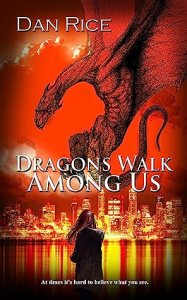
I’m about to eat my own words. In a previous post, I talked about how important a good cover and blurb are to convince potential readers to buy your book. Well, I put Dragons Walk Among Us by Dan Rice on my to-be-read list based on the title alone. I read it in an email (Dan is also with The Wild Rose Press), and put it on my list right away. I didn’t see the cover until I started following Dan on social media. I have never read the blurb.
Allison Lee is an angsty teenager who participates in environmental rallies, takes photos for the school newspaper, and is navigating her feelings for her crush. In addition to typical teenage drama, Allison also deals with racism as a biracial Chinese American. Her best friends, Dalia and Haji, stick with her through her ups and downs.
Allison is friends with a homeless veteran named Joe. One night, on her way to visit him, she is attacked. She wakes up in the hospital a couple weeks later completely blind. She lost her spot in her school’s social standing during her coma, and with her blindness, risks never regaining it. Her father introduces her to the creator of an experimental procedure that could give her eyesight back. Allison agrees to it, and after a few more weeks of surgery and healing, she is finally back at school with her friends.
There are a few unsavory side effects to Allison’s new eyesight, but the one she was not prepared for is a giant holographic dragon following her father’s colleague around. Allison makes the bold decision to tell the professor that she can see his dragon. Her confession pulls her into the world of dragons and an impending war with their enemies, the skaags.
Dan Rice expertly wove Allison’s human struggles into the tensions of the dragon community. The bigotry and prejudice Allison faces as a biracial human also plagues the dragon world in its own way. Allison was abandoned by her mother at birth, allowing her to bond with dragon characters who also struggle with feelings of abandonment.
Mr. Rice also captured the American teenager perfectly. Allison is quick to anger, quick to love, and quick to react. She struggles with self-esteem about her personal appearance. And she is passionate about her interests. Her friends, and even her enemies, are all believable high school students that I can see in my classroom.
I thoroughly enjoyed each and every scene, and I can’t wait to read the sequel.
In addition to my review, I am pleased to introduce Dan Rice, who kindly granted me an interview:
First, would you introduce yourself as a person and a writer?
Hi, I’m Dan. I pen the young adult urban fantasy series The Allison Lee Chronicles in the wee hours of the morning. The series kicks off with my award-winning debut, Dragons Walk Among Us, which Kirkus Reviews calls, “An inspirational and socially relevant fantasy.”
While not pulling down the 9 to 5 or chauffeuring my soccer fanatic sons to practices and games, I enjoy photography and hiking through the wilderness.
What inspired Dragons Walk Among Us?
I wanted to write a book from a relatively young age. I grew up reading fantasy and science fiction and naturally gravitated toward writing those genres. For a long time, I wanted to write gritty epic fantasy like Game of Thrones or Joe Abercrombie’s novels. Eventually, I discovered my authorial voice is more suited to young adult material.
The opening scene in Dragons Walk Among Us was inspired by my older son being harassed for his biracial appearance at summer camp. Allison’s encounter with Leslie grew from that seed, and the rest of the story flowed from there.
There is a lot of great racial diversity in Dragons Walk Among Us. Was this a conscious choice? Or did the characters tell you who they were as you created them?
My sons’ schools are far more diverse than the institutions I attended. I wanted to write a story that would ring true with young adult readers. So I created a diverse cast to match what I observed at school events and read in news articles about the increasing diversity across the United States.
You did an excellent job portraying the angsty teenager. What experience do you have with teenagers and/or what research did you do that helped you bring these believable characters to life?
Well, people were all or will be teenagers, angsty or otherwise, at some point in life. My oldest son still isn’t a teenager, but he’s been acting like one since about the age of eight. I often imagine what his antics might be like if he were a bit older.
Allison describes dragons as “European” and skaags as “Chinese”. In your worldbuilding, are both creatures somehow related?
The original skaags were laboratory creations the dragons made to hunt down rebels. The draconic empire deploys magic to bind the skaags as loyal soldiers. The magic is believed to be unbreakable.
The third book is coming out soon. Is this the end of Allison’s story, or does she have more adventures ahead of her? What’s next in your writing career?
The entire series will be four books. Right now, I plan to participate in a haunted high school series my publisher is doing. After finishing those projects, I will try penning a dystopian novel.
Last time Lisa Wilkes was on my blog, she was talking about her first book Flight Path in preparation for the release of her next book, Mid-Flight. I recently read Mid-Flight and am pleased to announce that Lisa agreed to an in depth interview.
Lexi Brennan is a flight attendant in the year 2037 when a meteor shower veers off course and strikes earth. The plane her best friend is on is hit by the falling space debris and all on board are incinerated immediately. Lexi feels extreme guilt because she was scheduled to be on that plane as well, but switched shifts. Jason Bresline is an airplane mechanic who is called in to do emergency fixes when the meteor shower hits. His mentor is also killed on one of the planes hit. Jason’s engagement falls apart shortly after. He and Lexi meet in Orlando, FL a year later for different training sessions for Skyline, the airline they both work for. They spend each night after classes together, getting to know each other and falling in love.
But all is not well in post-meteor America. The meteor shower brought a new disease that humans are struggling to combat. The fear of this disease, ContaCan, causes extremists to seize control of the government and implement totalitarian policies. Lexi, her brother, her friends, and Jason plan a way to secretly fight against the new policies. Jason and Lexi’s relationship is also one of healing and self-acceptance. Both have past traumas and hurt that they have to overcome in order to fully give themselves to one another.
I really enjoyed Ms. Wilkes’ world building. The connections between the fictional ContaCan and the real life Covid pandemics are very clear. She also expands upon very real fears that POCs and LGBTQ+ Americans face. Basically, Ms. Wilkes answered “What would America look like if the extremists gained control?” The technological advancements were also very intriguing.
So, let’s take a look at Ms. Wilkes’ world building. First, this is a Sci-Fi Romance, so technological advancements are expected. In American 2038, everyone has a chip implant called AutoScan which allows you to call, text, and receive information using brain waves. Text messages, news articles, and Internet searches show up across one’s cornea. The image my brain conjured when reading was a miniature screen constantly on your eyeball. People also use their thumbprint to pay for purchases and identify themselves. But this thumb scan is more than a driver’s license. All information has been made public – for national security, of course.
The disease brought on by the meteor shower is called Contagious Cancer – ContaCan for short. The world went into quarantine while scientists scrambled to find a cure (sound familiar?). Once a vaccine was made available, the world attempted to return to normal, but one problem emerged: the vaccine didn’t work on everyone. These people are labeled AR, or Antidote Resistant. ARs are forced to register as such by having their documentation readily available and get a government sanctioned tattoo on their left shoulder blade that reads “AR”. As the story progresses, Lexi and Jason watch via AutoScan how the government continues to pass more and more policies that chip away at human rights for ARs. The whole thing is very reminiscent of WWII.
Another layer to the story is the diversity representation among the characters. Lexi is bisexual, Colin is gay and suffers from mental illness, Jorge is gay and Latino, Jason is Black, Colleen is lesbian, and Reggie is gay and Black. Each character has suffered discrimination due to their race and/or sexuality.
I think my favorite thing about the above representation is Lexi and Jason’s relationship. Lexi is white and Jason is Black, but their racial and cultural differences don’t play into the tensions and struggles they are facing. It was really refreshing to see an interracial couple who could focus on things other than race. Not to say race is or should be ignored, because it’s not. Lexi and Jason do have conversations about his experience as the youngest Black airplane mechanic in the south; it’s just not the main plot point. And as someone who is in an interracial marriage, I really appreciate what Ms. Wilkes did with that part of the plot.
And now, onto the interview portion with Lisa Wilkes!
Chelsey:What was your inspiration for Mid-Flight? How did you come up with this story?
Lisa: Mid-Flight was originally going to be an aviation-themed love story, similar to my first published novel, Flight Path. However, Mid-Flight’s plot (and setting) changed drastically as I witnessed a lot of wild things occurring in society. The book was written in 2019 and 2020. At that time, I was completing my graduate school internship in the behavioral health unit of a hospital. Many of my clients had endured horrible abuse and mistreatment, which deeply impacted their mental health. I decided my next book would address those injustices. I wanted to shed light on the iniquities rampant in modern society, so my readers would be inspired to address these issues and take a stance in favor of equality and inclusion.
Mid-Flight’s characters are very diverse. Lexi is a bisexual flight attendant, Jason is the youngest Black mechanic at SkyLine Airways, and Colin is a brilliant programmer battling mental illness. The story aims to remind readers that we all have so much to offer this world. It also seeks to demonstrate that our differences can unify—rather than divide—us, especially as we work toward building a better and brighter future for all of humanity. I felt the book would be more impactful if it was set in the future, since the hostility and antagonism we see in our current world might be greatly magnified over the years, unless we take deliberate steps to protect those facing oppression.
Chelsey:How did you come up with the technological advancements? Are these advancements something you would like to see in real life?
Lisa: Mid-Flight’s technological references were a combination of my wild imagination and real-life initiatives/developments within the tech sector. For example, there are actual programs similar to AutoScan, where electrodes can scan our scalp for impulses and assess what we are thinking. Of course, there’s still a long way to go before the technology is perfected and made available to the public, but it was really fun to imagine how that might look fourteen years in the future!
I also really enjoyed writing about solar-powered cars, tablets, and buildings. I’m a huge fan of sustainable energy, and I truly believe our planet deserves far better than the treatment we have given it thus far. So it was exciting to envision the ways energy could be harnessed to power our lives without negatively impacting the environment.
Chelsey: Off the top of my head, it appears the majority of your characters identify as LGBTQ+. Was that a conscious decision? Or did your characters tell you who they were as you created them?
Lisa: I’d like to hope the world is becoming more accepting of the LGBTQ+ community, although recent legislation would indicate otherwise. I felt compelled to write a book that offered a positive alternative to the recent hostility we have witnessed from lots of folks in power. In my novel, I aimed to show the beauty of all these characters with different preferences, identities, and orientations. Lexi’s sexuality is nuanced and complex, so I really tried to capture that with sensitivity. Her best friend and her brother are gay. They are also amazing humans who deserve to be valued and appreciated. I guess it wasn’t really a conscious decision for me, as the author of Mid-Flight. But I am so glad these characters showed—and embraced—their authentic selves for the whole world to see.
Chelsey:I would like to applaud you for writing an interracial couple whose struggles have nothing to do with cultural differences. Same question as above. Did you consciously choose the race of each character or did they tell you who they were?
Lisa: This was a conscious decision. Lexi had experienced her own struggles; she was no stranger to exclusion or microaggressions. However, she didn’t know the full extent of discrimination until she met Jason and learned all the nonsense he’d faced because of his skin color. Lexi and Jason fell in love easily, linked by their tragic losses as well as their triumphs…and their powerful desire to make a difference in a broken world. It was important for these characters to represent different ethnic backgrounds. This reinforced the idea that true, deep, meaningful love is accompanied by a sense of moral responsibility and an ongoing quest for justice.
Chelsey:There are obvious connections between Covid and ContaCon. But the treatment of ARs also reminded me of WWII Japanese Internment Camps and Jewish Concentration Camps. What other world events (if any) inspired the AR plot point? And did you do any historical research for this part of the story?
Lisa: Interestingly, I had a wealth of knowledge in this area since I was completing my Master’s in Social Work when I wrote Mid-Flight. There are countless historical references to exclusion and annihilation of groups who have been vilified by the dominant majority. There are also tons of modern references, sadly; as a social worker, I have witnessed the effects of systemic bigotry. Recent attacks on the trans community have left people without resources, protections, or hope. I needed Mid-Flight to portray the horrifying possibility that extremists will continue to assault anyone arbitrarily deemed “other,” unless we expose and reject that widely-accepted mistreatment.
The ARs in Mid-Flight, a small subset of the population with a genetic anomaly, might be a new concept. Their plight, however, is a terrible tale that’s been replayed throughout history. It’s time we say enough is enough. Lexi and Jason found a creative way to do this within their airline and their sphere of influence.
Chelsey:Is Lexi and Jason’s story going to continue? What’s next for your writing career?
Lisa: Originally, I said there would not be a sequel to Mid-Flight. But I’ve been known to break my own rules, so it’s definitely possible I’ll write a follow-up novel at some point! In the meantime, I am working on a different project. I’m approximately 70 pages into my next novel, a metaphysical thriller about a love powerful enough to transcend multiple dimensions.
Lisa is an author, flight attendant, licensed social worker, and animal rescuer. She lives in Florida with her spouse and several rescue furbabies. Lisa uses her royalties to donate to animal rescues. Follow Lisa at her website: Books By Lisa Wilkes
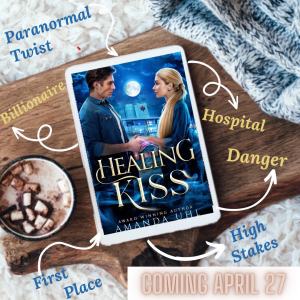
I’d like to introduce Amanda Uhl. Her newest release, Healing Kiss, releases this Thursday April 27th and is the topic of this interview.
What inspired your story?
Once upon a time, I had a healing experience. I held the hands of a stranger–a young woman–I met at a baby shower. My older sister was hosting the shower for someone in her husband’s office, and I was there as a helper and didn’t know any of the guests. The woman and I began discussing the paranormal. I described experiences I had had in the past, including an ability to pull energy from someone’s arm and hand, so it would fall asleep. Curious, the woman asked me to hold her hands. I did as she asked, and when I closed my eyes, immediately saw an orange light surrounding a dark shape. The orange light pulsed and glowed as I inhaled and exhaled.
Figuring I was the only one to experience the orange light, I let go of the woman’s hands and opened my eyes. The woman opened her eyes, giving me dazed look. “Wow. It felt like someone hugged me,” she said.
Two weeks later, I learned the woman had been trying for years to get pregnant without success. After holding my hands, she discovered she was pregnant. She called my sister to tell her the joyous news. “Your sister who held my hands, she caused it to happen,” she insisted
This real-life experience inspired Healing Kiss, my newest paranormal romance. When I describe the heroines’ attempts to heal her sister in the first chapter, I’m drawing on that real-life incident to bring an authentic feel to the scene.
What is your writing process?
I work full-time managing a creative team, so my day job often takes precedence over my writing life. The one rule I follow is to write a little bit every day, no matter how tired I feel. I am a panster, who has discovered the value of plotting, so I do a basic plot outline and write the book description before writing a single word.
How much time did you spend on this project?
I have written a book in as little as two months or, as in the case of Healing Kiss, four years! I am a bit of a perfectionist, which often sends me back to the drawing table as I attempt to make sense of the plot.
What is your writing schedule like?
Terrible. As I mentioned, I write a little every day. Due to my demanding day job, I do most of my writing late at night when the rest of the world is sleeping.
Anything else you’d like to share?
Healing Kiss placed in three romance-writing contests:
1st place The Far Side
1st place The Rudy
2nd place Diamonds in the Desert
Award-winning author Amanda Uhl has always had a fascination with the mystical. Having drawn her first breath in a century home rumored to be haunted, you might say she was “born” into it. After a brief stint in college as a paid psychic, Amanda graduated with a bachelor of fine arts in theatre and a master’s degree in marketing. Over the past twenty years, she has worked as an admissions representative and graphic designer, owned her own freelance writing company, and managed communications for several Fortune 500 companies, most recently specializing in cyber security and data. Amanda is an avid reader and writes fast-paced, paranormal romantic suspense and humorous contemporary romance from her home in Cleveland, Ohio. When she’s not reading or writing, you can find Amanda with her husband and three children, gathering beach glass on the Lake Erie shoreline or biking in Cuyahoga Valley National Park.
To preorder Healing Kiss, explore Amanda’s other books, and follow her journey, check out her website: https://amandauhl.com/
To save her dying sister…
Lillian Milano channels energy from the healthy to heal the sick, which makes her an incredible nurse. But her gift puts Lillian and those she loves in danger from an organization that will stop at nothing to exploit her talent. When her sister becomes gravely ill, wealthy computer genius Tristan King is the one man with enough vitality to save her sister’s life. But being near him threatens to expose her secrets and destroy the walls she’s built around her heart.
She bargains with a billionaire.
Tristan doesn’t believe in the supernatural and is wary of emotional entanglements. But his beloved mother is dying, and his lying ex-fiancée won’t leave him alone, so he strikes a deal: In exchange for his help, Lillian must pose as his date for a hospital fundraiser. As the pair work together to save their loved ones, they confront a spiraling web of secrets that threatens their growing feelings for each other. The choices they make will either destroy their lives or heal their hearts.
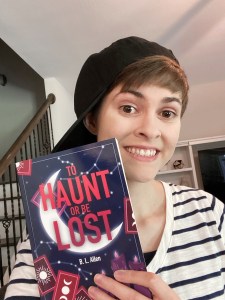
In April 2022, debut author B.L. Allen’s first book, To Haunt or Be Lost was made available for readers. I read it in October of this year, and when I got to chapter 21, I immediately knew that I wanted to highlight her book as one of my November posts. Chapter 21 highlights Thanksgiving, and while I’m sure other authors have done so in their work, it’s not something I have come across often in the books I read.
Before we get to that chapter, let’s summarize To Haunt or Be Lost. The main character, Lori, is an only child in her early years of college. Lori has social anxiety and is studying art. Her younger cousin, Agatha, comes to live with Lori’s family when Agatha’s parents die in a car accident. Agatha and Lori don’t get along, and now have to live together and share a car. This puts Lori riding the bus to college every day where she meets a young man named Gabriel who she develops feelings for. Simultaneously, Lori gets thrown into Agatha’s desire to get vengeance on the other driver involved in the accident because they survived. And all of this requires Lori to dig up difficult memories from her past and finally heal from them using the help of the last beings she believed in: ghosts.
Agatha and Lori have a rough past. They are both only children, and were forced into frequent sleepovers when they were kids. Agatha believes in ghosts and witchcraft, and Lori does not. During one of their sleepovers, an incident occurred where one of Agatha’s magical seances physically harmed Lori and sent her to the hospital. Not believing in magic, Lori is convinced that Agatha purposefully injured her; while Agatha stays firm in her claim that a spirit had possessed her and hurt Lori. Both Agatha’s and Lori’s parents believe Lori, and the two girls are no longer forced to see each other anymore. The next time they do see each other, it’s Thanksgiving at their grandparents house, and Lori is prepared to defend herself.
Lori packs pepper spray because her parents have decided to forgive the whole incident, and she is expected to do the same. During dinner, Agatha makes faces at Lori from across the table, and even draws her finger across her neck while glaring. Towards the end of dinner, Agatha’s mom proposes everyone say what they are thankful for. It starts out as normal stuff: family, home, health, jobs, etc. When it gets to Lori, she says:
“I am thankful for pepper spray, which I can use to defend myself with if I’m in danger.”
Lori’s comment causes a short awkward silence. Then it’s Agatha’s turn, who says:
“I am thankful for this body that I am able to live in.”
And with those two comments, Thanksgiving was ruined. But was it really? Is it really Thanksgiving if that crazy family member doesn’t say something?
I enjoyed To Haunt or be Lost. I’ll admit, it took me a while to like Lori. I thought she was a judgmental spoiled brat in the beginning. But her redemption arc is well done. So, I reached out to B.L. Allen – okay, I admit, she’s my cousin, so it didn’t take much to send her an email – and she agreed to a digital interview! So, for the rest of the post, enjoy getting to know B.L. Allen.
How did you come up with the storyline for To Haunt or Be Lost?
To Haunt or Be Lost was an idea that came to me rather quickly, in a way that I’m not sure I can fully explain. It was October of 2015 and I knew I wanted to participate in NaNoWriMo, which was only a couple weeks away. I had other story ideas, but I wasn’t excited about them at the time. One day I was goofing around with my husband when I threw a blanket over my head and said “I’m going to bury myself alive to cheat my way into the spirit world!” and at that moment a whole story started to click in my head, or at least that’s when a bunch of separate ideas conglomerated into one. I made a quick outline for the idea in a notebook, and then wrote the first draft that November.
Several key parts of the story were actually inspired by real life events, which is perhaps my way of taking “write what you know” a bit too literally. For example, when I was in college I took public transportation to school, which is at the center of a major plot point in the story. When I took the bus, there was this older woman who would sit next to me on the bus nearly every day, which lasted a few months I think. She never said anything to me, but she’d come straight to the seat next to mine and sit down quietly for a few stops before getting off. I thought maybe I felt like a safe person to her, since there are often creepy individuals who take the bus and it can be scary to talk to them. We had a strange unspoken agreement that we were “bus buddies” keeping each other safe, and I liked that. So in To Haunt or Be Lost, I took that idea of an unspoken friendship/agreement and made it a romance.
The story also involves repeated mentions of a worry doll, which I had no knowledge of until I was visiting my sister’s work one day. One of her co-workers had just come back from a trip to Guatemala, and had bought a bunch of worry dolls as souvenirs for everyone in the office. My sister and I each got one, and I really liked the concept of speaking to this tiny doll about your worries, putting it under your pillow, and letting it worry for you so that you wake up with a weight lifted off of you. Regrettably, I seem to have misplaced my worry doll, but I’m sure it’s in a box somewhere and I’ll find it again one day.
But perhaps the main focal point of To Haunt or Be Lost is the relationship between the main character, Lori, and her cousin, Agatha. At this point it shouldn’t be surprising that Agatha’s personality was directly taken from people I know in real life, although I won’t name names because if they’re reading this it might be awkward. I had one friend who was quite bubbly, but I also often butted heads with her. She was more of a friend who was convenient, but not really someone I meshed with very well. Lori and Agatha’s relationship is strongly inspired by my relationship with that particular friend. I had another friend who enjoyed witchcraft, and would teach us fun witchy things like how to predict the number of kids you’ll have and what letter your soulmate’s name will start with. This friend also would do tarot card readings for our group, which was especially fun around Halloween. I’m sure my mom wasn’t too happy about that, but it was all in good fun. Ultimately I combined my bubbly friend and my witch friend together into one character, and Agatha evolved into my favorite character in the book. Lori, on the other hand, happens to be my least favorite, but it might be because she’s a bit of a self-insert.
When it comes to communicating with the deceased, how much of the technique that Lori and Agatha do is research based and how much did you create for world building?
As far as how much of the spirit communication was made up and how much was based on research, I’d say it was about fifty-fifty. Some aspects I invented specifically as a means to progress the story, and other things I based on what I had read about. When it came to Bloody Mary, I tried to keep it as close to what the childhood game of summoning Bloody Mary might be like. The candles, the chanting of her name, the turning in circles and waiting for something to jump out and scare you…it was all part of that familiar sleepover experience many kids attempted with their friends and dared each other to do at one point. When I was a kid, my friends and I even went so far as convincing ourselves that our elementary school was haunted by Bloody Mary. Strange spots on the wall? Must be blood. A classmate acting strangely? Must be possessed. We were invested in this conspiracy and wholly believed we were ghost hunters on a mission to protect the school.
Agatha also performs seances, which do have some truth surrounding what a seance might look like such as holding hands and creating a circle of candles, but as far as chanting in Portuguese and painting blood symbols go, I’m pretty certain I made those things up if I remember correctly. Also something that’s central to the story is that believing in ghosts is what causes a person to be able to see them, thus explaining why Agatha can see ghosts, but Lori cannot. This was made up for the sake of the story progression, but I quite like how it played into certain plot twists.
One of the ghosts that Lori meets is Bloody Mary, who is supposed to be Mary Tudor or Mary I of England. When it came to her physical appearance and personality, how much was based on the historical record, the paranormal record, and your own imagination?
The chapter where Lori meets Bloody Mary is actually my favorite chapter in the book. She is strongly inspired by Mary Tudor and it’s implied in To Haunt or Be Lost that that’s who she was meant to be in life, but in reality it’s not entirely known if the legend of Bloody Mary stemmed from Mary Tudor or some other Mary. I based her physical appearance mostly on Mary Tudor, although I chose to describe her hair as black because I thought that might be creepier. As far as personality, I based it off of the supposed paranormal experiences surrounding Bloody Mary. Primarily, Bloody Mary is described as an evil and dangerous spirit, although sometimes is seen as friendly. I leaned into her evil side more, but also attempted to humanize her. I asked myself: if she was a real person, and if she were, for some reason, waiting to be summoned from bathroom mirrors at sleepovers all over the world, what might she say to these people? Anger and misery felt like the most appropriate emotions for her. Angry it’s a game to people, miserable to be haunting the earth forever, but also accepting this fate in a strange and twisted way.
Out of all the holidays you could have highlighted, what made you choose Thanksgiving?
The honest answer, which is a ridiculous answer but is absolutely true, is that it was Thanksgiving at the time I wrote it. Because it was a book I was writing for NaNoWriMo, which takes place in November each year, I was staying at my husband’s grandparents’ house for a few days that month while still trying to churn out the first draft of my story in only a month’s time. I was stuck and didn’t know how to progress the story, so what did I do? I took from my surroundings, which is a common trend for me. Because Thanksgiving was what was going on at the time, that’s what I wrote about. So stupid, but it actually turned out well in the end I think. It gave me an opportunity to highlight family dynamics that otherwise may have never been highlighted, especially since Agatha’s parents are known to be deceased at the start of the book. The Thanksgiving chapters, which are set in the past, help to show her parents and their personalities more, making it an extra gut-punch knowing that in the present time they are actually dead. I also had a unique opportunity to make Thanksgiving a little bit…creepy. Sure, Halloween might be the go-to holiday for ghosts, hauntings, and spooky things, but taking a holiday of gratitude and giving it a sinister twist with Agatha’s creepy behavior was strangely satisfying.
Is there anything from Lori’s Thanksgiving dinner that was inspired from your own Thanksgiving memories? What are your Thanksgivings like?
Thanksgiving is one of those holidays that varies from year to year. It all depends on which side of the family I’m spending it with. In my husband’s family, they have the tradition of going around the room and asking everyone to name one thing they are grateful for, which is exactly what Lori’s family does as well. Fortunately though, my Thanksgivings don’t typically feature a crazy cousin out to kill me.
What’s the next step in your writing career?
I’ve now had a taste of the self-publishing world and have learned a lot. I’ve done some things right, and some things horribly wrong, but going into it I knew that the first book was primarily going to be a learning experience. I should probably note I was only 21 when I wrote the first draft of To Haunt or Be Lost, and I’m nearly 28 now. To say my writing has evolved tremendously over the years would be an understatement, and my next book will have so many more layers and depth than past stories I’ve written. Although I suspect that my second book will be a learning experience as well, I already know many ways I’m going to approach my next book differently. I’m currently working on another standalone book, and this time it will be longer than my first book and will also be less inspired by people and events in my personal life. In fact, it’s more largely inspired by various religions and cultures around the world, and of course it’s a ghost story because those are the types of stories I like the most. Get ready for heavy topics like suicide, familiar legendary beings like the Grim Reaper, as well as heartbreaking backstories for a wide array of characters. Don’t worry, I’m sprinkling in some dark humor and an overarching theme of hope as well. I refuse to believe the afterlife is meant to be bleak, although perhaps it can seem that way. I will be self-publishing again, and my next book should release sometime next year, although I do consider myself a professional procrastinator. Once I feel like a more seasoned author, I might try my hand at traditional publishing.
I hope you enjoyed learning about B.L. Allen and her writing inspiration. To Haunt or Be Lost currently averages 4.17 stars on goodreads and 4.6 stars on Amazon. It can be purchased as a digital copy or paperback.







 Chelsey M. Ortega