When Once Upon A Dream Has A Beast: Bloodstone

“I know you

I walked with you 

Once upon a dream

I know you

The gleam in your eyes

Is so familiar a gleam…”

The adult version of Sleeping Beauty involves sensual dreams with a sexy, but faceless hunk; who also happens to be a beast – at least, that’s how others view him.

In Bloodstone by Helen C. Johannes, the heroine Mirianna has a dream lover who makes the men in her village pale in comparison. So Mirianna has saved herself for this dream man, constantly searching for him during the day. 

Durren has been cursed for fifteen years. No one can look upon his face without dying. So he completely covers himself in black clothing from head to foot, earning the feared nickname of the Shadow Man. He also dreams of a beauty who shudders under his touch for reasons other than fear. 

“And I know it’s true

That visions are seldom

As they seem.

But if I know you

I know what you’ll do.

You’ll love me at once

The way you did

Once upon a dream.”

Except that’s not what happens when Mirianna and Durren finally meet in person. Durren is in possession of the legendary bloodstones (gems made from dragon blood), and Mirianna’s father needs them to make jewelry for a client. Mirianna fears the Shadow Man and feels manipulated by him when she learns her dream lover is the legendary beast of the land. And Durren feels unworthy of Mirianna’s affections. But he gives in to his urges, and uses the threat of the real beast, Krad, to take Mirianna home with him. If she agrees to live with him, he’ll save the rest of her traveling party from the Krad. 

“Tale as old as time

True as it can be

Barely even friends

Then somebody bends

Unexpectedly

Just a little change

Small to say the least 

Both a little scared

Neither one prepared

Beauty and the beast.” 

Mirianna and Durren will navigate treachery, past mistakes, and life threatening plots with the help of a lioness and a blind boy. Amongst the danger and drama, they will be given the opportunity to fall in love and save the world.

I’m excited to introduce you to Helen C. Johannes, who has agreed to an interview. Helen is the author of three fantastic high fantasy romances: The Prince of Val-Feyridge, The Lord or Druemarwin, and Bloodstone. And a mid-grade fantasy Frederick Fly-Catcher. Helen lives in the Midwest with her husband and grown children.


How did you come up with bloodstones? Are they based on any existing jewel or gemstone?

They are loosely based on the Apache tear and obsidian. The Apache tear is darkly translucent, and obsidian is such a deep, glossy black, like clotted blood. I wanted something that would both be petrified hard and yet capable of radiating light when struck by the sun.

How I came up with the idea goes back to my father’s expeditions to Alaska to dredge for gold, and the stories he told about finding garnets among the gold flecks while panning. That’s the inspiration for the Shadow Man panning the stream in the early chapters and encountering the she-lion. My father and his friends, fortunately, never encountered anything larger than Alaskan ground squirrels.

I really admire your worldbuilding creativity in not just Bloodstone, but The Prince of Val-Feyridge and The Lord of Drumarwin. How do you come up with these lands, histories, cultures, and names? How much time does it take to create such extensive worlds?

This is challenging to answer since I’m very much an “into the mist” writer, and I create what I need when I need it, seemingly out of the stuff of my imagination. However, I’ve been fortunate to have traveled widely in Europe and the UK and to have studied medieval history before I concentrated on German and English language and literature. That connection to very old places and the treasure trove of myths, legends, and fairy tales, along with a love of tramping through castles, has given me a pretty solid grounding. You’ll probably recognize some Germanic as well as Old English in my names of people and places. And I must not forget mentioning how much The Lord of the Rings affected me when I read the books as a high school senior.

As far as names, some come almost instantly along with the full character (Rees and Pumble), some require refining or changing entirely (Syryk, Brandelmore), and some take half the book to decide what they want to be called (I’m looking at you, Shadow Man).

Were the connections to beloved fairy tales deliberate?

Having a big, illustrated collection of fairy tales as my first remembered childhood book probably is the reason fairy tales resonate with me. That and growing up on Disney’s animated versions of those tales. I don’t know that the connection is always deliberate so much as that the tales are archetypal stories embedded in our culture.

Bloodstone at its heart is a Beauty-and-the-Beast-type story, and I had that in mind from the beginning, but for The Prince of Val-Feyridge and Lord of Druemarwin, the Cinderella and Princess and the Pea connections arose organically from the characters and their journeys.

What are you currently working on? Do readers get to return to any previous worlds? Or are you bringing us someplace new?

I’ve just published my second children’s book, The Dis’Aster Family’s Halloween, a picture book based on characters my children created. My first children’s book is Frederick Fly-Catcher, a middle grade fantasy chapter book. Currently, I’m working on a throwback 1960’s YA romantic suspense/gothic (there’s something freeing about a setting that’s pre-computers and cell phones). And I’m mulling a return to a novella in the Crown of Tolem world. I gave myself plenty of characters to work with there.


Helen C. Johannes is one of my favorite fantasy authors. She has such an amazing imagination when it comes to world building, and a talent with words to show the reader that magical world. The clear connections between beloved fairy tales made the foreshadowing and guessing that much more fun. If you like your high fantasy intertwined with romance, then Bloodstone is for you. 

Follow Helen at her blog: https://helencjohannes.blogspot.com/
What’s in a Cover?

As much as we like to say, “You can’t judge a book by its cover.” It simply isn’t true. The cover is what draws a potential reader to click on the title or pick it up and read the blurb. Then the blurb should be good enough to convince the potential reader to buy it, and go from potential reader to reader. 

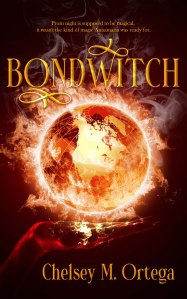
Last week my socials shared the cover to Bondwitch, and I would like to share how the cover was created.

 I started to create the cover in my mind when the list of potential publishers dwindled, and I thought I would be self-publishing; which meant I would have to figure out the cover. You can buy premade stock covers, but I wanted my cover to match my story, not just kind of match my story. So I knew that I was going to have to find an artist who could create what I wanted.

I have always loved the original cover to Twilight by Stephenie Meyer. The snow white hands offer the tempting red apple. Forbidden fruit equates to forbidden love. That cover captivated me when I was sixteen, and it still captivates me today. So, with the Twilight inspiration in my mind, I also wanted the idea of a hand holding something. I envisioned a hand holding floating spheres to represent water, fire, earth, and air. 

When I signed with The Wild Rose Press, the contract stated that the publisher pays for the cover art and has final approval of the cover art. I was perfectly fine with that because they’ve been in this business for at least seventeen years, so they know what they are doing. So, I pushed my idea onto the back burner and focused on editing my story. 

When it was time to do the cover art, I received an “Art Cover Information” form to fill out. The form asked me general questions about my story like the tone, the time period, the geographical setting. The form provided a list of TWRP artists and links to look at their previous work, then I could pick my top artist – but it wasn’t guaranteed they would be the one assigned to my book. I then got to provide links to book covers that matched the aesthetic I wanted emulated in mine. 

Then came specific questions to help create the deeper details of the art. And with those questions came some helpful statistics. According to research this is the order of cover components most likely to sell:

  1. Covers without any people
  2. Covers with just a male
  3. Covers with a couple
  4. Covers with just a female 

Research indicated that my vision of a hand holding elemental magic would work! (That isn’t to say the other covers are bad, because they aren’t. I simply felt validated that my original vision was a good one.)

Another bit of helpful advice the form gave me was to NOT request too much detail. I think it said to try to go for less than 5 components, perhaps only 3. The form explained that too much detail was hard to decipher on the thumbnail images that readers would be looking at online. 

With that helpful information, I decided to decrease the number of magical spheres. And this is what I requested:

What element do you consider most important: a visual representation of magic

High Pitch Concept: When a young witch’s powers are unlocked, her family’s enemies descend upon her community; forcing her to flee across the country and train in secret.

General vision: a feminine hand, palm up, a sphere that represents one of the elements (preferably fire) floating above the palm

The artist given my book was Jennifer Greeff, and my goodness, I think she did an amazing job! 

She gave me exactly what I asked for and then some. And I already have the gears turning in my brain for the covers for the rest of the series. 

What’s your favorite book cover? Why? (Or top three, if you’re like me, and you can’t choose only one to save your life.) Let me know in the comments!

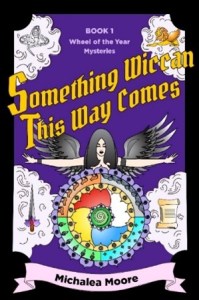
New Release: Something Wiccan This Way Comes by Michalea Moore

Not Your Grandmother’s Cauldron…

The Tarot has spoken: Love and murder are in the cards.

A Tarot-reading witch and a high-tech billionaire combine their talents to solve crimes, clear their names, and find true love. Something Wiccan This Way Comes from Eloquent Peasant Books combines romance and magick with a witchy flavor and a hint of Tarot wrapped in a mystery. Think J.D. Robb’s Eve Dallas meets Practical Magic.  

Something Wiccan is the first book in an eight-book series, The Wheel of the Year Mysteries. Many witches celebrate the eight Sabbats, known as the Wheel of the Year. Each book is centered around a Sabbat. 

Something Wiccan takes place in the near future in a world riddled by pandemics. Maren Lilienthal, a rebellious heiress and witch, is cheated out of her fortune and forced to return to her wealthy family and hometown. A town where old secrets, ghosts, lovers, and enemies never die. Maren believes the safest place for her might be the broom closet. Cyrus Harper, a sexy billionaire who made his fortune with virus-scanning technology, charms her into coming out. Not everyone falls under the spell of the town’s newest couple or wishes them well. When Cyrus and Maren are framed for a ritual murder on Imbolc, the Wheel of Fortune Tarot reading holds the answer to what happened. Will white magick, Tarot, and technology save them or make things worse? Something Wiccan is definitely not your grandmother’s cauldron.

Something Wiccan was inspired by a managers’ meeting from hell. Our division VP called someone’s presentation “a mishmash of voodoo ideas” and the presenter “a crazy witch.” Despite a salvo of gasps and disapproving snorts, he persisted, calling her ideas a miscarriage; the woman had returned from leave following a stillbirth. 

A coworker whispered, “I wish she was a witch; she could stick some voodoo pins into him and finish him off.” I replied, “Then we’d have the Salem witch trials in our very own conference room.” She said, “You should write a novel about that.” Thus, the seed was planted. It germinated a decade later and flowered into an idea for a series of novels with a modern witch as the protagonist.

While Something Wiccan germinated, I wrote two “training wheels” novels about Ancient Egypt, which may still see the light of day. But, writing a series is a different beast than writing a stand-alone novel. 

Confession time: I am not a plotter. Even during my career as a technical writer, I eschewed outlines. I have a sneaky feeling that if I outlined, I’d never write the novel, having gotten the idea out of my system. Nor am I a full-fledged pantser because I know where every novel will end. For me, the joy is in the journey. 

Still, a series requires a bit more discipline. I created a character Bible with a cast of characters, their homes, their clothes, their life events, the music they listen to, and so forth. In a series, I also realized that you must plant clues in one book that might not come to fruition until several books later. I have eight journals (one for each novel). I record ideas and scenes for future books, paste photos that inspire me, create Tarot readings, and add articles that are part of my research. 

My motto is “Aim low, achieve high.” I try to write every day. I’m mostly successful; I don’t beat myself up if I miss a day. I don’t aim for a specific word count. Some days it’s a paragraph, and sometimes an entire scene. My Egyptian novels took 10 and 2 years to write, respectively. Something Wiccan took a year; the second book, Season of the Witch coming out in May, took 9 months. My critique group jokes that I should get Book 8 out in a week. I begin each writing session by listening to what I wrote the previous day to get back into the flow; I use Word’s Review🡪Read Aloud feature.

I’ve always been a reader and a writer. There’s a well-concealed photo of me on the potty chair “reading” a picture book. I taped stories written in crayon to the bricks of my grandmother’s front porch. In 3rd grade, I published my first novel using an old typewriter. Back in the days when carbon paper was the only way to make copies, I produced three copies of a story about my grandfather teaching my cat, duck, and chicken to eat together. I received 25 cents from my grandmother, mother, and a neighbor. Magic, right?

As a child, I was the Queen of our Public Library, which looked like a castle; the children’s reading room was a tower. My favorite books were The Girls’ Book of Famous Queens and Cleopatra of Egypt. I checked out those books so often the librarian said I was depriving the other children and limited my check-out privileges.

You don’t get interested in Egypt without stumbling into its magical system. Egyptian magic led me to the world’s first and arguably greatest witch/magician, the goddess Isis. Once you find Isis, you’re on the doorstep of a great love story. Isis is the protagonist in my first Egyptian novel, Queen of Heka. I was hooked on powerful, magical women who love powerfully. . . when they find a worthy man. I wanted to write about them. Magic is the icing on the cake. Find out more about me and my books at https://www.michalea.com/. Something Wiccan and the next book, Season of the Witch, are available at https://www.amazon.com/gp/product/B0BXMY157X.