June 2024 Newsletter

Subscribe to continue reading
Subscribe to get access to the rest of this post and other subscriber-only content.
Subscribe to get access to the rest of this post and other subscriber-only content.
Maeve Jackson is starting over after a broken engagement—and mustering out of the Army. No job and no prospects, she spins out on black ice and totals her car.
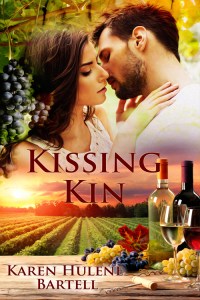
When struggling vintner Luke Kaylor stops to help, they discover they’re distantly related. On a shoestring budget to convert his vineyard into a winery, he makes her a deal: prune grapevines in exchange for room and board.
But forgotten diaries and a haunted cabin kickstart a five-generational mystery with ancestors that have bones to pick. As carnal urges propel them into each other’s arms, they wonder: Is their attraction physical…or metaphysical?
The idea for Kissing Kin first came to me during 2020 because of the striking similarities between Covid and the Spanish Flu of 1918, but publishers convinced me no one wanted to read about pandemics. Time passed.
Then I noticed a handmade cookbook my grandmother had constructed during the depression. It’s made of two cardboard flaps reinforced at the edges with duct tape and held together by two metal ring binders. That book inspired me. (I used some of its recipes in Kissing Kin, for instance, Simple Sponge Cake, Mother’s Soft Gingerbread, and…the treatment of chicken lice with nicotine-sulfate.)
The general tone of the cookbook, which was meant as a Christmas present during the 1930s, was chatty. It read more like a diary than a book of recipes, and it motivated me to begin writing Kissing Kin.
If wishes were fishes, Kissing Kin would be made into a movie. I realize that’s a longshot, but it never hurts to dream. On that note, Maeve, the female protagonist for my Kissing Kin dream cast would have to be Millie Bobby Brown because of her amazing acting range. With her talent, she could pull off being an M2 Bradley driver in Afghanistan and the unwitting spectator to specters.
The male protagonist would have to be Timothée Chalamet. Not only is he a heartthrob, but he’s a versatile actor, whether the genre be drama, comedy, or action. I can see him as the struggling vintner, who makes Maeve a deal. On a shoestring budget to convert his vineyard into a winery, he offers her room and board in exchange for pruning grapevines.
And for your enjoyment, an excerpt:
Grandma’s bedtime stories echoed through my mind as I sped west on I-10. At an early age, family history had merged with myth until the name Fort Lincoln was as legendary as Avalon or Middle Earth.
But when the snow-covered peaks loomed closer, their reality was undeniable. Maybe her stories weren’t tall tales…
And what about her proverbs? “Idle hands are the devil’s workshop.” I winced. No job and no prospects. Mustering out after a five-year Army stint, I had to ask myself: What next? Where next?
Cody slipped into my thoughts, but I dismissed him, refusing to romanticize our breakup.
A troop of cavalry soldiers galloped toward me from the nineteenth century, but a second glance proved the images were metal cutouts–two-dimensional illusions that resembled an officer and guide leading two columns of cavalrymen.
The silhouettes evoked tales of my great-great-grandfather, Ben Williams. Beginning his military career as a scout, he’d been field promoted during combat, then commissioned as Second Lieutenant at Fort Lincoln.
I smiled, proud of our similar career paths. Maybe Grandma’s stories influenced me more than I realized.
Leaving the Interstate, I turned south. Road signs noted towns that sounded familiar from family stories but seemed as mythical as Camelot or Tintagel Castle.
Closer now, the mountains’ features came into view. No longer mere outlines on the horizon, each craggy palisade and butte towered over the highway. Fluffy hoarfrost transformed the landscape into an icy spectacle, with flaky, crystal shards overlaying each leaf and every blade of grass. A frozen fairyland! Just the way Grandma described it. Inspired by the raw beauty, I straightened my shoulders. Maybe I’m viewing my discharge the wrong way. Instead of adrift, maybe I’m free…
Kissing Kin can be purchased here: https://books2read.com/u/boXl10

Author of the Trans-Pecos, Sacred Emblem, Sacred Journey, and Sacred Messenger series, as well as Kissing Kin, Fox Tale, Wild Rose Pass, The Keys: Voice of the Turtle and more, Karen is a best-selling author, motivational keynote speaker, IT technical editor, wife, and all-around pilgrim of life. She writes multicultural, offbeat love stories steeped in the supernatural. Born to rolling-stone parents who moved annually, Bartell found her earliest playmates as fictional friends in books. Paperbacks became her portable pals. Ghost stories kept her up at night—reading feverishly. The paranormal was her passion. Novels offered an imaginative escape. An only child, she began writing her first novel at the age of nine, learning the joy of creating her own happy endings. Professor emeritus of the University of Texas at Austin, Karen resides in the Texas Piney Woods with her husband Peter and her mews—three rescued cats and a rescued *Cat*ahoula Leopard dog.98
Connect with Karen at her website: https://karenhulenebartell.com/
Before we dive into this month’s newsletter, I’m sure you’ve noticed it is on a different platform. (And those of you who are subscribed to my blog, but not newsletter: Welcome to my newsletter! It’s switching over to my blog.) The company I used to send my newsletters through has decided to stop accepting gmail accounts and wants their users to have paid professional emails. Because of this, I have decided to move my newsletters over to my blog. However, this will be the only newsletter that is available to everyone. Just like the old newsletter, starting in March, you will need to be subscribed to this blog to receive the newsletter. All other blog posts will remain available to everyone.
How you subscribe to the blog:

I hope you all have a successful transfer. If not, or you have questions, please send me a message through my Contact page.
January is named for the Roman God, Janus; God of doorways, beginnings, and the rising and setting of the sun. And the new beginning I’m experiencing at work has reminded me why I love teaching English Language Development (formally called ESL). The majority of my ELD students are advanced, so the curriculum is more in line with a traditional English class. I now have 4 beginning students, and get to teach them the English language. I am loving it.
My daughters had a dance concert at the end of January. Being the dance mom that I am, I chaperoned 2 of the 4 shows, and bought a ticket for the other two. They were very happy up on stage, dancing their little hearts out. But it was also their last performance for the time being. One wants to switch to gymnastics, and the other is switching to soccer. When I was a kid, I experienced several different extracurriculars before I stuck with ballroom dance; so I’m excited to see all the different things my kids try.

I have started my final round of edits to Bondwitch: Hybrid, and when I’m finished, I’ll be pitching it to The Wild Rose Press! I also gave my first presentation at an author event hosted by the Santaquin Library in Santaquin, Utah. My topic was “The Three Publishing Pathways, and Why I Chose a Small Press”. It went better than I thought. I had a small audience, and a few people asked questions at the end. You can watch it below:
I’m also excited to say that Real Life Romance stories are returning to my blog for the month of February. Four guest authors will be sharing real love stories from their lives or their ancestors’ lives. Last year’s stories were beautiful, and this year’s stories will be just as great. The first one goes live tomorrow.
Out of the 4 books I read during the month of January, I recommend 3 of them:
The Nameless Luna by Hope Dwinell
Out of Body by Kimberly Baer
Alien Survivor: Stranded on Galatea by Juniper Leigh
I wish you a happy month of love.
Sincerely,
Chelsey M. Ortega
It was October 2021, and I was trying to figure out if I had accidentally written a romance when I was trying to write a fantasy adventure. I had experienced a less than successful response from beta readers. Most didn’t finish, and different versions of the same reason stuck out: “I didn’t know this was going to be a romance.”
It’s not. I mean, there’s a romantic subplot that is heavily intertwined with the main plot (and the romantic subplot does become the main plot of the sequel). But if the romance isn’t the main plot, then it’s not a romance, right? With this confusion, I had to stop preparing a query letter and research romance, because I needed to query the right publishers.
I came across a week-long webinar all about writing romance put on by ProWriting Aid called “Romance Writers Week.” Almost every presenter stressed the same thing: in order for a story to qualify as a romance, the relationship between the love interests is the focus of the story and it must end in Happy-Ever-After (HEA) or Happy-For-Now (HFN).
Right away, I was like, “Um, excuse me? What about Nicholas Sparks?” Someone else asked that question, but more respectfully. The presenter said, “Nicholas Sparks doesn’t write romance, he writes love stories.” It turns out, a love story does not require a HEA, but a romance does.
As I talked to other writers and studied what makes a romance a romance, I was correct in originally thinking that I did not write a romance. But the romantic subplot was important enough that I needed to market to romance readers, and make sure the subplot matched romance expectations. But I struggled with the HEA/HFN aspect. I felt like if the ending required a guarantee that the romantic interests end up together, then if a story is a romance, the ending is already spoiled the moment I open the book.
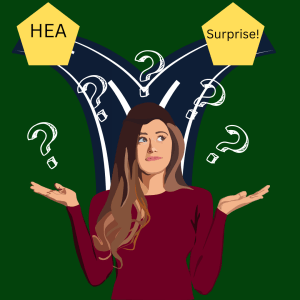
I went through a little identity crisis as a romance reader. The love stories I have read where the couple goes their separate ways or one of them dies, gave me enough pause to believe that any romance could end that way. So the tension and roller coasters the characters go through, I went through with them. But knowing ahead of time they are going to overcome it, temporarily took that magic away from me. I felt like “the man behind the curtain” had been exposed, and I was struggling with what I saw.
In the next romance I read after learning about HEA, the female MC was in a carriage accident. The final sentence of that chapter is, “And he watched his wife die.” I snorted and rolled my eyes. No he didn’t. She can’t die if this is a romance. The next romance I read had a gunshot at the end of a chapter, but who did the bullet hit? Well, before turning the page, I knew it wasn’t the female MC. How was I ever going to enjoy a romance again?
As I reached out to other romance readers about this identity crisis, most of them said something along the lines of, “I like knowing I’m guaranteed a happy ending. I read romance to feel happy. So it’s not about a surprise ending. It’s about the journey. How is the author going to bring them tension, danger, and drama to test their relationship? How are they going to overcome it? Is the journey believable, relatable, and entertaining?”
It took me a while to accept that mindset. And I had to read through several romances where I practiced viewing the story from that angle. But I eventually got it, and I’m back to enjoying romances.
This has also helped me in my own writing. Since as the author, I know the ending, I need to make sure that the journey to that ending is believable, relatable, and entertaining for my readers.
Are you a romance reader? What’s your favorite romance? What’s your favorite type of romance or trope?
When I finished my first draft of Bondwitch, I googled “how to publish a book”, and boy, did I have a long road ahead of me. After lots and lots of editing, comments from beta readers, and more editing, I had a choice to make: query an agent, query a small press, or self-publish.
Querying an agent seems to be the more traditional path. Once an author signs with an agent, their agent will then pitch the author’s book to a publisher. If the publisher accepts the book, then the book gets published. The publisher has an editor, artist, and marketing team to help with the process
Going with a small press is very similar to the above, just minus the agent. The author acts as their own agent. They query the publisher, the publisher either accepts or rejects the book. These publishers are called “small press” because they either don’t publish as many books as “The Big Five” publishers per year, or they aren’t as well known, or they don’t offer the “whole package” (for example, one author friend is with a publisher who requires its authors to hire their own editor and cover artist, and the publisher covers everything else). Even with the label of “small”, some are still pretty large.
Self-publishing is where the author does everything on their own: editing, cover art, formatting, and marketing – or they pay someone to do it.
Of the three, self-publishing is the only one that guarantees your book will get published. If you want a publisher to publish your book, they have to accept it. That is often a long and painful road of rejections before someone believes your book is marketable.
Regardless of which path an author takes, marketing is something the author must be heavily involved in. We have to create ways in which potential readers will come across our book and hopefully buy it.
At first, I thought I wanted to go the agent route. As I researched agents who repped fantasy and romance, I discovered something. Most agents don’t accept a broad genre. They have something called a Manuscript Wish-List, which specifies what kind of stories within a chosen genre they are interested in. For example, one agent may list “Urban Fantasy with a strong female protagonist”. See how more specific that is than just “fantasy”? So as I looked at agents’ MSWLs, very few of them were asking for the kind of story Bondwitch is – or, at least it seemed that way to me. And the ones who did, wanted to rep authors from marginal backgrounds; and as a straight white Christian, that’s not me. Now, I want it understood that I am not victimizing myself here. I completely respect those agents for wanting to give diverse authors a better chance in the publishing world. It just simply meant that I needed to choose a different publishing path.
As I started looking at small publishers, I came across a similar problem with agents. Many of them are so small, that they publish a very specific type of story, that once, again, Bondwitch did not fit into. Bondwitch falls under “mainstream” YA Fantasy, and many small publishers pride themselves on publishing more “unique” stories.
At the same time that I was researching agents and small publishers, I started getting feedback from beta readers. Many of them couldn’t finish because they said they didn’t care for romance. I didn’t think I wrote a romance. Yes, there is a strong romantic subplot, but the main plot is not a romance. But, if the subplot was that big of a deal to potential readers, I needed to look at my genre categories differently. This led to a lot of research that I’ll talk about in a future post. But long story short, I was able to find a list of small publishers that had fantasy lines and romance lines, that way Bondwitch could fit into both.
I actually found The Wild Rose Press by accident. Several of the stories I read on Readict had “Published by The Wild Rose Press” at the end. I looked them up, and they didn’t require an agent for an author to query them! The stories I had been reading fell under the same aesthetic as Bondwitch, and I felt deep in my soul that The Wild Rose Press was the publisher for me. (My experience querying them can be read here.)
After all that research, and lots of thinking and going back and forth, I decided that querying a small press was the route for me. I like the idea of being my own agent, but I also need help with everything beyond writing the story. So the small press seemed like a great choice for me. I also believe in my story enough, that if all the publishers I queried rejected me, I was going to self-publish. While I queried, I created a self-publishing plan, just in case. Luckily I didn’t have to implement it, but at least I have it on the back burner if I ever want to, or if a future story doesn’t work for traditional publishers.
I am very happy with The Wild Rose Press and I hope to stay with them for a long time. They will always be my first choice.
 Chelsey M. Ortega