Interesting WWII Facts from the Warhawk Air Museum

Last week I traveled to Nampa, Idaho for my great-grandmother’s funeral. Whenever we have visited, I have always seen an advertisement for the Warhawk Air Museum. This time, I decided to finally go since I don’t know when/if I’ll go to Nampa again. As a history buff, I thought I’d share what stuck out to me in the museum.

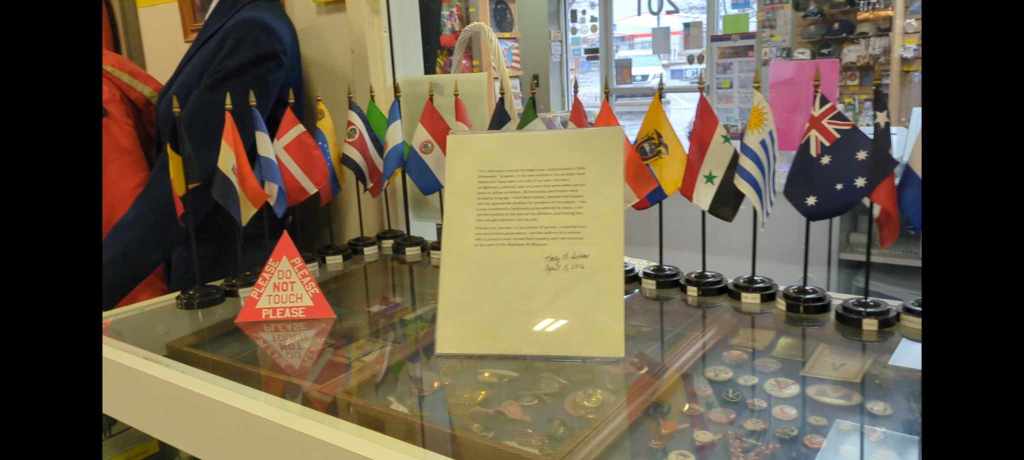
Who were the Allies?

In school, most history teachers focus on the U.S., Great Britain, France, and the Soviet Union fighting for the Allies. But in reality 47 countries allied together against the Axis powers.
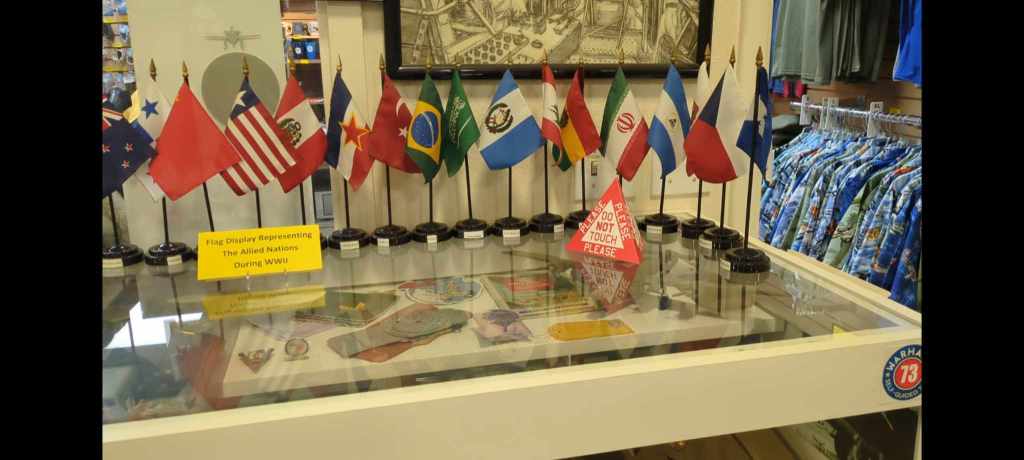
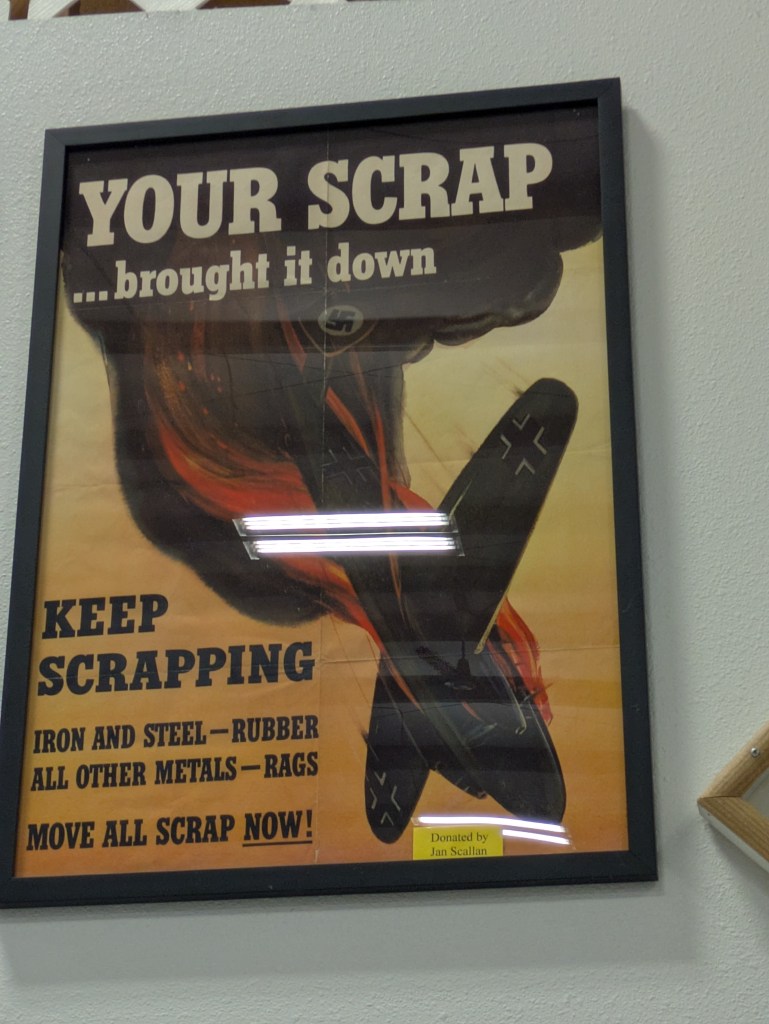
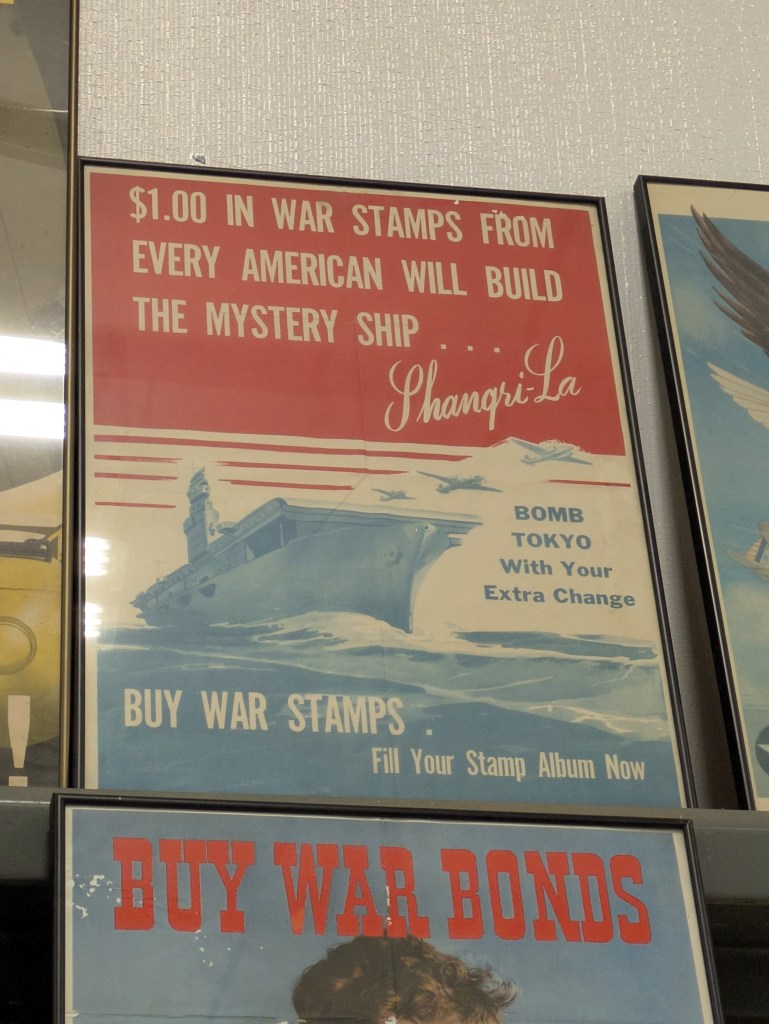
War Propaganda

There was a plethora of war propaganda to encourage American citizens to help with the war effort. Most of the propaganda is about being frugal with food and resources and buying war bonds. War bonds were debt securities. Basically, you gave the U.S. money, and it would grow in interest. The government would pay you back in interest when the bond “reached maturity,” which was several years after the bond was purchased. This allowed the government to get more money for the war without raising taxes. Below are the posters that stuck out to me. 

“Spoils of War” decorations

Starting in WWI, using shell casings to create home decor became popular:
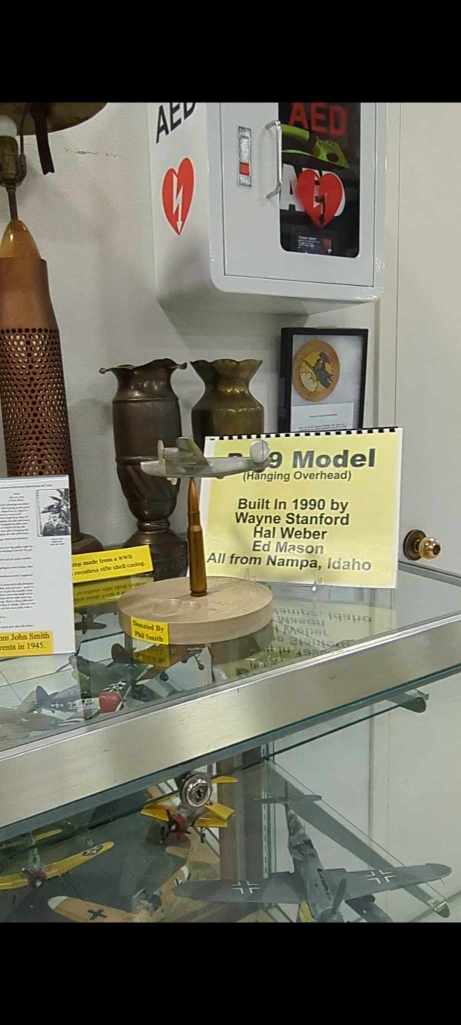
American soldiers were allowed to take and keep whatever they could carry home or pay to send home from conquered areas. Three examples in the museum were two Japanese Flags and a silk Japanese parachute.

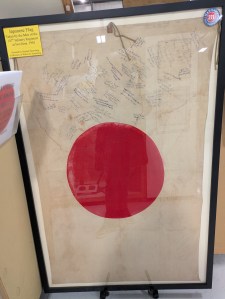
The flag below had flown at Iwo Jima, and when U.S. forces won the island, they took the flag down and signed their names. Whoever ended up with the flag in their possession, donated it to the museum. 
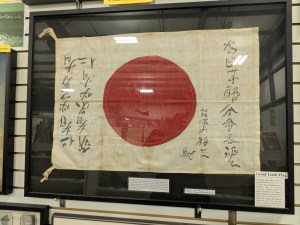
The flag below was a personal flag for a Japanese soldier who had it blessed by a Buddhist priest and signed by his loved ones. It’s sobering to guess that the original owner died at the hands of an American soldier, and that’s how it ended up in a museum in the U.S.
The silk parachute was mailed home by an American soldier who ended up in Honshu, Japan. When he returned home and met his future wife, his mom used the silk parachute to make her daughter-in-law’s wedding dress. The info cards explained that his parachute hadn’t been used. It was found in a warehouse taken over by the U.S. military during the mainland invasions.

The News Doesn’t Always Get Their Facts Right

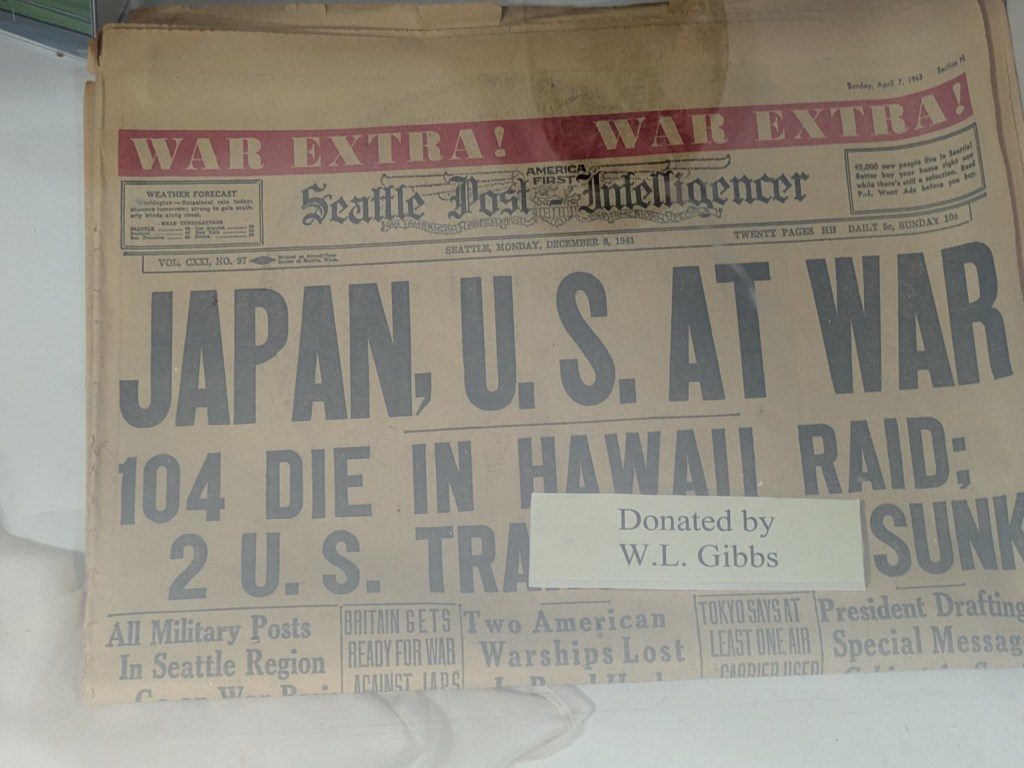
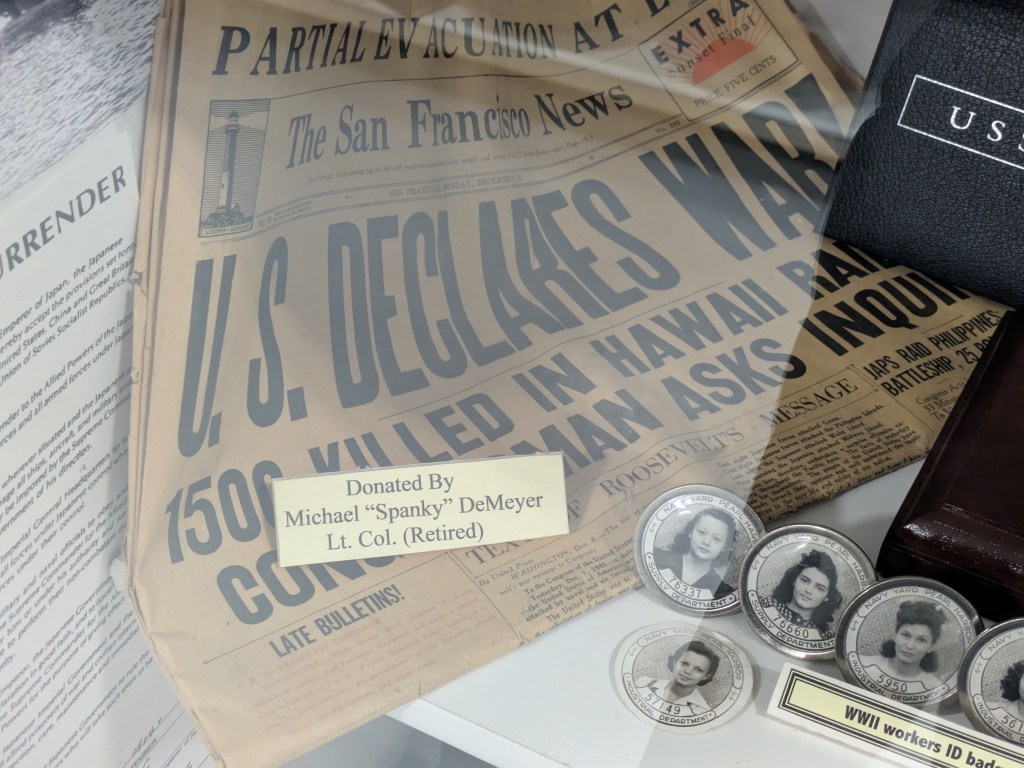
Below are two newspaper headlines announcing the attack on Pearl Harbor. The one from Seattle reported that 104 died while the paper from San Francisco reported 1500 died. Of course, getting fast and accurate information during that time wasn’t instant or easy. But it’s a good reminder to look at multiple sources when forming an opinion or making a decision.
Pieces of the Berlin Wall are scattered around the world

About ⅔ of the museum was dedicated to WWII, and the rest covered the other modern wars that the U.S. has been involved in. There was a small section dedicated to the Cold War, starting with pieces of the Berlin Wall. When I teach the Cold War, I show a newsclip showing Berlin residents hacking at the wall. I’ve watched that clip 8 times a school year, and it still makes me tear up.

Living on a battlefield was not glamorous

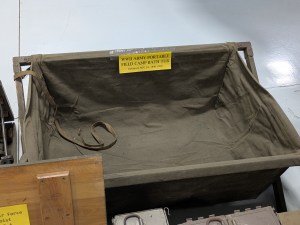
The picture below is a portable bathtub. I’m no good at guessing measurements, but one would definitely have to spend their bath with their knees bent into their chest, and the horizontal sides would only cover the waist and feet. 
WWI was originally called The Great War

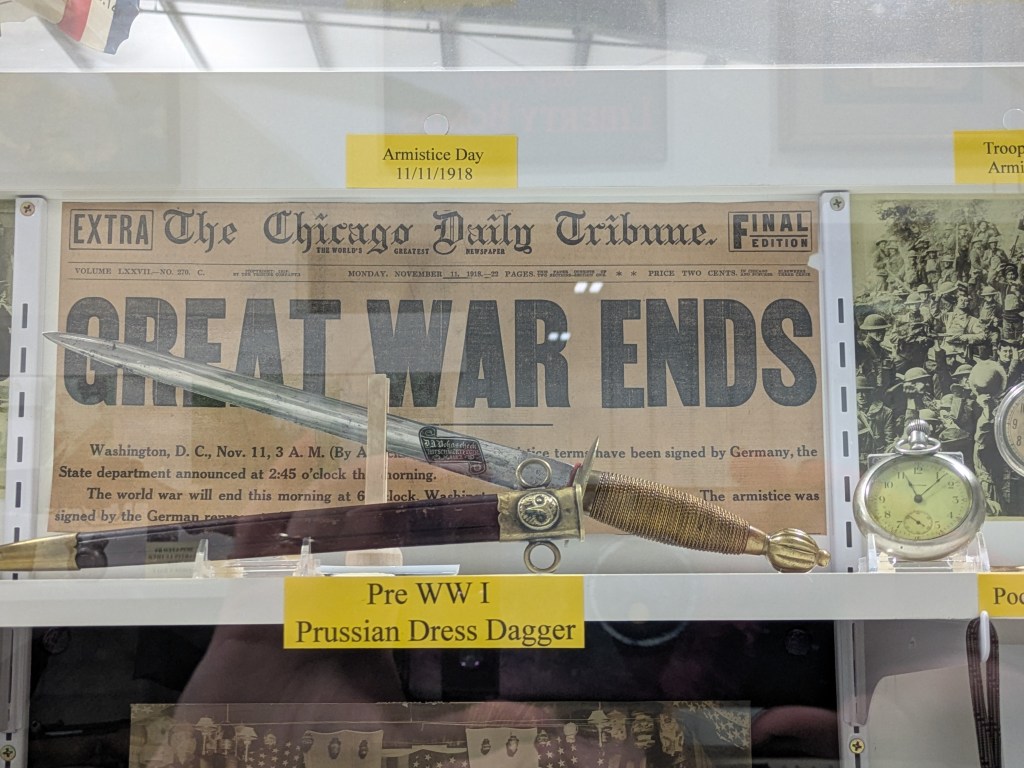
While I did know this before going to the museum, seeing the headline below was a great reminder. As a history teacher, we call The Great War by its new name because that’s its new name. While I do mention to my students that it was originally called The Great War, it’s not a fact I test them on. We focus on U.S. involvement and the changing technology from the first year of the war to the last year of the war. But it is good to know this if you’re going to study primary sources because this is the language that will be used during the time period.
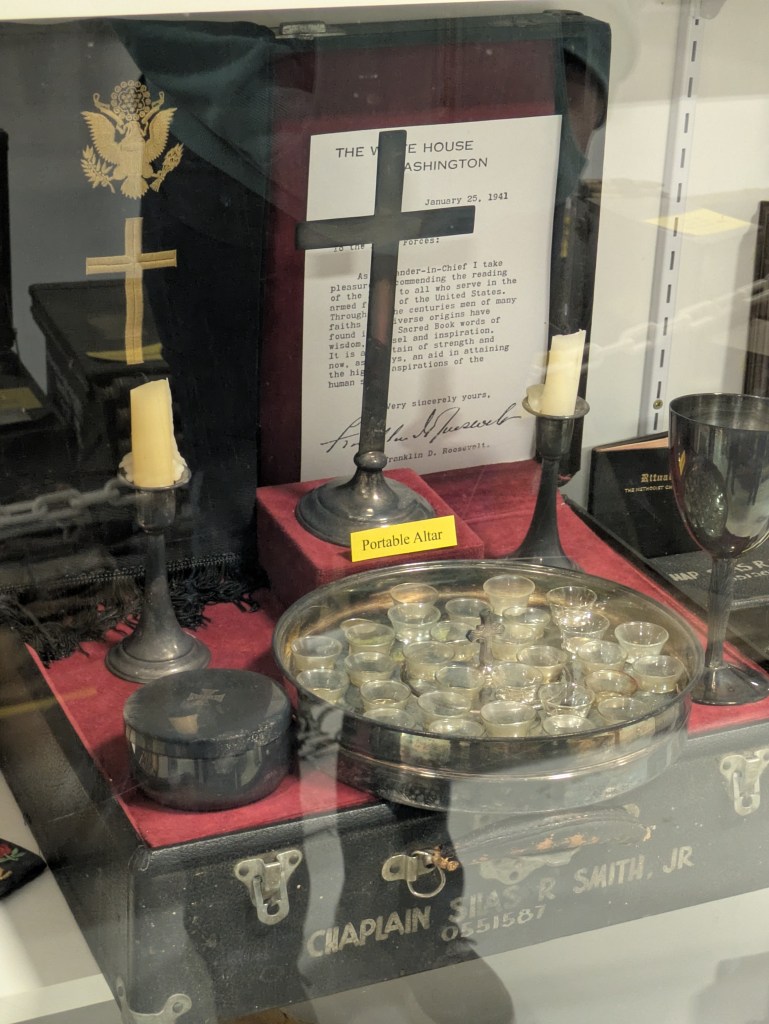
Soldiers have access to religious ceremonies while serving

I have a childhood friend who is now a military chaplain. And him choosing this career path is the only reason I know this position in the military exists, and thus I actually noticed these kits and took pictures of them to send to him. 

The Controversy of Vietnam

With each war that I teach my students, I ask the questions: Was entering this war justified? Did the U.S. stay true to their original goal? Did the U.S. fight fair? I keep my opinion out of the lesson. I am teaching my students to take the facts they’ve learned and form their own opinion in answering those questions and defending their opinion with evidence. We watch a short video about the Veterans Against the War gathering at the White House. But I’m going to add this banner to the lesson to show that just like civilians and politicians were divided about Vietnam, so too were the veterans sent there to fight.

The museum also has a section for the most recent occupation of Afghanistan. Overall, the feel of the museum is simply to educate. I didn’t get any pro or anti U.S./war vibes. It’s just simply “here’s what veterans have donated and this is what this donation teaches us.” I really enjoyed my visit.

What is an interesting fact about any war that you know? Share it in the comments! 

New Release: The Passenger by Joie Lesin

Joi Lesin’s debut novel The Passenger came out last month, and I am excited to introduce her and her Paranormal Historical Romance to you.


Let’s start with what is The Passenger about?

Elizabeth Reilly is twice haunted. She not only keeps the memories of her late husband, a casualty of World War II, close to her heart but she also inherited the ability to communicate with the spirits of the dead from her mother. 

When she aids a dying man, Paolo Clemente, in his last moments of life, she launches on a journey that will forever change her life and the life of the family Paolo left behind. After befriending Paolo’s ghost, Elizabeth travels to California to help him find peace. There she meets his son, Giovanni, who has recently returned from the war in Europe. Gio, as he is known by those closest to him, is only just settling back into his post-war life. When Elizabeth arrives, bringing news of the father he never truly knew, Gio is suspicious of both Elizabeth and her story.

The Passenger is a historical paranormal romance that explores the themes of love, grief and discovering who we truly are. These things are set against the backdrop of paranormal historical and picturesque settings that transports the reader to another time and place. Add to that, the characters are forced navigate the challenges of long hidden family secrets, matters of the heart, and the supernatural.

For me, the setting is as much of a character as the people who populate the story. The Passenger takes place in Cana, a fictional town nestled somewhere in California’s wine country. It’s a town where there’s so much more than meets the eye. 

To visit Cana, you must travel over winding roads bordered on both sides by green, rolling foothills and tall, sun filtering conifers surrounded by native plants. Along the way, the ancient trees part to reveal estates of all sizes. Here, a vineyard displays rows of grapes ripe for the picking. There, a ranch complete with cattle grazing the hillside. This is where you’ll find the vineyard Paolo Clemente bought after immigrating from Foggia, Italy to America. 

History and the paranormal are my two favorite genres. What inspired this story?

The inspiration for Elizabeth, Paolo, and Gio’s story came to me when I was 16 years old. I was on the city bus on the way home from school playing the “What If” game, making up stories for random passengers. 

On this particular day, I noticed a man sitting at the back of the bus who seemed a bit down on his luck. I wondered, what if he were alone in the world? What would happen if this man collapsed there on the bus? Would he die right there on that bus alone? What if I, or someone else, comforted him in his dying moments?

The tale blossomed from there until I finally sat down to write it 16 years later.

That’s amazing that such a seemingly small moment stuck with you for so long. How does that affect your writing schedule?

As a writer, I find I am a combination of a pantser and plotter—I puzzle together rather than plot my stories. For me this means I spend a significant amount of time thinking about the story. I tend to work out the story in my head like a problem that needs to be solved. This also means that part of my writing routine may look like I am just staring into the sky, but I am working hard—honestly.

All of my stories start with a single scene. Most of the time when that scene first comes to me, I don’t yet know the characters, but I see a moment in time. From there I treat it like a puzzle. I discover who the characters are by writing the opening and closing scenes. From there, I write to discover what has to happen to lead them from that opening to the single scene that birthed the story for me—and how to progress forward from that pivotal moment to the closing scene. Any plotting I do happens a scene or two at a time. It may not sound like it but it’s both organic and methodical for me.

I am, and have always been, a night owl. So, when I’ve gathered enough of the story elements together in my head, I sit down to write, usually, at night. Why? Because my creativity is most alive under the moonlight.

Welcome to the night writer’s club! When you aren’t writing, who are you?

Outside of writing, I am many things—a wife, mother, stepmother, daughter, sister, and friend. Until three years ago, I was also a Business Analyst, but now have the opportunity to focus on my writing full-time. 

For grounding myself, I simply love to lose myself in books and always have—both reading and writing them.

For fun, I take pictures and share them on social media. I’m always on the lookout for a view that’s new to me. I’m also a novice ukelele player. By this I mean, I’ve been learning how to play for the last four years. My husband did restring my ukelele for lefthanded playing, so I think I should get the hang of it one day soon—maybe. Which leads me to say, aside from books, one of my biggest interests is music. I have an eclectic taste, but my favorite to listen to by far is indie rock—80s and current.

I think anyone who can play a musical instrument is awesome. What’s next in your writing career?

 I am currently working on two projects at once. 

The first is a story that takes up where The Passenger left off. Like its predecessor, Watch Over Me is a ghost story and answers some questions left open at the end of The Passenger. This paranormal romance takes place in 1968 and tells the continuing story of Elizabeth’s daughter, Bella. What was the inspiration? A scene of Bella running through the vineyard with someone—or something—in pursuit while the earth trembles.

I’m also working on a mermaid novel that explores the relationships between sisters, mothers, and daughters. I’m very excited about this story and cannot wait to share more about it. 

First though, my ghosts are calling and want their stories told.


Minnesota-based author, Joie Lesin is a life-long fiction writer and the author of The Passenger. She has long been fascinated by anything otherworldly including ghosts. She loves to write a good ghost story—especially when it includes a touch of romance.

Originally from Massachusetts, at six years old, Joie moved to her mother’s birthplace, Minnesota. By eight, Joie lost her New England accent, however, it’s gradually returning as the years go by. She grew up in Minneapolis but now resides in St. Paul with her husband and their blended family—which includes a rambunctious grand-corgi.

Joie misses the ocean, but she often finds herself walking by one of Minnesota’s many lakes and travels to one of the coasts as often as she can. In fact, she considers California her home away from home. When she’s not writing, reading, or walking, you can find her listening to music. She absolutely loves music—especially live—and songs have sparked most of her story ideas.

Follow her at her website: https://www.jlesin.com/

She’s a 1940s ghost whisperer. He’s the son of a ghost.

Burdened with her empathic gift, Elizabeth Reilly wants to be free of it and fit in with normal people. Nevertheless, when the spirit of an old man asks for her help, she travels across the country to help him return home. Gio Clemente is still angry with his father who abandoned him as a child. To help the father pass on, Elizabeth must persuade Gio to let go of his anger. Though he resents her intrusion, they are both stunned to find themselves fighting a profound attraction. Elizabeth can accept his headstrong brand of love, but can Gio accept her gift—and believe in her?

The Passenger, a 1940s ghost story set in the California wine country, tells a tale of family connections, life-changing choices, and love—lost and found.

The Passenger is available now: https://www.jlesin.com/thepassenger

My Grandparents’ WWII Love Story by Lee Ann Sontheimer Murphy

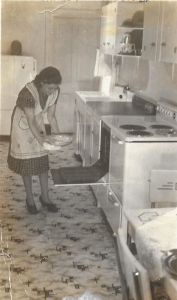
She was a widow with four children, ages sixteen to three, struggling to make ends meet after losing her husband in 1943. Edna Neely had grown up in a fine house, with a fur coat, and her own car at 16 but her world crashed when the stock market did. Everything was liquidated to pay her father’s debts when the banks failed. 

He was a farmer, older than the average soldier, and the “kids” serving in his unit called him Pop. Until he joined the Army, because he didn’t wait to be drafted, Claude Roberts lived near the small farming community of Fillmore, Missouri. Fillmore has fat farmland; fertile fields raise some of the state’s finest corn and soybeans. Surrounding farms produce cattle and hogs for the livestock market. In my grandfather’s day, nearby St. Joseph, MO still ranked as the third largest packing site in the nation.  He came from a large family but my grandmother was an only child.

After she married, my grandmother found a lifelong best friend in neighbor Margie Violett. The two young woman both had young children at home. They bonded over recipes, shared neighborhood gossip, and the age-old effort to understand the men they married.

After my grandmother was widowed, she joined the war effort. She volunteered her time at a local USO canteen and even though she hadn’t planned to find another husband, she was soon dating young men stationed at Rosecrans Field, an Army Air Corps based nearby. More than one proposed marriage but she declined, satisfied with her children and life.

Several of her cousins were away serving in the war and she wrote letters to each of them. When Margie suggested she add her Uncle Claude to her pen pal list, she did. Edna and Claude wrote numerous letters. She detailed her everyday life on the home front and he shared what he could of Army life in the Pacific Theater of war.

Despite the differences in location and background — she was raised in the shadow of the Missouri Capitol in Jefferson City, Missouri and he came from an Andrew County farm – they found common interests. My great-grandmother, Edna’s mother, also hailed from the Fillmore area. They poured out their hearts about music, life, and fell in love by letter.

When V-J Day came, the war ended and Claude would be coming home. They wrote about meeting in person but my grandmother never expected it to play out the way it did.

She woke up one winter morning to find a man, rolled up in his overcoat against the cold, on the porch asleep. It turned out to be Claude. When he’d gotten as far as St. Joe, he headed for the address he knew from the letters but since it was late at night, he decided to wait until morning. By the time my grandmother opened the door, he was nearly frozen.

Grandma invited him in, served him breakfast, and fell the rest of the way in love. They married a few months later and he became one of the best grandpas a child could have.

That’ s a real life love story. I write romance, from sweet to heat but I often draw on actual inspiration from my long relationship with my late husband or other family tales.

You can find my books on Amazon and elsewhere. https://www.amazon.com/stores/Lee-Ann-Sontheimer-Murphy/author/B004JPBM6I

And you can read my ramblings and writings on my blog here: https://leeannsontheimer.blogspot.com/

Real Life Romance: Of Love and War by Annie R. McEwen

May 16, 1938

Dear Albert,

The joke is on you this time. I bet a friend that you would never write to me twice in succession. As it happens, you did!

That was the start of a letter from Jean Morlach to Albert Patrick, my parents. Jean, known then as Gina Morlacci, had emigrated from Italy to the U.S. with her parents in 1921. Albert, whose family was already established in America, helped the Italians as they struggled to set down roots in Pennsylvania. Albert, born in 1915, and Gina/Jean, born in 1912, became best friends before they even had a common language. 

You see, it was my turn but I was so darned busy with my hobby show that I neglected to write. You wrote again, thinking it was your turn. I’m so glad you did. 

When Jean and Albert got engaged in 1939, it surprised absolutely no one except Jean’s parents. Still struggling to make a success of their Italian grocery, they’d expected that Jean, their oldest child, would stay at home to help. Jean and Albert had other ideas. Jean was so worried about her parents’ reaction that she wrote Albert about it. She was considering abandoning her devout Catholicism so her marriage to Albert could take place quietly and fast. 

You know, I’ve been thinking (I do it sometimes) that perhaps we’d better marry in a Protestant church. I don’t mind.

Albert, who’d divided his growing up years between Florida and Pennsylvania, got an apartment in Tampa and set about furnishing it for his bride. Jean industriously, but on the sly, added to her stock of soft goods. Knowing nothing of the Florida climate, she worried about heating. 

Are you getting gas in the house, or are you getting an oil stove? I just was wondering about it. 

Last night, I embroidered for a while and made napkins. I have four sets, now. 

When she wasn’t making linens, working at her new job as a grade school teacher, or slaving at her parents’ grocery, Jean longed for Albert.

It seems ages since I saw you last. You seem so very far away—almost unreal. There are ever so many things I’d like to talk over with you, but I guess they will keep. Only, I do miss you so very, very much. 

In 1940, while World War Two loomed and Albert was sure he’d be drafted, Jean and Albert married, not in a Protestant church but in the vestry of a Catholic one. Jean’s parents were as angry as she’d feared. She fled with Albert to Florida, leaving her trousseau—all those embroidered linens—behind. The newlyweds had just enough time together in Florida to conceive their first child when Albert was drafted. He went off to train with the U.S. Air Force. The young airman was shocked by the unreadiness for War he saw in his first posting to Atlanta. He wrote Jean about it.

I don’t think these people realize a war is going on, so much waste and complaining. Several plants and a dairy are on strike, 325 fellows here just sentenced for draft evasion. There was an air raid drill the other day and officials complaining about poor cooperation from people. 

War and loosening social mores were producing changes in American society, and not everyone was comfortable with them. Albert was appalled by local women. Or maybe his letter was an attempt to reassure his lonely bride back home that his eyes weren’t wandering.

The girls up here are awful. Their skirts are 3 to 4 inches above the knee and they smoke more cigarettes than men. More imitation blondes than I ever saw in my life. I’m not laying it on thick, it is the truth with no exaggeration. 

Jean had her own complaints, mostly about her rowdy students. She’d gotten a job in a rural community outside Tampa, teaching eight grades in a one-room schoolhouse.

I’m just a bunch of nerves. You know it’s difficult to keep smiling all day in front of the students when I feel like throwing some of them out on their heads.

As difficult as those war years were, Jean and Albert were sustained by their love letters. Jean’s always closed like this one. 

All my love to you alone. 

Jean

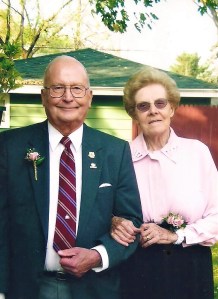
Jean and Albert were married sixty-two years. After Albert’s death, Jean lived another nine years, but she was never truly happy. Her last utterance before her own passing was Albert’s name.

As Albert’s ended like this, from 1941.

I love you, sweetheart.

Your husband

Annie R McEwen is an award-winning author of historical romance, paranormal romance, and romantic suspense. Her Bound Trilogy from Harbor Lane Books launches on May 7, 2024 with Bound Across Time, a love story that transcends death itself. Annie also has upcoming titles from Bloodhound Books (UK) and The Wild Rose Press. For release dates, giveaways, Annie’s quirky blog, and more, go to www.anniermcewen. Be sure to Subscribe for her fun newsletter and a free Regency Romance story. While you’re at it, visit Annie on Instagram: https://www.instagram.com/anniermcewen/ and Facebook: https://facebook.com/Quillist/ 

New Release: Outcast Artist in Bretagne by Diane Scott Lewis

My story is set in Brittany, France, in the small village of Saint Guénolé. It’s 1941, a year after the Germans have invaded France during WWII. A beautiful country backdrop marred by swastika flags, roaring motorcycles, and marching German soldiers. Norah, an Englishwoman, fled to France to hide the shame of her out of wedlock pregnancy the month before the invasion. Trapped, the baby stillborn, she lives with her cousins and draws birds, aching to return home.

August is the battle-worn German Commandant. He loathes Hitler’s policies. A widower, he starts to appreciate France and needs a change in his life. The lively Englishwoman catches his attention. Is she a spy? Or are his interests more visceral?

A TV mini-series, Island at War, inspired my story. The commandant was a complex, often-charming man.

I’m a terrible pantser, throwing ideas around, a vague idea of where to begin and where to end, until my characters show me where they need to go. Then I tighten it all up. The project could take a year and I try to write every morning, from 7 to 12. I fell in love with these characters and hate to say goodbye.

Diane Parkinson (Diane Scott Lewis) grew up near San Francisco, joined the Navy at nineteen, married in Greece and raised two sons in Puerto Rico, California, and Guam. She’s a member of the Historical Novel Society and wrote book reviews for their magazine. She’s always loved travel and history and has had several historical novels published. Diane lives with her husband and one naughty dachshund in western Pennsylvania.

Follow Diane at https://dianescottlewisauthor.blogspot.com/

Unwed and pregnant, Norah Cooper flees England to hide with her cousin in Brittany just before Germany’s 1940 invasion of France. After her baby is stillborn, she’s trapped under the Occupation as war expands across Europe. Norah grieves and consoles herself by sketching wildlife. When she’s caught too near the coast, she comes under scrutiny of the German commandant, Major August von Gottlieb.

August loathes what Hitler is doing to his country and France but is duty-bound to control the people in his jurisdiction. The lively young Englishwoman piques his interest. Is she a spy? He questions her and asks her to sketch his portrait so he might uncover the truth.

Soon, their relationship evolves into a passion neither of them can deny. She endures taunts from the villagers. His superiors warn him of not being harsh enough—he could be transferred or worse. He plans to sabotage a major war machine of the Reich, while she secretly helps the Resistance. Both acts are fraught with danger while kept secret from one another. Will their love ruin her and end in heartbreak? Or will they overcome the odds and survive the surging threats on all sides?

The Love Story of Susie Black’s Great-Grandparents

I first learned about how my maternal great-grandparents got together and their interesting love story as a young woman just out of college while helping my nana prepare for the Jewish New Year celebration. The story Nana told was so riveting, that I remember the telling as clearly as if it was yesterday. We’d been chatting and working in the kitchen when Nana asked me to polish a gorgeous set of candlesticks set on the counter. I opened the bottle of polish she handed me and lifted one of the candlesticks. “Nana, how old are the candlesticks?” I fingered the intricately beveled brass. “I’ve never seen anything like these before. They must be antiques.”

Nana nodded. “They are antiques. They are over one hundred years old. My grandparents gave them to my parents as a wedding gift. They were the only personal things my mother could take with her when she left Warsaw.”

I looked at her puzzled. “They’re not very big. She must have had a really small suitcase.”

Nana gazed at the candlesticks, and the memory brought a wistful twist to her lips. “A beautiful young woman, my mother.” Nana waved her hands in the shape of a woman’s physique. “Mama was a buxom beauty with raven hair and an hourglass figure, like a Jewish Sophia Loren, and crazy in love with a handsome man. She wanted to marry for love and fought her parents against an arranged marriage. They finally relented, but Mama was devastated after being jilted at the altar. No one ever discovered the missing groom’s fate. Had he run away with another woman or been killed in a pogrom? He disappeared into thin air. In those days, women were not educated and held few jobs outside of the home. So, to be supported, a young girl had to marry. My father is the man Mama’s parents arranged the rejected marriage with. He was a tailor. His profession made him a desirable catch. After Mama was left at the altar, the community considered her damaged goods. But my mother was so beautiful that even after she had rejected the arrangement, my father still agreed to marry her. They met for the first time on their wedding day. Papa gazed lovingly into Mama’s violet eyes as the Rabbi pronounced them man and wife. And right then, Mama fell head over heels in love with the stranger she had just wed.”

Nana pursed her lips. “Once they married, things became even worse than ever for Polish Jews. My parents wanted to start a family, but neither wished to bring children into such a hateful, dangerous place. After one of the bloodier pogroms that killed many people they knew, my parents decided to leave Poland via the Jewish underground. This was a network of brave souls throughout Eastern Europe who helped Jews escape. My father went first. He made his way north to Birmingham, England, and took a job sewing the coal miners’ uniforms.”

Nana dipped her head. “Mama understood it was too dangerous for them to leave together. But once he left, panic set in, as she had no idea if he’d make it all the way to England or not. She feared he would be killed or captured and imprisoned during his treacherous journey and she’d never see him again. After almost a year had gone by without a word from Papa, Mama was convinced he was dead. She became despondent, sick in both body and soul, and almost died of a broken heart. Then she finally received a message from him. But letters took months to arrive, if at all, and were few and far between. Papa saved his money, and after two years, he sent for my mother. She received word from the underground and had to be ready to leave quickly. Can you imagine saying goodbye to your parents, siblings, and friends, realizing you might never see them again?”

My heart clenched as I nodded no.

“Anyway,” Nana continued, “A man came to their shtetel at midnight on a moonless night. My mother could only take one small knapsack that held some clothes, a family photo, and the candlesticks. She bid her family goodbye, and the man took her to the narrowest part of the wide Warsaw River, which was infamous for its dangerously strong currents. If you weren’t familiar with the way they ran, you’d be pulled under by the current and drown. My mother climbed on the man’s back, and he swam her across. On the other side, he handed her to the next underground person. She slept in forests and caves during the days and traveled either by horseback or on foot at night. Fighting off wild animals and the elements, as well as hiding from the law, it took her over two months to travel this way across Europe. She arrived at Calais and boarded a freighter to England. With little money, clothes, or the ability to speak English, she managed to travel to London, then north to Birmingham, and finally reunited with my father.”

I applauded like I would at the end of a play. “Oh, Nana, what a love story. It could be a movie or a play.”

Nana smiled. “Yes, it has all the drama of a film or a play. They defied the odds and their love sustained them through the darkest days. The unbreakable bond of love my parents had for one another turned the seemingly impossible into a reality.”

I pointed to the candlesticks. “Nana, when I get married, I want those candlesticks to be your wedding gift.”

Nana patted me on the cheek. “Consider them yours.”

Susie Black as an Author:

Named Best US Author of the Year by N. N. Lights Book Heaven, award-winning cozy mystery author Susie Black was born in the Big Apple but now calls sunny Southern California home. Like the protagonist in her Holly Swimsuit Mystery Series, Susie is a successful apparel sales executive. Susie began telling stories as soon as she learned to talk. Now she’s telling all the stories from her garment industry experiences in humorous mysteries. Connect to Susie here: https://linktr.ee/susieblack.com

Highlight of Susie Black’s latest release:

Slated for publication release on February 15, 2023, the second book of The Holly Swimsuit Mystery Series is set in the heart of the competitive Los Angeles Apparel Industry. Death by Pins and Needles is the story of one ruthless woman who didn’t care who she had to step on to get to the top. Lissa Charney is the showroom manager of a ladies’ swimwear line in the California Apparel Mart. Since Lissa didn’t think any of the rules applied to her, she had no problem breaking them all. From job stealing to dumping a boyfriend when he needed her the most, selfish and self-centered Lissa’s list of enemies rivaled those of Al Capone. So, when Lissa is murdered, no one on the swimwear aisle was particularly surprised…the only surprise was what had taken so long.

Who wanted Lissa Charney dead? The list was as long as your arm…. but which one actually killed her? The last thing Mermaid Swimwear sales exec Holly Schlivnik expected to find when she opened the closet door was nasty competitor Lissa Charney’s battered corpse nailed to the wall. When Holly’s colleague is wrongly arrested for Lissa’s murder, the wise-cracking, irreverent amateur sleuth sticks her nose everywhere it doesn’t belong to sniff out the real killer. Nothing turns out the way she thinks it will as Holly matches wits with a heartless killer hellbent for revenge.   And as if Holly’s life is not already a hot mess, throw the complication of a hunky new man who sets her every nerve ending on fire into the mix, and things get really interesting.

A Boy Carrying a Watermelon by Kitty Shields

The original Kitty Shields was a titan at 5”0’. She could convince the tides to turn left and guilt the devil into helping her clean the house. She was a force of nature, and also my mommom. As with most love stories, this is as much legend as truth. But let me tell you a romance that started with a boy carrying a watermelon down the street.

Kitty Shields and Joe McElhenny grew up in the same neighborhood in South Philadelphia—both products of a strong Irish Catholic upbringing in a close-knit community. He was seven years older than her, so for the early part of their lives, they ran in different circles. Until one June morning when an eleven-year-old girl struggled to carry a watermelon twice the size of herself down the steep hill to her house. And a gallant eighteen-year-old boy offered to carry it for her. She never forgot that morning or the kindness of that boy.

The two continued to circle each other. As these things usually happen, Kitty grew into a beautiful woman. When she was about seventeen, she walked by a group of young men loitering out on their front steps. Joe saw her and called out, “Kitty, can I walk you home?” She looked him dead in the eye and said, “You look fine right where you are.” Because nothing says romance like telling the boy you like to stay the hell away from you. Years later, Kitty admitted her mouth sometimes went a little too fast for her head.

Soon after, Joe joined the Navy. It was 1938 and the U.S. had not entered WWII yet. In fact, his ship, the U.S.S. Canopus, pulled out of Pearl Harbor ten days before the attack that would take America into the war. In 1942, the U.S.S. Canopus was assigned to the Philippines, where the crew served and repaired submarines and other ships. After the surrender at Bataan, the crew scuttled and sank the Canopus rather than giving it over to the enemy. Along with over two hundred other members of the crew, Joe was taken prisoner and held by the Japanese for two years.

Meanwhile, Kitty took a job as an administrator at the Philadelphia Naval Yard. More than most, she was aware of what the war really cost in terms of lives. And like many people during that time, she had put her life and dreams on hold. But after the war was won, Kitty made a decision that she was ready to get married and she went looking for a certain boy that she remembered from the neighborhood. Using her connections at the navy, she tracked him down in the middle of the Pacific where he had been assigned on the U.S.S. Missouri.

Joe was out at sea when he received a letter from home, a letter in handwriting he didn’t recognize. He tore it open, worried about what news might be inside. After scanning the contents, he jumped up and headed out of the room where his friends were. They called after him, “Bad news, Joe?” He stopped long enough to grin back at them and say, “No. Best news of my life.” Then he ran off to write his reply.

After that, Kitty and Joe corresponded, getting to know each other and growing a healthy respect and affection for this person that neither had set eyes on in years. When Joe’s ship finally returned to Philadelphia, they dated properly. On the third date, Joe asked Kitty to marry him. She looked at him dead and said, “You’re insane. People don’t marry after three dates. We have to wait a while.”

“Well, what’s a while?” he asked.

“A year,” she said.

“Okay.” He shrugged. “I mean, I already know, but I’ll wait forever if that’s what you want.”

She didn’t make him wait forever. She did make him wait a year, though. At long last, they were wed, and Joe was transferred to the naval yard as a legal officer. Now, Joe was a bit sluggish in the mornings. And one morning he was being particularly slow to get out the door. Kitty threatened his life if he didn’t get his behind moving and get to work. She was eight months pregnant with their first, and a little ungainly and a lot uncomfortable.

He looked at her and said, “I’m afraid to leave you. What if you fall and I lose you? I can’t handle that.” She patted his cheek and stood on her tip-toes to give him a kiss and told him she’d be fine. And to please, get the hell to work.

Some love stories are epic. Some love stories are tragic. And some love stories are about falling in love with your husband all over again because he hovers over you while you’re pregnant. Kitty said she never forgot the way he looked at her that morning and knew she’d made the best decision of her life. Joe said he never loved anyone else. This is a love story that started with a boy carrying a watermelon down the street.

By: Kitty Shields (the younger)

About the Author: Kitty Shields (she/her) lives outside Philadelphia, where she writes to overcome the fact that she was born a middle child with hobbit feet, vampire skin, and a tendency to daydream. In her spare time, she binds books, takes bad photos, and dodges the death traps her cat sets.

You can check her debut novel Pillar of Heaven from Amazon here (https://www.amazon.com/dp/B08GFV95K5). It’s a Tale of Assassins, Telepaths, & Lattes:

With the holidays looming and student loans coming to call, Kate McGovern needs to find a good-paying job and fast, preferably away from the masses of caffeine junkies and coffee snobs at her current job. But finding a job sucks. Finding your first proper job after college when you have no experience and no idea what you want to do really sucks. Then Kate’s favorite customer puts her up for an executive assistant gig with one of the richest men in Boston. And suddenly, Kate’s luck has changed. The catch? Her new boss expects her to read his mind. Literally. And she’s pretty sure he’s evil. No big deal. First jobs are always tough, right?

Follow Your Man by Helen C. Johannes

1947 Germany…

WWII has been over for nearly two years, but the Occupation is ongoing. Americans hold Bavaria and the small city southwest of Munich where my mother lives. She’s 26, still living with her parents. She’s lost a brother in the submarine corps. Her sister’s husband was shot down on the Russian front, but he somehow made it home. Rationing and curfews are the stuff of their daily life. She works the late shift as a nurse’s aide. She and her coworkers must be escorted home by the US Military Police.

Drafted at his high school graduation on VE day, my father is barely 20, one of the lucky ones posted to Occupation Europe. It’s cold, damp, and the rations are nothing to write home about, but he grew up in the Northwoods without indoor plumbing or electricity, and he worked his way through high school milking cows. Life in the Army is pretty good for a smart kid who doesn’t drink or smoke. He’s already a sergeant in the MPs. 

One night he and his partner escort local nurses’ aides home after curfew. They pick them up in their jeep and drive the women home through darkened cobblestone streets. One of the women, a pretty brunette with long, wavy hair smiles at him. He remembers that smile. She only speaks German, but he can fix that. The army offers courses in German. Soon, he’s teaching her English with comic books while he practices his German.

By 1948 he and his buddies all have German girlfriends, and some couples want to marry. Regulations say anyone who marries a foreign national must return stateside with the spouse within a month of the wedding. Decision time. Will my mother leave everyone she loves, the city she grew up in, her entire culture to follow this American soldier to a country that defeated hers? Will she step into the unknown with only the man she loves to keep her company? Will the new world be better than the current one?

It’s a life-changing choice, but she makes it. In a whirlwind they have three weddings over two weekends: one to satisfy the German government, one to satisfy the American government, and one to satisfy the church. Then they’re on a train to Bremerhaven for her first ocean crossing. As she stands on deck, she says goodbye to her homeland, her continent, wondering if she’ll ever return, if she’ll ever see her family again.

She’s followed her man to New Jersey, then to his home in the Northwoods while he serves in Korea, then to Illinois when he returns. On to Ft. Lewis, Washington, traveling across this vast nation by car in 1956, then back six months later all the way to the port of NYC for a much-desired return tour of duty in Germany for three years to spend reconnecting with family. Then to West Texas for three years, then back to Illinois, then on to the Northwoods when he retires. Now she has a new role, wife of a teacher. Later, when he retires from that, she’s the wife of an alderman.

Seventy-two years she’s followed her man, become a citizen, adapted to a new culture, worked and played and made friends, raised a family. Together, she and my father have created a legacy of love, hard work, and adventure for those of us that follow. When love calls, they’ve shown us, take a chance.

After growing up following these parents around this country and Europe, I couldn’t help but take their example to heart. I’ve followed my man in government service from Montana to the Midwest, and we’ve traveled together to three continents and dozens of countries. Everywhere I’ve lived or visited has informed my writing, and the love I’ve seen and shared inspires my work. My author tagline is “Hearts in Search of Home” because I’ve learned that home is wherever those you love choose to make it: https://helencjohannes.blogspot.com/

In celebration of the Month of Love, I’ve put my first book on sale on Amazon Kindle for 99 cents. An enemies-to-lovers fantasy romance, THE PRINCE OF VAL-FEYRIDGE, Crown of Tolem Series #1, is loosely inspired by that sense of adventure and willingness to take a chance my parents imparted to me.

She’s all wrong for Prince Arn, this lowborn healer who keeps meddling in his march to conquer her homeland. If only she hadn’t helped him, and he hadn’t kissed her, he could stop looking for her everywhere, hoping to find her…again.

Check it out here: https://www.amazon.com/Prince-Val-Feyridge-Helen-c-Johannes-ebook/dp/B003JH8CO2?ref_=ast_author_dp