The Alien Stories I Do Like…

I do not care for alien invasion movies, except for Independence Day. Super 8 was pretty good as well. But the rest? Two thumbs down. 

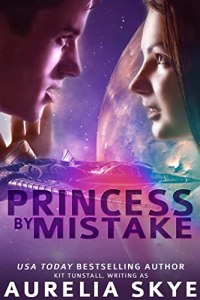
I came across a book called Princess by Mistake by Aurelia Skye. The blurb gave a description of a bounty hunter chasing down a runaway princess in order to return her to the prince she’s supposed to marry. Said bounty hunter captures the wrong woman, the female MC. They go on an adventure as he tries to take her to this mysterious prince and she tries to convince him she’s not the missing princess.

What I failed to understand from the blurb was that all the characters, except the female MC, were aliens. By the time I figured that out, I thought, “I’m already reading it for free. I might as well give it a try.” I LOVED it. And ever since, I have fallen down the alien romance rabbit hole.

Princess by Mistake has a “sequel” called Wrong Place, Right Mate. It takes place two hundred years later, and neither character is connected to the original characters. It simply takes place in the same world and the male aliens are from the same planet. A scientist from earth crashlands on the wrong planet. A bounty hunter alien comes across her and takes her on his hunting adventure. It was wonderful as well. The epilogue implies more are coming and I’m anxiously waiting. 

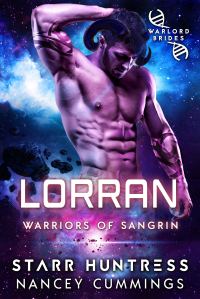
The next author I came across was Nancey Cummings. She has two of her own alien romance series, and has a book in 3 different multi-author alien romance series.

Her first and largest series is Warriors of Sangrin. There are currently 11 books in the main series, and 3 side stories. This series covers life after an alien invasion opens Earth up to the rest of the universe. The invading species, the Shulik, murder all of Earth’s leaders on international television, plunging the unprepared terrans (what other species call humans) into a war for their lives. The Mahdfel show up and ally with earth to defeat the Shulik. The Mahdfel have a very specific treaty negotiation for this alliance: brides. Mahdfel are a warrior species who are genetically engineered to produce only males, so they must mate with females from other planets. 

The scent of their fated mate calls to them, and one of their top scientists invents a mouth swab test to speed up the mate finding process. Females of marriageable age living on Mahdfel-allied planets must submit to testing once a year. The year they match, they are transported across the stars to wherever their mate is. Health conditions, already being married, being engaged, or already having children can exempt a female from being tested. And many of our heroines will do such things to avoid the test – at first. 

Each book covers a novella length adventure for a different couple. However, they are all interconnected via siblings, best friends, being in the same clan, or dealing with the same villain. Like the previous alien stories, I fell into this one by accident and read two of the side stories and the 8th book before I discovered the correct order. I was hooked from chapter 1, and have only the 11th book left to read. You can find a list of completed works here: https://nanceycummings.com/warlord-brides-universe/. 

Nancey’s second series is called Tail and Claw. I have only read the first one, Have Tail, Will Travel. So I’m not as well-versed in the lore and worldbuilding as I am the Warriors of Sangrin. But what I can tell so far is that Earth is aware of aliens and has relationships with the rest of the universe. There is a dating app called Celestial Mates that matches sentient beings based on a questionnaire. They get married over a tablet, and one of them travels to wherever the other is. 

Have Tail, Will Travel reminds me of that old children’s book Sarah, Plain and Tall. A human woman is matched with an alien male, Merit, who has ended up as sole guardian of his orphaned niece and nephew. Merit uses Celestial Mates to find a female to be a nanny. His “nanny” wants love and adventure. They’ll have to overcome their miscommunication amongst dangerous monsters and a plotting sister-in-law.

I’m excited to read the rest of the series.

The intimacy scenes for both series are at a heat level of spicy.  

And that’s where I’m at with my latest guilty pleasure. Once I get caught up on Nancey Cummings’ books, I’ll definitely be checking out other authors like her. 

Do you like alien stories? What’s your favorite? (They don’t have to be a romance.) Let me know in the comments!

When History and Magic Collide: Stone Heart

When a book is close to its release date, the author usually offers ARCs (Advance Reader Copy). Readers get a FREE copy with the hope that they will provide an early review. I’m so excited and honored to have read Stone Heart by Kitty Shields early. 

Stone Heart combines my two loves: history and magic. I actually haven’t read a lot of fantasy stories that take place in the past, and I found I really enjoyed such a combination.

Our hero, Edward, the Marquess of Winchester has struggled for the past decade. His father died in the colonist rebellion (a.k.a. The American Revolution), thrusting the noble mantle on him much earlier than anticipated. He thought he found love with his best friend’s cousin, Phoebe, but knowledge of her past causes him to end things. The story opens with Edward attending the opening night of a new opera, accompanied by his mother and a new young woman his mother wants him to court. The lead singer dies on stage in front of the entire audience. 

Edward gets wrapped up in the investigation and learns that Phoebe is in danger of dying in a similar way. Although he is still convinced that their relationship is over, Edward isn’t so cold he would allow Phoebe to die, so he races to the continent to save Phoebe. On his journey, Edward will learn to accept help from old friends, new friends, and unexpected allies. What true love is and what lengths one goes to get that love is the center of all characters’ motivations and actions. Different types of love are explored throughout the story that gives hope for a happily ever after.

When it comes to the historical aspects of the story, Kitty Shields does an excellent job of weaving the aftermath of the war into her characters’ lives and conversation. She also puts several real people and places into the story as side characters. I didn’t know about any of them, and so I appreciated the appendix at the end of the book that gave the factual history of each person and why Kitty chose to put them in her story.

The magic in Stone Heart was really unique. There are descendents of a mythical creature called a stone giant. The stone giants had the ability to remove their hearts from their chests to prevent themselves from dying in battle. Their descendants can grow their heart into a red diamond and give it to their love for safe keeping. Phoebe does this and gives her heart to Edward. He doesn’t fully understand or believe, so he unintentionally literally breaks her heart. 

While Edward is racing to save Phoebe, he runs into Roma travelers, who also participate in different forms of magic. The types of magic the reader gets to experience with the Roma are sending nightmares to their slumbering victims, reading tarot cards, listening to the wind, and using flowers for spells. There is even one paranormal monster that Edward has to fight in a cemetery. 

The third and final plot line that makes Stone Heart so great is a side character who stole the show: Tilton. Tilton is a young aristocrat going on his rite of passage tour of Europe. Tilton is energetic and friendly, two things Edward is not. Tilton inserts himself into Edward’s quest and ends up going on an adventure. Tilton is my absolute favorite part of the story. 

In reviewing this lighthearted adventure, I couldn’t pass up the opportunity to interview the author, and she agreed! So, without further ado, I present Kitty Shields.

Introduce yourself as a person and a writer.

Hello, Gentle Readers. I am Kitty Shields. I live outside Philadelphia with a black cat named Jinx who is plotting to kill me. I started writing as a way to cope with insomnia when I was a kid. When I couldn’t fall asleep, I’d sneak downstairs, hop on a computer, and write weird stories. Well, first I’d go down and play video games, but after a while I beat all the games and turned to writing.

As a writer, I start with a nugget of emotion and a scene. So Stone Heart came from the opening scene of Edward on the docks heading to the ship filled with regret. My book Pillar of Heaven, which is like The Devil Wears Prada as an urban fantasy, began with the main protagonist dealing with crappy customers at her barista job and her planning to sabotage all their lattes. The story Star Eater, which is about a sleep-walking teenage boy and his demon, began with him waking up on a golf course in the middle of the night.

I imagine these tiny scenes and from there I build the stories forwards and backwards, adding a dash of magic as I go.

What inspired Stone Heart?

Like I said, Stone Heart evolved from that opening scene. I clearly saw this guy on the docks heading towards a ship and weighed down with regret because of something he had done, so much so that he wasn’t sure he would sink the ship or not. I really liked the notion of emotions manifesting to the point where it brings about this leap of faith moment—is he going to survive getting on the ship or not?

At the time, I was in grad school getting my writing degree and I was experimenting with different genres and voices. I had never tried historical fiction before so this was an initial experiment. My cohort hated it. They hated everything about it: the voice, the scene, the allusions to mythology, the flowery language. They ripped it apart.

That was a little disheartening, so I put it aside. But that character and scene kept drawing me back. Every now and then I’d revisit the story and write a moment here or there. Nothing was really connected yet just a bunch of ideas. Tilton came from one of those exercises. I had began filling out Edward’s journey on the boat and it depressed me! So I created Tilton to cut through Edward’s melancholy and bring some humor into the story.

If you want to learn more about Stone Heart or perhaps see who I’d cast for each of the characters, check out my website: https://www.kittyshieldsauthor.com/stoneheart.html .

I really enjoyed the historical slang, though most of it I had never heard of before. Would you introduce these fun words to our readers and what they mean?

Sure! Here are some fun words for you:

Toffs: Slang for someone with an aristocratic background or belonging to the landed gentry, particularly someone who exudes an air of superiority.

Dandy: a man unduly devoted to style, neatness, and fashion in dress and appearance.

Roma: a people originating in South Asia and traditionally having an itinerant way of life, living widely dispersed across Europe and North and South America and speaking a language (Romani) that is related to Hindi. Commonly known as gypsies, although that is a derogatory word.

Doshman: a word that means ‘enemy.’

It’s clear you did extensive historical research for the historical aspects of Stone Heart. What about the magical aspects? Was any magic inspired by European folklore of the day? Or did you make it all up?

Yes, the magic threads are all based on actual myths. I did a lot of research which, to be honest, was a lot of fun. It was more of a challenge to edit out what I really didn’t need. Hrungnir is a Viking giant and he could remove his heart so that when he went into battle, no one could kill him. The part I made up was about his descendants, about this line of families that could grow gems out of their chests.

Revenants are souls of the damned that come back. Based on the Old French word, revenir, which means ‘to return.’ The part I made up was them sucking the life force out of victims. Even the smaller bits, like the farnblume, is based on a Baltic myth about a healing flower. Most of what you’ll find in the story is based on a real myth. I invite you to look something up if it intrigues. I fully blame most of the story on falling down some really interesting research rabbit holes.

The side characters are so fascinating. Particularly Tilton. Will we see any of them again in future works? What’s next in your writing career?

Yes! Tilton is definitely my favorite and he will return. The sequel will be Tilton’s story. I’ll tease you with the title: Crow Heart. I’ve already gotten a first draft done and am in the middle of editing. The third book will follow Halkerstone. I’ve also got a few ideas for side stories. I’d love to see more of the St. Germaines; they were a blast to write. And who knows what other fun characters will appear on the way.

Stone Heart releases August 16, 2023. 

Going in Blind: Dragons Walk Among Us

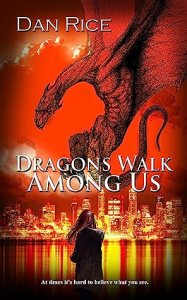
I’m about to eat my own words. In a previous post, I talked about how important a good cover and blurb are to convince potential readers to buy your book. Well, I put Dragons Walk Among Us by Dan Rice on my to-be-read list based on the title alone. I read it in an email (Dan is also with The Wild Rose Press), and put it on my list right away. I didn’t see the cover until I started following Dan on social media. I have never read the blurb. 

Allison Lee is an angsty teenager who participates in environmental rallies, takes photos for the school newspaper, and is navigating her feelings for her crush. In addition to typical teenage drama, Allison also deals with racism as a biracial Chinese American. Her best friends, Dalia and Haji, stick with her through her ups and downs. 

Allison is friends with a homeless veteran named Joe. One night, on her way to visit him, she is attacked. She wakes up in the hospital a couple weeks later completely blind. She lost her spot in her school’s social standing during her coma, and with her blindness, risks never regaining it. Her father introduces her to the creator of an experimental procedure that could give her eyesight back. Allison agrees to it, and after a few more weeks of surgery and healing, she is finally back at school with her friends.

There are a few unsavory side effects to Allison’s new eyesight, but the one she was not prepared for is a giant holographic dragon following her father’s colleague around. Allison makes the bold decision to tell the professor that she can see his dragon. Her confession pulls her into the world of dragons and an impending war with their enemies, the skaags. 

Dan Rice expertly wove Allison’s human struggles into the tensions of the dragon community. The bigotry and prejudice Allison faces as a biracial human also plagues the dragon world in its own way. Allison was abandoned by her mother at birth, allowing her to bond with dragon characters who also struggle with feelings of abandonment. 

Mr. Rice also captured the American teenager perfectly. Allison is quick to anger, quick to love, and quick to react. She struggles with self-esteem about her personal appearance. And she is passionate about her interests. Her friends, and even her enemies, are all believable high school students that I can see in my classroom. 

I thoroughly enjoyed each and every scene, and I can’t wait to read the sequel. 

In addition to my review, I am pleased to introduce Dan Rice, who kindly granted me an interview:

First, would you introduce yourself as a person and a writer?

Hi, I’m Dan. I pen the young adult urban fantasy series The Allison Lee Chronicles in the wee hours of the morning. The series kicks off with my award-winning debut, Dragons Walk Among Us, which Kirkus Reviews calls, “An inspirational and socially relevant fantasy.”

While not pulling down the 9 to 5 or chauffeuring my soccer fanatic sons to practices and games, I enjoy photography and hiking through the wilderness.

What inspired Dragons Walk Among Us?

I wanted to write a book from a relatively young age. I grew up reading fantasy and science fiction and naturally gravitated toward writing those genres. For a long time, I wanted to write gritty epic fantasy like Game of Thrones or Joe Abercrombie’s novels. Eventually, I discovered my authorial voice is more suited to young adult material.

The opening scene in Dragons Walk Among Us was inspired by my older son being harassed for his biracial appearance at summer camp. Allison’s encounter with Leslie grew from that seed, and the rest of the story flowed from there.

There is a lot of great racial diversity in Dragons Walk Among Us. Was this a conscious choice? Or did the characters tell you who they were as you created them?

My sons’ schools are far more diverse than the institutions I attended. I wanted to write a story that would ring true with young adult readers. So I created a diverse cast to match what I observed at school events and read in news articles about the increasing diversity across the United States.

You did an excellent job portraying the angsty teenager. What experience do you have with teenagers and/or what research did you do that helped you bring these believable characters to life?

Well, people were all or will be teenagers, angsty or otherwise, at some point in life. My oldest son still isn’t a teenager, but he’s been acting like one since about the age of eight. I often imagine what his antics might be like if he were a bit older.

Allison describes dragons as “European” and skaags as “Chinese”. In your worldbuilding, are both creatures somehow related?

The original skaags were laboratory creations the dragons made to hunt down rebels. The draconic empire deploys magic to bind the skaags as loyal soldiers. The magic is believed to be unbreakable.

The third book is coming out soon. Is this the end of Allison’s story, or does she have more adventures ahead of her? What’s next in your writing career?

The entire series will be four books. Right now, I plan to participate in a haunted high school series my publisher is doing. After finishing those projects, I will try penning a dystopian novel.

Follow Dan at his website: https://www.danscifi.com/

A Hidden Werewolf Gem: The Alpha and Her Hunter

Shifter romances probably outnumber all other romances on reading apps like Dreame, Readict, Radish, etc. And because of that, there are common and expected tropes and world building details within those stories. I often love it when an author “breaks the rules” for the genre they are writing in, especially when it’s done well and it’s not an obvious they-were-trying-to-be-different situation. 

The Alpha and Her Hunter by Lauren Rutherford falls into the well-done category of breaking the norm for shifter romances.

Willow is a wolf shifter in a world where the females are the strongest and the leaders. Garin is a Hunter, born into the most ruthless Hunter family in existence, the Red Hoods. Garin’s family has moved into Willow’s town with the purpose to stir up trouble. Despite their families’ feudal past, Garin and Willow can’t fight the attraction between them. They will face jealousy, bigotry, and death plots in order to earn the approval to love. In this enemies-to-lovers/Romeo & Juliette romance, I was on the edge of my seat the whole time. I fell in love with Willow and Garin and rooted for them until the last page.

The majority of what sets this shifter romance apart from others is the world building. In this world, female shifters are bigger and stronger than males when they are in their wolf form, and thus females are the Alphas of their families and clans. The Alpha is determined by the physical and mental/psychological strength of their wolf. Each pack or clan has an Alpha, and within that group, each family group has an Alpha.

There is a type of mate bond called imprinting (like in Twilight), but finding one’s true mate is rare, so most shifters settle for arranged marriages. Willow is betrothed to a male shifter who she is not feeling it for at all. 

Hunters are humans who hunt werewolves. Now, not just any human can be a Hunter. They have extra abilities: they are stronger than your average human, go to special schools to train, and they can smell werewolves. Because of this, Hunters also participate in arranged marriages in order to keep their bloodlines strong.

The unique world building changes are only part of why I loved this book so much. The characters are likable, and the pacing for their growth (as they transition from enemies to lovers) is believable and satisfactory. And if you prefer a clean romance, the heat level is sweet. 

While there is an official resolution to the plot, it’s clear a sequel should be coming, and I can’t wait to read it. 

I give The Alpha and Her Hunter 5 stars. It can be read on the following apps: WebNovel, Mangatoon, Tapas, Dreame, and AnyStories.

Meet the Characters of the Holly Swimsuit Mystery Series

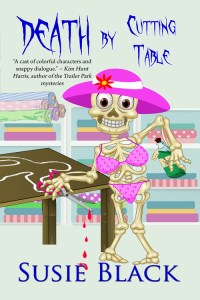
If you enjoy cozy mysteries, you might have seen these skeletons floating around the internet:

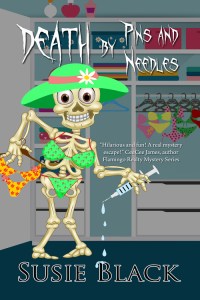
Shortly after the second book, Death by Pins and Needles was released, it became apparent that the cover skeleton needed a name. Ms. Black put the naming in the hands of the readers and set up a contest. The winning name got a free digital copy of Death by Pins and Needles. 

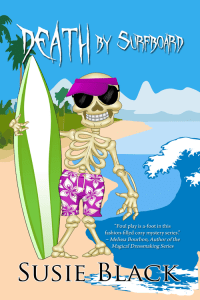
As you can see by the cover for the third book, Death by Surfboard, Susie now has a male skeleton that needed a name. She created another contest with the same prize. Well, I helped name the male skeleton (Susie will be sharing the details of these two contests down below), and I got a free copy of Death by Surfboard! 

So, here is my review of Death by Surfboard:

Holly is a swimwear executive, and she has a new colleague who she does not trust. She tried to warn her boss about him, but she got shooed out of his office instead. Well, quickly into this new hire Holly is proved right. And who does her boss assign to clean up terrible-colleague’s mess? Holly, of course!

Lucky for Holly, and unlucky for terrible-colleague, his body is found on the beach, attached to his surfboard. But the issue is not over for Holly because the detective, who also happens to be Holly’s friend, accuses not one, but two innocent suspects. So, Holly, being the nosy do-gooder that she is, can’t just sit back and let the detective figure things out. She then spends page after page doing crazy things that risk her job and her life on her quest to discover the real murderer. 

This is my first time reading a cozy mystery, and I’m in love. Even though it’s the third book in the Holly Swimsuit series, I was able to jump in and figure out who everyone is and the layout of Holly’s world. Holly reminds me of a grown-up Hanna Marin (Pretty Little Liars): fashion forward, blunt, and she can’t pass up an opportunity to solve a mystery. I thought it was a great challenge for the victim to be such an unlikeable character. I mean, the reader is made to feel he deserves what he got, so why try to solve his murder? Because the two suspects the police are looking at Holly knows are innocent. So, it becomes less about justice for the victim and more about protecting the innocent from being framed. I was determined to figure it out before Holly did, and I’m proud to say, I was half right. I’ll definitely be reading the first two in the near future.

Reading a series out of order is not new for me. I do it all the time. So, I have teamed up with Susie Black herself to introduce the recurring characters of the Holly Swimsuit Mystery series. That way, no matter where you start in her books, you will know who is who.

Hello, please allow me to introduce myself. I am Susie Black, author of The Holly Swimsuit Mystery Series. I’ve been asked to share what entails writing cozy mystery series.

Like the protagonist in my Holly Swimsuit Mystery series, I am a ladies’ swimwear sales exec. From the beginning of my career, I have kept a daily journal that chronicles the quirky, interesting, and often challenging people I’ve encountered as well as the crazy situations I’ve gotten myself into and out of. The journal entries are the foundation of all my writing.

As a sales exec, I am a people person. So, naturally, my primary focus is on character development. Once the characters are created, the plot easily falls into place because it reacts to the characters in the story, not the other way around. I chose to write my stories as part of a series, but because I like to give options, each book can be read on its own out of order without the reader getting lost. Pretty cool, huh? So, how in the world did I accomplish this? By making references to the background of the story setting and the main characters. I make each plot, the murder method, the victim, the murderer, and the minor characters different in each tale. But I anchor the continuing main characters with consistent and distinct histories, personalities, and quirks that readers invest in and root for because they appear real.

Here are some of the important continuing main characters who appear in every book and a bit about them:

HOLLY SCHLIVNIK: Wise-cracking, irreverent Holly is the protagonist of the series who is patterned after yours truly…Holly is the me I always wanted to be. Loyal to a fault and fearless, Holly is a ladies’ swimwear sales exec/nosy amateur sleuth who can’t mind her beeswax and sticks her nose everywhere it doesn’t belong. Holly has a quirky personality trait. She inherited her nana’s fear of death. They both respond to death by laughing.  And Holly does when she discovers a corpse. Holly is famous for this quirk and all her friends ask if she laughed whenever she has discovered a corpse. Holly’s pet phrases to describe her feelings are Yikes, Cripes, Holy Guacamole, and Merde.  

QUEENIE LEVINE: A compact dynamo equipped with a razor-sharp wit and sharper tongue, Queenie is Holly’s close friend and professional colleague…and her erstwhile crime-solving sidekick. Queenie has a distinctive habit of pushing her index finger up on the tip of her nose whenever she’s thinking out loud. When trying to flesh out the murderer, Queenie is always the one who asks “Who has the most to lose?”

JOAN BINDER: Quick-witted, sarcastic Joan is the oldest of the Yentas- four of Holly’s colleagues she meets with for coffee every workday morning at a coffee shop in the California Apparel Mart lobby to kibbitz and compare notes and opinions. Joan has a habit of looking over her eyeglasses perched on the tip of her nose in her “kindergarten teacher” disapproving pose whenever she delivers one of her acerbic zingers.

Dr. Sophie Cutler: Los Angeles County Assistant Medical Examiner Sophie Cutler is Holly Schlivnik’s lifelong friend and not your typical Coroner. For a medical doctor, “Snip,” as Holly calls Sophie, has atrocious eating habits. She is a pizza and cheeseburger lover as well as a desertaholic. Sophie refuses to share any of her cheesecake and is known to use a fork as a weapon to fight off Holly’s attempts to swipe a bite.

Smart Alec Snip has caller ID on her phone. When Sophie sees it is Holly calling, irreverent Snip answers the phone with hilarious greetings: such as “Good afternoon. This is Los Angeles County Assistant Medical Examiner Dr. Sophie Cutler. You stab ‘em we slab ‘em.”

Sigmund Freud AKA Siggie: Introduced in book three of the series, lovable, nosy Siggie is Holly’s male standard-size Poodle/assistant sleuth, and Psychiatrist. Holly discusses everything with Siggie-her love life, her friends, how to deal with pain-in-the-patootie customers, as well as viable options to flesh out a killer with her four-legged companion. Siggie might not speak but he gets his points across just the same. If he likes Holly’s game plan, he barks his approval. He shows his disdain for some of Holly’s crazier sleuthing ploys by rolling his eyes or shaking his head from side to side.

The book cover Skeleton:  Whodathunk that a skeleton wearing a swimsuit would ever garner such a huge amount of attention? I’ve had countless numbers of readers tell me they found the book cover with the skeleton so intriguing; they bought the book to see what kind of story was inside! The skeleton on every book cover was so popular it took on a life of its own and became the face of The Holly Swimsuit Mystery Series brand and became a successful marketing ploy.

Before the release of Death by Pins and Needles, the skeleton demanded she is given a name so I ran a contest to name the female skeleton and was inundated with hundreds of entries. So many great names were submitted that I ended up using several of them as a first name, middle name, and surname: Mizz Bone-ita Skelemina Bonz.

Before the release of Death by Surfboard, Mizz Bonz informed me she had a boyfriend and insisted he needed a name. So, to make our girl happy a second contest was launched and her boyfriend is now known as Mitzer Skeltor Bone-Jangles. Writing a standalone book requires a goodly amount of character development and plot planning. Writing a series requires the same. But by having a cast of long-term continuing characters an author must create one with distinctive histories, personalities, and quirks for them to keep readers interested enough so the series successfully continues.

The series continues in Holly’s next adventure, Death by Cutting Table, which publishes August 2, 2023.

Follow Susie Black and her journey at https://authorsusieblack.com/

Favorite Fictional Dads

Like what I did with Mother’s Day, I want to highlight some excellent fictional fathers and father figures for Father’s Day. Unlike with my fictional moms post, this one was harder to write. It turns out, there aren’t as many great fictional fathers as I anticipated. It seems that writers really like to have absent or subpar fathers in their stories (which I am guilty of). But I was able to find three for this first year of Favorite Fictional Dads.

Rubeus Hagrid from Harry Potter is arguably one of the best father figures in fantasy. Without having ever met baby Harry, Hagrid braves the wreckage of the Potter’s destroyed home to rescue him and deliver him to Dumbledor. Hagrid didn’t know what danger he could possibly face by doing that; after all, no one really knew what happened. Ten years later, he would jump back into Harry’s life to tell him he was a wizard and take him school supplies shopping.

Harry enters Hogwarts knowing no one but Hagrid. Hagrid frequently invites him to tea to give Harry a safe space to share his feelings about this new world. Hagrid is always understanding, but will offer advice and correction when needed. He also serves as a father figure for Hermione. While Hermione isn’t an orphan like Harry, her parents are muggles, so she is braving the wizarding world alone as well. In the Prisoner of Azkaban, Ron and Hermione spend several weeks fighting, and Harry semi-takes Ron’s side. Hermione spends many nights crying in Hagrid’s cabin. Even though Hermione met Hagrid through Harry, Hagrid views her as her own person and continues to care for her regardless of her friendship status with the boys. I imagine that Harry, Ron, and Hermione aren’t the first lonely Hogwarts students Hagrid has befriended.

Charlie Swan from the Twilight series can be a complicated situation. When I was a teenager, I hated Charlie in Eclipse. But the older I get, the more I see things from his perspective. Charlie is a single father whose teenage daughter decides to move in with him when her mother marries a traveling baseball player. Charlie doesn’t really know how to be a dad, but he loves Bella unconditionally and he wants to protect her.

One of the many things my own father taught me was that no matter how much a man may dislike the boy dating his daughter, he never wants his daughter’s heart broken. Charlie doesn’t know what the reader knows. From his point of view, the boy his daughter is dating continually puts her in dangerous situations. She makes erratic decisions for Edward. And there is always the chance of Bella’s heart being broken, again. In Charlie’s, he has very good reasons to distrust Edward and want him far away from his daughter. 

And even though, to Charlie’s utter dismay, Bella stubbornly sticks with Edward, Charlie will support her. When Bella breaks her hand punching Jacob in the face, Charlie tells her he’s going to have to teach her how to throw a proper fist. He says that no one should kiss his daughter if she doesn’t want it. When Bella marries Edward, Charlie walks her down the aisle and provides his mother’s comb for her “something old” and “something blue”. And in the end, Charlie wants to be in Bella’s life so much, that he will accept the supernatural that she is now a part of, even if he doesn’t understand all of it. 

Charlie is the protective father who will support his daughter no matter what.   

William Stafford was real. He was the second husband of Mary Boleyn. However, his character adaptation in The Other Boleyn Girl is fictional. When comparing Philippa Gregory’s caricature of him and the historical facts that Alison Weir dug up for her biography on Mary Boleyn, Philippa Gregory’s version is fictional, so he can be part of my fictional dads post. (This isn’t a criticism of Philippa Gregory’s work. I highly admire her as a historical fiction author, and will probably write a post dedicated to her in the future.) 

In The Other Boleyn Girl, William comes into Mary’s life after her first husband has died and she’s been cast aside by the king for her own sister. William gains Mary’s trust and love by how he treats her two orphaned children: Catherine and Henry.* William teaches both children how to ride a horse and becomes the father they never had. In a society where children are used for what they can bring the parents, William is simply a loving stepfather. He doesn’t care that these children are of royal blood. He doesn’t care to get Catherine an advantageous marriage. He doesn’t care that Henry could serve the future king (if Anne can give birth to a living son). He just wants to raise them safely. 

Mary and William marry in secret and are forced to admit their “sin” when Mary becomes pregnant. This is William’s first biological child, but in his mind baby Anne** is his third child. He has always viewed Catherine and Henry as his. As the children grow and the court becomes more dangerous, William protects his children from their royal bastard status. When Anne is taken into the tower, William secretly rides to the palace Henry is living with other noble boys his age, and brings him home. Anne makes Catherine serve as her lady in waiting while in the tower.*** But as soon as Anne’s head is off her body, William sneaks up to the platform, pulls Catherine down and gets her on the road back home. 

In the fictional version of the Tudor court, William Stafford was the best stepfather the Carey children could have had. He raised them with love. He played with them. And as they grew and their lives became dangerous, he protected them and prepared them to survive their cousins’ reigns.  

*In the book, both are the illegitimate children of King Henry VIII that William Carey (Mary’s first husband) was forced to pretend were his. In real life, most historians agree that Catherine was most likely fathered by Henry VIII and accepted by William Carey, but Henry was most definitely William Carey’s biological child.

**In real life they had a son, but in order to keep them with the court so that Mary could be a witness to Anne’s fall and execution, Ms. Gregory made their baby a girl. Mary marrying in secret and giving birth to a son when Anne was struggling to carry a baby to term, caused Anne to cast her sister out of court. And Mary and William moved to Calais until she became the sole Boleyn heir after Anne and George were beheaded. 

***Once again this detail is also fictional. Catherine served as lady in waiting to Elizabeth I, not Anne Boleyn.

Happy Father’s Day! Give some love to the men in your life.

What if a Global Pandemic Came from Space? An Interview with Lisa Wilkes

Last time Lisa Wilkes was on my blog, she was talking about her first book Flight Path in preparation for the release of her next book, Mid-Flight. I recently read Mid-Flight and am pleased to announce that Lisa agreed to an in depth interview. 

Lexi Brennan is a flight attendant in the year 2037 when a meteor shower veers off course and strikes earth. The plane her best friend is on is hit by the falling space debris and all on board are incinerated immediately. Lexi feels extreme guilt because she was scheduled to be on that plane as well, but switched shifts. Jason Bresline is an airplane mechanic who is called in to do emergency fixes when the meteor shower hits. His mentor is also killed on one of the planes hit. Jason’s engagement falls apart shortly after. He and Lexi meet in Orlando, FL a year later for different training sessions for Skyline, the airline they both work for. They spend each night after classes together, getting to know each other and falling in love.

But all is not well in post-meteor America. The meteor shower brought a new disease that humans are struggling to combat. The fear of this disease, ContaCan, causes extremists to seize control of the government and implement totalitarian policies. Lexi, her brother, her friends, and Jason plan a way to secretly fight against the new policies. Jason and Lexi’s relationship is also one of healing and self-acceptance. Both have past traumas and hurt that they have to overcome in order to fully give themselves to one another.

I really enjoyed Ms. Wilkes’ world building. The connections between the fictional ContaCan and the real life Covid pandemics are very clear. She also expands upon very real fears that POCs and LGBTQ+ Americans face. Basically, Ms. Wilkes answered “What would America look like if the extremists gained control?” The technological advancements were also very intriguing.

So, let’s take a look at Ms. Wilkes’ world building. First, this is a Sci-Fi Romance, so technological advancements are expected. In American 2038, everyone has a chip implant called AutoScan which allows you to call, text, and receive information using brain waves. Text messages, news articles, and Internet searches show up across one’s cornea. The image my brain conjured when reading was a miniature screen constantly on your eyeball. People also use their thumbprint to pay for purchases and identify themselves. But this thumb scan is more than a driver’s license. All information has been made public – for national security, of course.

The disease brought on by the meteor shower is called Contagious Cancer – ContaCan for short. The world went into quarantine while scientists scrambled to find a cure (sound familiar?). Once a vaccine was made available, the world attempted to return to normal, but one problem emerged: the vaccine didn’t work on everyone. These people are labeled AR, or Antidote Resistant. ARs are forced to register as such by having their documentation readily available and get a government sanctioned tattoo on their left shoulder blade that reads “AR”. As the story progresses, Lexi and Jason watch via AutoScan how the government continues to pass more and more policies that chip away at human rights for ARs. The whole thing is very reminiscent of WWII. 

Another layer to the story is the diversity representation among the characters. Lexi is bisexual, Colin is gay and suffers from mental illness, Jorge is gay and Latino, Jason is Black, Colleen is lesbian, and Reggie is gay and Black. Each character has suffered discrimination due to their race and/or sexuality. 

I think my favorite thing about the above representation is Lexi and Jason’s relationship. Lexi is white and Jason is Black, but their racial and cultural differences don’t play into the tensions and struggles they are facing. It was really refreshing to see an interracial couple who could focus on things other than race. Not to say race is or should be ignored, because it’s not. Lexi and Jason do have conversations about his experience as the youngest Black airplane mechanic in the south; it’s just not the main plot point. And as someone who is in an interracial marriage, I really appreciate what Ms. Wilkes did with that part of the plot. 

And now, onto the interview portion with Lisa Wilkes!

Chelsey: What was your inspiration for Mid-Flight? How did you come up with this story?

Lisa: Mid-Flight was originally going to be an aviation-themed love story, similar to my first published novel, Flight Path. However, Mid-Flight’s plot (and setting) changed drastically as I witnessed a lot of wild things occurring in society. The book was written in 2019 and 2020. At that time, I was completing my graduate school internship in the behavioral health unit of a hospital. Many of my clients had endured horrible abuse and mistreatment, which deeply impacted their mental health. I decided my next book would address those injustices. I wanted to shed light on the iniquities rampant in modern society, so my readers would be inspired to address these issues and take a stance in favor of equality and inclusion.

Mid-Flight’s characters are very diverse. Lexi is a bisexual flight attendant, Jason is the youngest Black mechanic at SkyLine Airways, and Colin is a brilliant programmer battling mental illness. The story aims to remind readers that we all have so much to offer this world. It also seeks to demonstrate that our differences can unify—rather than divide—us, especially as we work toward building a better and brighter future for all of humanity. I felt the book would be more impactful if it was set in the future, since the hostility and antagonism we see in our current world might be greatly magnified over the years, unless we take deliberate steps to protect those facing oppression.

Chelsey: How did you come up with the technological advancements? Are these advancements something you would like to see in real life?

Lisa: Mid-Flight’s technological references were a combination of my wild imagination and real-life initiatives/developments within the tech sector. For example, there are actual programs similar to AutoScan, where electrodes can scan our scalp for impulses and assess what we are thinking. Of course, there’s still a long way to go before the technology is perfected and made available to the public, but it was really fun to imagine how that might look fourteen years in the future!

I also really enjoyed writing about solar-powered cars, tablets, and buildings. I’m a huge fan of sustainable energy, and I truly believe our planet deserves far better than the treatment we have given it thus far. So it was exciting to envision the ways energy could be harnessed to power our lives without negatively impacting the environment.

Chelsey: Off the top of my head, it appears the majority of your characters identify as LGBTQ+. Was that a conscious decision? Or did your characters tell you who they were as you created them?

Lisa: I’d like to hope the world is becoming more accepting of the LGBTQ+ community, although recent legislation would indicate otherwise. I felt compelled to write a book that offered a positive alternative to the recent hostility we have witnessed from lots of folks in power. In my novel, I aimed to show the beauty of all these characters with different preferences, identities, and orientations. Lexi’s sexuality is nuanced and complex, so I really tried to capture that with sensitivity. Her best friend and her brother are gay. They are also amazing humans who deserve to be valued and appreciated. I guess it wasn’t really a conscious decision for me, as the author of Mid-Flight. But I am so glad these characters showed—and embraced—their authentic selves for the whole world to see.

Chelsey: I would like to applaud you for writing an interracial couple whose struggles have nothing to do with cultural differences. Same question as above. Did you consciously choose the race of each character or did they tell you who they were?

Lisa: This was a conscious decision. Lexi had experienced her own struggles; she was no stranger to exclusion or microaggressions. However, she didn’t know the full extent of  discrimination until she met Jason and learned all the nonsense he’d faced because of his skin color. Lexi and Jason fell in love easily, linked by their tragic losses as well as their triumphs…and their powerful desire to make a difference in a broken world. It was important for these characters to represent different ethnic backgrounds. This reinforced the idea that true, deep, meaningful love is accompanied by a sense of moral responsibility and an ongoing quest for justice.

Chelsey: There are obvious connections between Covid and ContaCon. But the treatment of ARs also reminded me of WWII Japanese Internment Camps and Jewish Concentration Camps. What other world events (if any) inspired the AR plot point? And did you do any historical research for this part of the story?

Lisa: Interestingly, I had a wealth of knowledge in this area since I was completing my Master’s in Social Work when I wrote Mid-Flight. There are countless historical references to exclusion and annihilation of groups who have been vilified by the dominant majority. There are also tons of modern references, sadly; as a social worker, I have witnessed the effects of systemic bigotry. Recent attacks on the trans community have left people without resources, protections, or hope. I needed Mid-Flight to portray the horrifying possibility that extremists will continue to assault anyone arbitrarily deemed “other,” unless we expose and reject that widely-accepted mistreatment. 

The ARs in Mid-Flight, a small subset of the population with a genetic anomaly, might be a new concept. Their plight, however, is a terrible tale that’s been replayed throughout history. It’s time we say enough is enough. Lexi and Jason found a creative way to do this within their airline and their sphere of influence.

Chelsey: Is Lexi and Jason’s story going to continue? What’s next for your writing career? 

Lisa: Originally, I said there would not be a sequel to Mid-Flight. But I’ve been known to break my own rules, so it’s definitely possible I’ll write a follow-up novel at some point! In the meantime, I am working on a different project. I’m approximately 70 pages into my next novel, a metaphysical thriller about a love powerful enough to transcend multiple dimensions.

Lisa is an author, flight attendant, licensed social worker, and animal rescuer. She lives in Florida with her spouse and several rescue furbabies. Lisa uses her royalties to donate to animal rescues. Follow Lisa at her website: Books By Lisa Wilkes

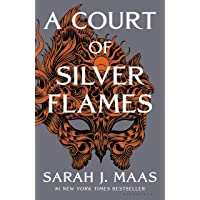
Silver Flames: Overcoming Toxicity

Nesta Archeron is the Severus Snape of Sarah J. Maas’ ACOTAR series. Like Snape, the reader spends the first several books hating her as she tears down our heroine, Feyre. Unlike Snape, Nesta eventually acknowledges her shortcomings and works her way out of the toxic person she had become. 

The first four books are from Feyre’s point of view, so the reader’s view of Nesta is only outward: her words and body language. It isn’t until the fifth book, A Court of Silver Flames, that the reader gets to be inside Nesta’s head and learn about her memories, feelings, and interpretations of past events. 

As the oldest sister, Nesta has the most prominent memories of their mother before she died. Nesta was her mother’s favorite child, the family’s golden egg. She taught Nesta how to be cunning and aim for the best. She instilled in Nesta that she was better than everyone else and was one day going to marry very well. And so, Nesta became exactly who her mother raised her to be: arrogant, ambitious, and cruel. Their family losing their fortune crushed Nesta, and she was furious her father gave up and let them starve. Even in their poverty, Nesta still acted like a queen, expecting the rest of her family to figure out how to survive and serve her. She was especially cruel to Feyre, because Feyre was their mother’s least favorite. She protected Elain because their mother’s plan had been to use Elain’s natural beauty to snag a good marriage. Nesta is a product of her mother, and she is toxic. 

She is the toxic family member that today’s youth are encouraged by social media to cut out of their lives. I could not wait for Feyre to kick Nesta to the curb. As High Lady she could do it. But like other complicated plot points in the series, Sarah J. Maas decided to take me on a ride. 

Nesta’s journey to healing and redemption is a continuous one step forward two steps back path. And the first time the reader is fooled into thinking Nesta is progressing is halfway through Thorns and Roses. Feyre returned home for a couple weeks before she traveled to Under the Mountain to free Tamlin and his court. Tamlin had glamoured Feyre’s family into believing Feyre was off taking care of a sick aunt. Only, the glamor didn’t work on Nesta. She remembered everything and knew the truth. Nesta went so far as to try to get into Prythian on her own to find Feyre and save her, but she was unable to. Nesta encourages Feyre to go back to Prythian to get a second shot with Tamlin. But then her parting words are, “Don’t come back.” With that final statement, I realized Nesta still held resentment for her sister. 

In the Mist and Fury, Nesta refuses to allow Feyre and Rhysand to use the Archeron home as a meeting place to converse with the human queens. Nesta’s reasoning is that if anyone nearby finds out, they will all be in danger. Cassian promises Nesta that he will personally ensure that her property and the people who live on it will remain safe. When Elain wants to help, Nesta reluctantly agrees; but she isn’t going to do so quietly. She is incredibly rude to all of their guests, including the human queens (though, they deserved it). At the end of the book, when Nesta is forced into the Cauldron, she goes in fighting, and points a finger at the King of Hybern, a death promise. 

In Wings and Ruin, Nesta is so focused on protecting Elain, she fails to spend time accepting what happened to her. She wears a mask of judgment and arrogance to hide her pain. She continuously insults every character who tries to help or connect with her. She is especially nasty to Cassian. During the final battle, Nesta drops her mask and gets the reader’s hopes up that she is changing. She lies on top of Cassian, prepared to die with him, and Cassian kisses her; Nesta accepts the kiss. Frost and Starlight quickly shows us that we were wrong in hoping for improvement. She goes back to being angry and rude. 

At the beginning of Silver Flames, Nesta is cut off financially by Rhysand and Feyre. They end her lease on her apartment, and move her into the House of Wind. She is given two choices: 1. Live in the House of Wind, train with Cassian, and work in the library. 2. Return to the human lands, and take care of herself. There really isn’t much of a choice for Nesta. As High Fae, she wouldn’t survive the human lands, so she’s going to make option one incredibly difficult. 

Every morning of the first week, Cassian takes Nesta to the Illyrian war camp to train her. And every morning, Nesta sits on a rock and refuses to do anything, making Cassian the laughing stock among his warriors. Cassian is dumbfounded until he finally understands Nesta’s refusal: “I’m not going to train in this place.” The Illyrians are the most sexist species in Prythian. During the war they labeled Nesta a witch, and on her first day there to train with Cassian, they made comments about how any weapon she touches will have to be cleansed, especially if she is menstruating. So Cassian takes Nesta to the training grounds on the roof of the House of Wind, and she slowly starts to train and trust Cassian.

Nesta spends her afternoons working in the library that is below the House of Wind. This library is unique not only in the books housed there, but in the librarians who take care of it. The library is a sanctuary for high priestesses who are victims of abuse. Their trauma is so horrible, that they hide away from the world. Nesta becomes close to one high priestess librarian, Gwyn. She eventually convinces Gwyn to join in the training sessions, and they are joined by a female Illyrian, Emerie. Emerie’s wings were clipped by her father, prohibiting her from flying. She also battles her male uncles and cousins in proving she can run a business.   

Overtime, more priestesses brave the outside world to train with Nesta. Together, the small group of women decide they want to resurrect the training and creation of the centuries deceased Valkyrie warrior. Nesta, Emerie, and Gwyn are the first to complete Valkyrie training and officially be named Valkyries. After that, Cassiand and Azriel set up a different obstacle course each day, that no female is able to complete. On the day that Nesta, Emerie, and Gwyn finally complete it, two generals from the Illyrian army were invited to watch. The three females are then informed that they just completed the qualifying round that Illyrian males must complete in order to qualify for the Blood Rite – a yearly Hunger-Games-type of competition that warriors participate in. At the end of one week, the surviving warriors are ranked based on where on their sacred mountain they are found. 

During all of this training and friendship, Nesta has two other things going on. The first is using her Made powers to find three objects called the Dread Trove: the Crown, the Harp, and the Mask. They are sure that Queen Briallyn has the Crown. Which means they need to find the Mask and the Harp before she does. Nesta is a successful in getting both objects – a great risk to her and Cassian’s life. 

The second and hardest thing she is working on is her relationships with Cassian, Amren, Elain, and Feyre. Nesta is very attracted to Cassian, but she fights her attraction because she doesn’t feel worthy of love. (I also think she struggles with his friendship and loyalty to Rhysand because Nesta hates Rhysand.) She first gives in physically. The two engage in foreplay and eventually sex with the understanding that its “just sex”. Of course, it’s not. Both are crazy for one another, but Nesta thinks Cassian is just using her for pleasure and vice versa. They won’t admit feelings until it is almost too late. 

Back when Nesta was grieving, Amren was the only one who told the others to give her space. Nesta botched that compassion, and the two got into a big fight, causing Amren to walk away from their friendship. When Nesta accidentally imbues three blades with her Made powers, Amren votes to keep the information and the blades away from Nesta. Nesta is so furious when she learns of Amren’s distrust, she performs her biggest sin in the series.

Feyre is pregnant with a boy, and this boy has Illyrian wings. Feyre’s pelvis is High Fae and not shaped to safely deliver a winged baby. When it is time to deliver, she will die, and the baby will probably die as well. This information has been kept from Feyre so that she might have a peaceful pregnancy while everyone else scrambles behind the scenes to find a way to save her. 

When Nesta goes to confront Amren about her voting to keep Nesta in the dark about the magic blades, Feyre shows up to mediate. Nesta is so angry, she tells Feyre the truth about her pregnancy. Everyone is furious with Nesta: Rhysand, Cassian, and Amren. To be honest, this is the first time in the entire series I was on Nesta’s side. Feyre had a right to know what was happening inside her body. The whole thing felt like more a Tamlin thing to do than a Rhysand thing to do. Rhysand is ready to kill Nesta, so Cassian takes her camping in some distant Illyrian mountains. 

It is on this trip that Nesta cracks open all of her pain, trauma, and self-loathing. Cassian holds her, comforts her, and loves her. Upon their return trip, Nesta tries to do better with her family and friends. During the Winter Solstice she and Cassian spend the night together, and the bond finally solidifies. Nesta is scared of the bond, and her reaction upsets Cassian, causing him to say he didn’t ask to be shackled to her. Understandably, Nesta is hurt and commands Cassian to leave her alone until she reaches out to him, or a week has passed, whichever comes first. Nesta flees to Emerie’s cottage with Gwyn. The two help her accept her mate bond with Cassian, but before she can reach out to Cassian, the three females are captured by Illyrian generals and thrown into the Blood Rite. The only three females on a mountain full of misogynistic males who think females belong in the kitchen and rape is okay.

This final showdown is going to be the final test of love for Cassian and Nesta. They will have to make sacrifices for one another, for their friends, for their family, and for the greater good of keeping Prythian free from invading forces. In completing this final sacrifice, Nesta is going to atone for the sins she committed against Feyre since they were young girls. Nesta will overcome the toxic traits her mother had instilled in her and become a new person. 

Nesta’s redemption is beautiful. It doesn’t excuse her past misdeeds. She goes through an excruciating repentance process, and comes out white as snow. When I first started Silver Flames, I really did not believe that I would change my mind about Nesta in the end, but I did. A very well-earned 5 stars.

Silver Flames is the most recent published installment in the ACOTAR series. I have scoured the internet to find out if it’s the last one, because there are a lot of things left open at the end of this one. The only thing I was able to find is Sarah J. Maas’ website lists the series as an “ongoing series”. Silver Flames was published in 2021, so I’m crossing my fingers we’ll have an announcement about the next installment soon! I’m also crossing my fingers that the next book is Elain’s story. I really need to know if Lucien is going to step up and be a good mate or if Azriel is going to steal her away. 
Frost and Starlight: Diversity in Healing

A Court of Frost and Starlight is the bridge between Feyre’s story and Nesta’s story. It is much shorter than the rest of the series. To be honest, I think it was meant to be a holiday special. The entire plot surrounds the characters preparing for and celebrating the Winter Solstice. They are also all healing from the recent war against Hybern and the human queens. But each character doesn’t heal at the same pace, or even finish healing by the end of this 4th book. 

Rhysand literally died at the end of the war. The only reason he is back is because Feyre convinced the remaining six High Lords to help her bring him back by donating a piece of their own magic and life force. Whatever happened to Rhys’ spirit while he was dead greatly affected him, and he is struggling to differentiate between reality and his fears. Rhysand jumps back into being High Lord, rebuilding Velaris and other cities, and investigating contentions in the Illyrian army. But where he finds his true healing is in his relationship with Feyre. This is Feyre’s first Winter Solstice in the Night Court and it’s also her 21st birthday. Rhysand is determined to give her a celebration she will never forget. I do not believe Rhysand is fully healed by the end of the Winter Solstice – events of the fifth book show otherwise – but he is doing a lot better than some of the other characters.  

Feyre has a lot of pre-war and post-war trauma to sift through. Now that Nesta is living in the Night Court, Feyre has to find a way to overcome the emotional and verbal abuse she suffered from her older sister both during her human years and recently as a Made High Fae. She has to deal with Rhysand frequently visiting Tamlin. She witnessed her father die, her mate die, and countless others. And as the High Lady, she is helping the Night Court heal by getting involved in charity groups. But as the city heals on the outside, Feyre fails to heal on the inside. She feels tremendously guilty that so many people lost loved ones or lost their livelihood. Back in the very first book, the reader learned that Feyre likes to paint. She stopped painting after Hybern forced her to return to the Spring Court with Tamlin. Feyre cannot seem to bring herself to pick up a paintbrush, and she is invited to by some of the artists in the art section of Velaris. She finally does, and paints her true self – what she saw in the special mirror in the third book. She gives it to Rhysand as a Solstice gift; and they decide they are ready to begin their family. In trying to get pregnant, Feyre and Rhysand are moving forward from the war.   

Morrigan is like Feyre in that many of her traumas are from before the war. Around five hundred years ago, Mor was betrothed to the heir of the Autumn Court, Eris. She did not want to go through with the marriage because the males of the Autumn Court had terrible reputations, and Mor “prefers females” – that’s the terminology used in the series, “gay”, “lesbian”, etc. don’t seem to exist in High Fae language. Mor’s family is too traditional for her to confess her sexuality, so she ends her virginity by seducing Cassian. Her father beats her, and nails a letter to Eris on Mor’s stomach, abandoning her bruised and naked body on the border of the Autumn Court. Eris refuses to take on the responsibility of a soiled wife and leaves her there (though Eris has his own secrets that I may cover in a later post). Mor would have died if Azriel wouldn’t have found her. Understandably, More holds deep seeded hatred for her father and Eris. She is forced to see and work with both of them in preparations for the war. In order to keep her father’s loyalty, Rhysand promises him that he can visit Velaris when he wishes. Mor feels betrayed because Velaris is her sanctuary away from her sadistic family. To avoid her father, Mor spends a lot of time after the war in her estate away from Velaris. By the end of the fourth book, Mor is still in the stage of avoidance.    

Azriel’s scars go back centuries as well. His mother was a maid who was coerced into a relationship with the patriarch of the family she worked for. Azriel is the result of that union. His bastard status led to abuse from his half brothers and the Illyrian warriors he trained with when he joined the army. He hates the Illyrian race for what their traditional views on women and status did to him and his mom. Since he couldn’t save his mom, Azriel projects his mother’s damsel status on Elain. Elain is the meekest of Feyre’s and Rhysand’s family, and Azriel makes sure that Elain is not taken advantage of – both consciously and subconsciously – by the other members of the family. In doing so, Azriel seems to be the only one that Elain is comfortable around. Azriel is also deeply in love with Mor. He has no idea about her sexuality, and moons after her for centuries. While taking care of Elain seems to help heal him from his childhood, it remains to be seen if his heartache over Mor will be healed.   

Elain is also suffering from a broken heart. When she was human, she got engaged to the son of a wealthy human lord. Her fiancée’s family hates faeries and has an extensive collection of warriors and weapons to fight and kill faeries. When Elain was kidnapped and forced into the cauldron, she could not return to her human home and her human fiancée. Her wedding date comes and goes, and Elain is distraught. Her body becoming High Fae revealed that Lucien is her mate, but she wants nothing to do with him. She is still in love with her fiancée. When Rhysand seeks human allies in preparing for the war, Elain goes to her fiancée’s family. Her fiancée rejects her now that she is High Fae. Elain’s heart breaks even more, and she retreats further into herself. Lucien’s (to be honest pitiful) attempts to get her to accept the mate bond go ignored. By the end of Solstice, Azriel’s kindness seems to be warming Elain’s heart, which will continue into the fifth book. (To be honest, I’m rooting for an Azriel-Elain union, but Sarah J. Maas already surprised me by making Mor lesbian, so she’ll probably surprise me by putting Elain with someone else or with no one.)

Lucien has several levels of hurt. Some he has been holding onto for years: his father ordering the death of his lover because she was beneath him, the general hatred from his older brothers, and the loss of one of his eyes, resulting in a metal eye. His most recent struggles are the loss of his friendship with Tamlin, and Elain refusing to accept him as her mate. As a way to numb the pain Lucien creates an unlikely alliance with Jurian and Queen Vassa. The three of them live in the human lands in an abandoned mansion. He is nowhere close to being healed. He is using this new “friendship” to hide from his problems. Very few characters care to help him heal because they put some of the responsibility of Feyre’s abuse on him. He is Tamlin’s best friend and did nothing to stop the mistreatment of Feyre. And even when she saved him from being raped by Ianthe, he still was moody and ungrateful. 

Tamlin is probably one of the few characters who brought on his own pain. In the first book, Tamlin tells Feyre that Rhysand and his father killed Tamlin’s entire family, making Tamlin the unwilling High Lord of the Spring Court. In the second book, Rhysand tells Feyre it was an act of vengeance. Tamlin’s father desired to kill Rhysand. Rhysand had been friendly with Tamlin at previous High-Lord-and-family get-togethers, and he continued to correspond with Tamlin. So Tamlin told his father how he could get Rhysand alone: when Rhysand picked up his mother and sister on their way to visit him in the Illyrian war camp. On that particular trip, Rhysand was late to the meeting spot, and Tamlin, his brothers, and father killed Rhysand’s mother and sister. Rhysand and his father sneak into the Spring Court to exact revenge. Rhysand makes his father promise not to kill Tamlin or his mother. Rhysand’s father doesn’t listen and kills Tamlin’s mother along with his father while Rhysand kills Tamlin’s brothers. Tamlin then kills Rhysand’s father. The two spend the next several centuries hating each other. Tamlin blames Feyre for the destruction of his court and once again accepts no responsibility for his part in her pain that led to the vengeance. 

After the war, Rhysand visits Tamlin every once in a while to check in on him and make sure they have a strong enough alliance so that if the human queens move against Prythian, Rhysand can count on Tamlin for help. Tamlin lives in an empty and ruined castle, finally succumbing to the beast that Feyre thought him to be in the beginning of the first book. During an attempt at a heart-to-heart, Tamlin asks Rhysand if he has forgiven him for the deaths of Rhysand’s mother and sister. Rhysand says, “I haven’t received an apology yet.” Tamlin still in that moment refuses to apologize. Tamlin isn’t even trying to heal, and no one is willing to help him,   

Cassian is struggling with the fact that he survived when so many of his warriors didn’t; and as the top general, he has to answer to their families. During the war, The Cauldron shot an instant death huff of magic into a crowd of flying Illyrians. Nesta could feel it coming before it happened and called Cassian back, saving only him. Cassian has always struggled to convince the Illyrian warriors to respect him as their general because he is literally a bastard. The Illyrians are patriarchal and traditional to a fault. Cassian’s mother was unmarried when she became pregnant with him, placing the two of them at the bottom of the social ladder in their village. It didn’t matter that her pregnancy was a result of rape. It didn’t matter that everyone knew who her rapist was and that he was a married male with a family. Because males rule in this society, they can do whatever they want. So Cassian’s bastard status makes “legitimate” Illyrian warriors despise him. Things are worse after the war, and Cassian has to squash an attempt at rebellion among the warriors. All of this could be easier to handle if Cassian had Nesta at his side. But despite her actions in the war to save Cassian, and her willingness to die with him when all seemed lost; Nesta has returned to being the cold-hearted you-know-what she has been the entire series. On Winter Solstice she hurts him one too many times, and Cassian throws the gift he bought her in the river.  

Nesta is drowning in grief, but we won’t know the full extent until we get to the fifth book. At this point we know she is devastated over her father’s death and is still furious that she is no longer human. She chose to move out of Rhysand’s townhouse and now lives in a rundown apartment. Feyre and Rhysand pay for her rent and fund her lifestyle: spending each night in the pub. Feyre threatens to cut her off financially if she doesn’t come to Solstice. Nesta gives Elain a gift, and Elain gives Nesta a gift. Neither Feyre nor Nesta give each other gifts, showing that the hurt from their human lives is still strong. Nesta has a very long journey to healing that will be covered in the fifth book.

When I read through the book, I didn’t know it was a side story, and understandably felt the plot was weak and rushed compared to the previous three books, and my original rating was 3 stars. Then I jumped onto Goodreads to write my review and saw that it is considered book 3.1. So, now knowing that it is a side story meant to prepare the reader for the next book, I raise my rating to 4 stars. 

I’m about halfway through the fifth book and I have already been tempted to throw my Kindle across the room several times. My heart is slowly warming toward Nesta. I still think many of her past sins aren’t justified, but Sarah J. Maas seems to be good at redemption arcs, so I have an open mind.

Wings and Ruin: The Cost of War

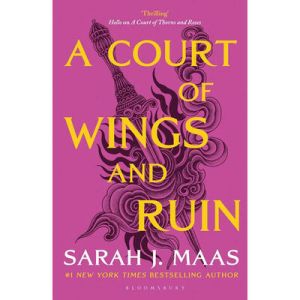
A pattern I have noticed in Sarah J. Maas’ A Court of Thorns and Roses series is that the subplot from the previous book becomes the main plot of the next book. In A Court of Thorns and Roses, Feyre’s relationship with Rhysand is the subplot of the Under the Mountain part of the book. In A Court of Mist and Fury, Feyre’s relationship with Rhysand becomes the main plot, and preparing for war against Hybern is the subplot. We get to A Court of Wings and Ruin, and preparing for war becomes the main plot. And if Mist and Fury’s big theme is redemption, then Wings and Ruin’s big theme is the cost of war.

What are the costs that our favorite characters have to pay as they prepare and fight in war? The four main costs I saw were betrayal, desensitization, difficult alliances, and sacrifice. 

Betrayal

The betrayals start in Mist and Fury before the war even begins. There is an object called the Cauldron which is the creator of the universe. It can be welded by any being powerful enough, but it also has some form of awareness to it. A book of spells was ripped in half centuries before and separated. This book is needed to control the Cauldron. One half is at the Summer Court. Rhys and Feyre do not believe the High Lord of the Summer Court, Tarquin, will willingly hand it over; so Rhys distracts the guards, while Feyre sneaks into the room the book is hidden in. Their plan is successful, and they immediately feel guilty when they return to Velaris. Tarquin sends them blood rubies with their names engraved on them, announcing them as enemies to the Summer Court. 

The second half of the book is under the guardianship of the six human queens. The book has a protection spell on it that makes it so the book must be freely given. Five of the six queens refuse to give the book to Feyre and Rhysand. The sixth queen sneaks it to them, betraying her “sister” queens. In return, they betray her by handing her over to Hybern, who kills her. Another queen, who is on the fence about this whole thing is handed over to a sorcerer and a curse is placed on her and leaves her a prisoner to him. In fact, the human queens are just full of betrayal. In an effort to convince them that he is trustworthy, Rhysand shows them Velaris. They tell Hybern about Velaris and where it is; Hybern then attacks Velaris. Luckily, Feyre, Rhysand and their court are able to defend Velaris, but the damage is done. Velaris has been exposed to the rest of the world. 

The most heartbreaking betrayal between the two books is probably Tamlin’s betrayal. Shortly after Rhysand rescued Feyre from the Spring Court, Feyre sent a letter to Tamlin saying that she left willingly and she wasn’t coming back. Tamlin refuses to believe this and goes on a crusade to find Feyre and “free” her from Rhysand. Tamlin allies with Hybern in capturing Feyre and Rhysand and splitting them apart. His high priestess, Ianthe, takes the betrayal one step further and hands Feyre’s human sisters, Nesta and Elain, over to the King of Hybern. Hybern uses the Cauldron to change Nesta and Elain into High Fae. 

What’s a betrayal without revenge? Feyre’s about to dish it out. In Wings and Ruin, she pretends that Hybern was successful in breaking her mate bond with Rhysand and returns to the Spring Court with Tamlin. While there, Feyre spies on Tamlin’s alliance with Hybern and sends that information to Rhysand through their bond. She also breaks Ianthe’s hand beyond repair, plants false stories into Ianthe’s head and a few others, and kills Hybern’s visiting generals. By the time Feyre escapes the Spring Court, Tamlin doesn’t have much of a court left.  

Tamlin ends up being the poster boy for a turncoat. He switches sides so frequently that it gives the reader whiplash, and even at the end, it’s still hard to know whose side he is truly on. I personally think he’s on Tamlin’s side. Whatever is going to help him come out alive and still in power. Shortly after Feyre returns to the Night Court, Rhysand invites the other High Lords to a meeting to form alliances and create a game plan against Hybern. Tamlin is invited and he does show up. The next day, he goes running back to Hybern and discloses everything from the meeting! Then when Feyre has snuck into Hybern’s camp to rescue her sister, Tamlin is the one to help her get out when she is about to be caught by Hybern’s beasts. With that betrayal, the question remains, whose side will Tamlin fight on? At first, Tamlin doesn’t show up at all. When things get dire, he shows up with Beron (High Lord of the Autumn Court), and two more surprise armies.   

And our final betrayal is Jurian, the human from the original battle five hundred years previous, brought back to life by Hybern. Hybern underestimated how much Jurian hates faeries. While Hybern is focusing on ripping Feyre and Rhysand apart, Jurian sneaks off to the human lands and raises a human army under the queens’ noses! 

The examples of betrayal in A Court of Mist and Fury and A Court of Wings and Ruin are definitely complex and diverse. Some can be argued as justifiable, others may start out justified and end badly, while others are just downright nasty. And I’m willing to bet  the betrayals I justify could be different from yours. Ms. Maas does an excellent job of making the reader question everyone’s choices. 

Desensitization

Most of the violence that Feyre has participated in has been self defense. When she killed Hybern’s visiting generals, they were trying to prevent her from leaving the Spring Court. The battle of Velaris happened suddenly and Feyre was too pumped up on adrenaline – and revenge, because the Attor is there – to really take in the blood and gore that was flying around. The battle of Adriata is Feyre’s first time preparing and marching into battle. It is quite a different experience for her, and when the fighting is over, Feyre throws up. Mor tells her they were all like that after their first battle; showing that over time, soldiers become desensitized to the horrors of war – not that they necessarily enjoy it, but they are able to glaze over or at least put on a facade that they are. But we’ll learn in the fourth book that being desensitized on the battlefield does not equate to being desensitized once you return home. 

Difficult Alliances

When a war involves more than two nations, the right alliances are paramount to success.

Hybern wants to have access to and control of the human lands. To do so, he reaches out to some very desperate characters: the human queens and Tamlin. Hybern promises the human queens immortality and a promise not to invade the continent, if they step back and allow Hybern to take over the human section of Prythian. Hybern gives Feyre to Tamlin if Tamlin will allow Hybern’s army to use the Spring Court as their path into the human lands. The plot never gets around to showing it, but I firmly believe that Hybern was going to betray the human queens as soon as he had the human lands in his grasp; had he lived long enough to do so.  

The seven courts of Prythian stand between Hybern and the human lands. Rhysand is determined for all seven High Lords to ally together to stand against Hybern. He successfully gets the Day Court, Dawn Court, Summer Court, and Winter Court to agree – though it was not without difficulty. Big headed and powerful men who are used to being solely in charge? Yeah, it took a lot. The Autumn Court outright refuses, and Tamlin goes running off to Hybern as soon as the alliance meeting is over. Rhysand knows that they cannot beat Hybern without all seven courts on board, but he is determined to try.   

These shifty alliances are what lead to many of the betrayals discussed in the first section. 

Sacrifice

In my opinion, personal sacrifice is the biggest cost of war. Everyone who heads onto the battlefield knows there is a chance they won’t come home. And sacrificing one’s life is not the only form of sacrifice. 

Feyre believes that they need a powerful being called the Bone Carver to help. His price? A very special mirror. The only way to get the mirror is to look into it and master whatever you see. It has been centuries since the last time the mirror had been mastered. Most beings who try go mad. The night before the final battle, Feyre decides the risk is worth it; even if she goes mad, Amren can use her body to weld the Cauldron’s magic. Feyre does master the mirror, but she went in not knowing if she could. She was willing to sacrifice her mind for her friends and family.  

Also before the final battle, Azriel helps Feyre rescue Elain. They are viciously attacked, and Azriel’s wings are severely injured. Rhysand orders Azriel to stay behind in the final battle. This infuriates Azriel. Their forces are spread thin as it is, even his injured self is better than having a hole in the line. He obeys his high lord, but as the battle worsens, Azriel joins the fray. During the battle, Cassian is greatly injured to the point of being immobile. The King of Hybern descends upon him and Nesta tries to stop him with the power she stole from the Cauldron, it is not enough. Nesta throws her body on top of Cassian’s and they accept death together. Before the King of Hybern can deliver the fatal blow, Elain stabs him in the neck with Azriel’s favorite sword, Truth Teller. When Azriel had been ordered to not fight, he sacrificed his hold over his sword to Elain so she had something to defend herself with. Even then, Elain was too frail and innocent to weld it, and she accepted it begrudgingly. Elain sacrifices her innocence to save her sister from the King of Hybern.  

While the battle is raging on, Feyre and Amren sneak over to the Cauldron to use its magic to stop Hybern’s power. The only way to do this is to put Amren in the Cauldron and relieve her of her bound form. This is risky because Amren may not remember the love and loyalty she feels for the Night Court and she could accidentally attack everyone (she reminds me of Calypso from Pirates of the Caribbean). Feyre and Amren take the risk. Not only does Amren let go of her “humanity”, but she also sacrifices her life. She is not going to survive this transition once she is done fighting.   

And the final sacrifice comes from Rhysand himself. Amren’s exit from the Cauldron breaks it, creating a blackhole that is sucking everything in. The Cauldron created life, so its destruction ends life. Feyre is the only one powerful enough to fix it (she has all seven High Lord’s powers), but even then it’s not enough. Rhysand transfers all of his energy and power into Feyre so she can finish fixing the Cauldron. This transfer kills him, and even though it saved Prythian, Feyre is inconsolable. She demands that the remaining High Lords help bring Rhysand back like what they did for her when Amarantha killed her. At first they disagreed, saying the situation was different because Feyre had been human. She begs and pleads, and they give in. One by one, each High Lord sacrifices a bit of his life force and magic to bring Rhysand back. It works doubly well, and not only does Rhysand come back to life, but he brings Amren with him. 

No one walks away from this war unscathed. Everyone whether human or faerie, High Lord or lesser faerie has mountains of healing to do, which is what the next book is about. I rated A Court of Wings and Ruin 4 stars. I thought the war plot was excellent (if you can’t tell by the once again long blog post); though a little lengthy. Rhysand and Feyre’s relationship strengthened and Rhysand continued to trust Feyre and allow her room to make her own choices – and mistakes. The only thing I struggled with was the lack of character growth from Nesta and Elain. We are three books in and they are still the same selfish idiots they were in the first book. Though, I did just start the fifth book, which is Nesta’s and Cassian’s story; so I’m crossing my fingers that Nesta has an acceptable redemption arc, because I currently do not like her at all. 

But before we can dive into Nesta’s head, there is a Solstice celebration to attend in A Court of Frost and Starlight. Stay tuned for that post, coming soon!